Full Text (PDF)
Journal of Animal Feed Science and Technology 12(2):p 47-49, July-December 2024. | DOI: https://doi.org/10.21088/jafst.2321.1628.12224.1
Original Article
Haematological Changes in Haemonchus Contortus Affected Lambs
L.S.S. Varaprasad Reddy, K. Jalajakshi, S.N. Suchitra
Author Information
Licence:
Attribution-Non-commercial 4.0 International (CC BY-NC 4.0)This license enables reusers to distribute, remix, adapt, and build upon the material in any medium or format for noncommercial purposes only, and only so long as attribution is given to the creator.
Journal of Animal Feed Science and Technology 12(2):p 47-49, July-December 2024. | DOI: https://doi.org/10.21088/jafst.2321.1628.12224.1
How Cite This Article:
L.S.S. Varaprasad Reddy, K. Jalajakshi, S.N. Suchitra, Haematological Changes in Haemonchus Contortus Affected Lambs. Jrl of Ani Feed Sci and Tech 2024;12(2):47-49.Timeline
Received : October 28, 2024
Accepted : November 21, 2024
Published : December 30, 2024
Abstract
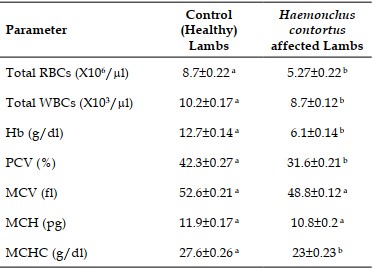
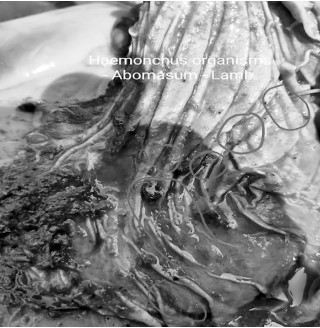
The present study was conducted to investigate the hematological changes in Haemonchus contortus affected lambs. A total of 350 Nellore brown sheep flock maintained in an extensive system of grazing, and out of which 40 lambs were selected randomly. Even though the sheep were dewormed regularly, an outbreak was noticed. Two lamb were found dead in the flock prior to screening. During screening out of 40 lambs, 18 lambs were found normal and were kept as control group and 22 lambs which exhibited clinical signs of anemia, poor growth, emaciation, diarrhea were selected. Blood samples were analyzed for the estimation of Total erythrocyte (RBC), total leukocyte (WBC) count, hemoglobin concentration (g/dl), Packed cell volume (%), MCV (fl), MCH (pg), MCHC (g/dl) and compared with normal animals. The infection was confirmed to be due to H. contortus following the recovery of Haemonchus worms at post-mortem. Haematological profile revealed that there was a significant (P < 0.05) decrease in total erythrocyte count, total leukocyte count, hemoglobin concentration, packed cell volume and MCHC values in H. contortus affected lambs.
References
- 1. Ameen, S.A., Joshua, R.A., Adedeji, O.S., Ojedopo, L.O and Amao, S.R (2010). Experimental studies on gastro intestinal nematode infection; The effects of age on clinical observations and haematological changes following Haemonchus contortus infection in west African dwarf goats. World Journal of Agricultural Sciences., 6:39-43.
- 2. Bordoloi, G., Jas, R., and Ghosh, J.D (2012). Changes in the haemato-biochemical pattern due to experimentally induced haemonchosis in Sahabadi sheep. Journalof Parasitic Disease, 36(1): 101-105.
- 3. Ceriac, S., C. Jayles, R. Arqet, D. Feuillet, Y. Felicite, H. Archimede and J-C. Bambou. (2017). The nutritional status affects the complete blood count of goats experimentally infected with Haemonchus contortus. BMC Veterinary Research. 13:326.
- 4. Kuchai, J.A., Ahmad, F., Chishti, M.Z., Tak, H., Javid, A., Ahmad, S., and Rasool, M. (2012). A study on morphology and morphometry of Haemonchus contortus. Pakistan Journal of Zoology, 6:44.
- 5. Kuchai, J.A., Chishti, M.Z., Zaki, M.M., Ahmad, J., Rasool, M., Dar, S.A., and Tak, H. (2011). Prevalence of nematode parasites in sheep of Ladakh-India. Journal of Agriculture Extension and Rural Development., 3(13), 229-231.
- 6. Mannan, M.A., Masuduzzaman, M., Rakib, T.M., Chowdury, S and Hossain. (2017). Histopathological and haematological changes in haemonchosis caused by ruminants of Bangladesh. Bangladesh Journal of Veterinary and Animal sciences, 5(2):17-23.
- 7. Radostitis, O.M., Blood, D.C and Gay, G.C 91994). Veterinary Medicine. A text book of the diseases of cattle, sheep, pigs, goats and horses. 8th edition, London, Bailliere Tindall, Ltd. pp. 1223-1230.
- 8. Roeber, F., Jes, A.R and Gasser, R.B. (2013). Impact of gastrointestinal parasitic nematodes of sheep and the role of advanced molecular tools for exploring epidemiology and drug resistancean Australian perspective. Parasites and vectors 6:153.
- 9. Sharma, D.K., Chauhan P.P.S., and Agrawal R.D. (2000). Haematological changes in experimental haemonchosis in Barbari goats. Journal of Animal Science, 70(4):353-355.
- 10. Siham, E.S., Karfar, A.E., EI Amin, S.M.M.(1997). Clinical picture and chemotherapy of experimental Haemonchus contortus and coccidial infection in goats. Sudan Journal of Veterinary Science and Animal Husbandry, 36(1-2):158-166.
- 11. Soulsby, E.J.L.(1982). Helminths, Arthropods and Protozoa of domesticated animals. 7th Ed. The English Book society and Bailliere Tindall, London.
- 12. SPSS Inc., (2013). SPSS for windows (Release 22.0) Standard Version. SPSS Inc. Headquarters, 233 S. Wacker Drive, 11th floor Chicago, Illinois 60606, USA.
- 13. Urquhart, G.M., Armour, J., Duncan J.L., Dunn A.M. and Jennings F.W. (1996). Veterinary Parasitology. 2nd Ed. Blackwell Science, United Kingdom. p.307.
Data Sharing Statement
There are no additional data available. All raw data and code are available upon request.
Funding
This research received no funding.
Author Contributions
All authors contributed significantly to the work and approve its publication.
Ethics Declaration
This article does not involve any human or animal subjects, and therefore does not require ethics approval.
Acknowledgements
We would like to express our gratitude to the patients, their families, and all those who have contributed to this study.
Conflicts of Interest
No conflicts of interest in this work.
About this article

Cite this article
L.S.S. Varaprasad Reddy, K. Jalajakshi, S.N. Suchitra, Haematological Changes in Haemonchus Contortus Affected Lambs. Jrl of Ani Feed Sci and Tech 2024;12(2):47-49.
Licence:
Attribution-Non-commercial 4.0 International (CC BY-NC 4.0)This license enables reusers to distribute, remix, adapt, and build upon the material in any medium or format for noncommercial purposes only, and only so long as attribution is given to the creator.
| Received | Accepted | Published |
|---|---|---|
| October 28, 2024 | November 21, 2024 | December 30, 2024 |
DOI: https://doi.org/10.21088/jafst.2321.1628.12224.1
Keywords
Haemonchus contortusHematologyLambSearch for Similar Articles
Similar Articles
- ERRATUM
- A Successful Management of Canine Dystocia by Elective C-Section: A Case Report
- Surgical Intervention for Open Cervix Pyometra in a Rottweiler: A Case Report
- Improving the Characteristics of Dairy Products Using Ultrasound Technology: A M...
- Hematological Findings in Nellore Brown Sheep Infected with Babesiosis
Article Level Metrics
Last UpdatedSunday 18 October 2026, 20:00:53 (IST)
1408
Accesses
9
186
00
Citations
NA
NA
NA
Download citation
Article Keywords
Keyword Highlighting
Highlight selected keywords in the article text.
Timeline
| Received | October 28, 2024 |
| Accepted | November 21, 2024 |
| Published | December 30, 2024 |
licence
Attribution-Non-commercial 4.0 International (CC BY-NC 4.0)
This license enables reusers to distribute, remix, adapt, and build upon the material in any medium or format for noncommercial purposes only, and only so long as attribution is given to the creator.