Full Text (PDF)
Journal of Animal Feed Science and Technology 13(1):p 27-29, Jan-June 2025. | DOI: https://doi.org/10.21088/jafst.2455.8621.13125.4
Case Report
A Successful Management of Canine Dystocia by Elective C-Section: A Case Report
Rajesh Kumar, Nikita Singh, Nikhil Sachan, Jayanta Das
Author Information
Licence:
Attribution-Non-commercial 4.0 International (CC BY-NC 4.0)This license
enables reusers to distribute, remix, adapt, and build upon the material in any
medium or format for noncommercial purposes only, and only so long as
attribution is given to the creator.
Journal of Animal Feed Science and Technology 13(1):p 27-29, Jan-June 2025. | DOI: https://doi.org/10.21088/jafst.2455.8621.13125.4
How Cite This Article:
Nikita Singh, Nikhil Sachan, Rajesh Kumar et. al, A Successful Management of Canine Dystocia by Elective C-Section: A Case Report. Journal of Animal Feed Science and Technology. 2025; 13(1): 27-29.Timeline
Received : April 26, 2025
Accepted : June 06, 2025
Published : June 30, 2025
Abstract
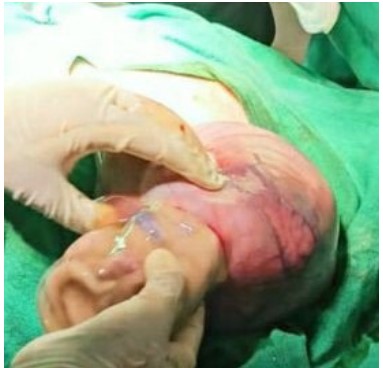
A 2-year-old pregnant Labrador bitch in second parity was presented to Veterinary Clinical Complex, A.N.D.U.A.T. Kumarganj, Ayodhya, with a history of complete gestation lasting 64 days. The dog exhibited anorexia and straining since 24 hours, yet unable to deliver foetuses. On clinical examination, the rectal temperature was 102°F. The vital parameters such as pulse rate, heart rate, and respiration rate were slightly elevated. The conjuctival mucous membrane colour appeared normal and pinkish. Per vaginal examination revealed a dilated cervix, and radiographic examination confirmed the presence of more than 5 foetuses. Considering the condition, a prompt decision was made to perform elective caesarean section (C section). Following C section, 9 live pups were delivered. The outcome highlights the importance of quick and precise decisions in critical situations to save the life of foetus and bitch.
References
- 1. Bennett, D. (1974). Canine dystocia–a review of the literature. J. Small Anim. Pract., 15: 101–117.
- 2. Bergstrom A., Nodtvedt A., Lagerstedt A.S. and Egenvall A. (2006) Incidence and breed predilection for dystocia and risk factors for cesarean section in a Swedish population of insured dogs. Veterinary Surgery, 35, 786–791.
- 3. Davidson, A.P. (2014). Neonatal ResuscitationImproving the outcome.Vet. Med. Small Anim. Clin., 44: 191-204.
- 4. De Cramer, K. G. M. (2017). Preparturient caesarean section in the bitch: Justification timing execution and outcome. PhD. Pretoria, South Africa: University of Pretoria.
- 5. Feldman (Eds.), Textbook of veterinary internal medicine, (Vol. 6, pp. 1655–1677). Philadelphia, PA: Saunders.
- 6. Jayakumar, C., Krishnaswamy, A., Sudha, G., and Honnappa, T. G. (2013).Planned Cesarean Section and other obstetrical interventions in dogs: A comparative evaluation based on neonatal survival. Indian Journal of Canine Practice, 5: 136-141.
- 7. Johnson, C. A. (2008). High-risk pregnancy and hypoluteoidism in the bitch. Theriogenology, 70: 1424–1430.
- 8. Linde-Forsberg, C. and Eneroth, A. (2000). Abnormalities in pregnancy, parturition and the periparturient period.In S. J. Ettinger, & E. C.
- 9. Lopate, C. (2008). Estimation of gestational age and assessment of canine fetal maturation using radiology and ultrasonography: A review. Theriogenology, 70: 397–402.
- 10. Moon, P.F., Erb, H.N., Ludders, J.W., Gleed, R..D. and Pascoe, P.J. (1998). Perioperative management and mortality rates of dogs undergoing cesarean section in the United States and Canada.J. Am. Vet. Med. Assoc., 213 (3): 365-369.
- 11. Schrank, M., Contiero, B. and Mollo, A., (2022) Incidence and concomitant factors of cesarean sections in the bitch: A questionnaire study. Front. Vet. Sci., 9: 934273. doi: 10.3389/fvets. 2022.934273.
- 12. Stolla, R., Dusi-Farber, B., Stengel, B., Schmid, G. andBraun, J. (1999). Dystocia in the bitch: A retrospective study. Wiener Tierarztliche Monatsschrift, 86: 145–149.
- 13. O’Neill, D.G., O’Sullivan, A.M., Manson, E.A., Church, D.B., Boag, A.K., McGreevy, P.D. and Brodbelt, D.C. (2017) Canine dystocia in 50 UK first-opinion emergency-care veterinary practices: prevalence and risk factors. The Veterinary Record, 181: 88.
- 14. Darvelid, A. W.and Linde-Forsberg, C. (1994). Dystocia in the bitch: A retrospective study of 182 cases. Journal of Small Anim. Practice, 35: 402–407.
- 15. Mosier, J.E. (1986). Normal and abnormal parturition. In: Small Animal Reproduction and Fertility. A clinical approach to diagnosis and treatment.Edt. Bruke, T.J. and Febiger, L., Philadelphia, USA, Pp. 335-345.
Data Sharing Statement
There are no additional data available. All raw data and code are available upon request.
Funding
This research received no funding.
Author Contributions
All authors contributed significantly to the work and approve its publication.
Ethics Declaration
This article does not involve any human or animal subjects, and therefore does not require ethics approval.
Acknowledgements
We would like to express our gratitude to the patients, their families, and all those who have contributed to this study.
Conflicts of Interest
No conflicts of interest in this work.
About this article

Cite this article
Nikita Singh, Nikhil Sachan, Rajesh Kumar et. al, A Successful Management of Canine Dystocia by Elective C-Section: A Case Report. Journal of Animal Feed Science and Technology. 2025; 13(1): 27-29.
Licence:
Attribution-Non-commercial 4.0 International (CC BY-NC 4.0)This license
enables reusers to distribute, remix, adapt, and build upon the material in any
medium or format for noncommercial purposes only, and only so long as
attribution is given to the creator.
| Received | Accepted | Published |
|---|---|---|
| April 26, 2025 | June 06, 2025 | June 30, 2025 |
DOI: https://doi.org/10.21088/jafst.2455.8621.13125.4
Keywords
BitchCaesarean sectionDystociaSearch for Similar Articles
Similar Articles
- ERRATUM
- Surgical Intervention for Open Cervix Pyometra in a Rottweiler: A Case Report
- Improving the Characteristics of Dairy Products Using Ultrasound Technology: A M...
- Hematological Findings in Nellore Brown Sheep Infected with Babesiosis
- Bicephalic Monster Foetus with Congenital Omphalocele: A Rare Case Report
Article Level Metrics
Last UpdatedSunday 18 October 2026, 14:41:57 (IST)
1407
Accesses
16
186
00
Citations
NA
NA
NA
Download citation
Article Keywords
Keyword Highlighting
Highlight selected keywords in the article text.
Timeline
| Received | April 26, 2025 |
| Accepted | June 06, 2025 |
| Published | June 30, 2025 |
licence
Attribution-Non-commercial 4.0 International (CC BY-NC 4.0)
This license
enables reusers to distribute, remix, adapt, and build upon the material in any
medium or format for noncommercial purposes only, and only so long as
attribution is given to the creator.