Full Text (PDF)
Journal of Animal Feed Science and Technology 10(1):p 15-18, January-June 2022. | DOI: https://doi.org/10.21088/jafst.2321.1628.10122.2
Review Article
Enrollment of Rumen Microbiota in Utilization of the Dietary Lipids and Synthesis of Cis 9 Trans 11 Conjugated Linoleic Acid: A Review
Ram Kumar Singh, Mala Singh, Avijit Day
Author Information
Licence:
Attribution-Non-commercial 4.0 International (CC BY-NC 4.0)This license enables reusers to distribute, remix, adapt, and build upon the material in any medium or format for noncommercial purposes only, and only so long as attribution is given to the creator.
Journal of Animal Feed Science and Technology 10(1):p 15-18, January-June 2022. | DOI: https://doi.org/10.21088/jafst.2321.1628.10122.2
How Cite This Article:
Ram Kumar Singh, Mala Singh, Avijit Day/Enrollment of Rumen Microbiota in Utilization of the Dietary Lipids and Synthesis of Cis 9 Trans 11 Conjugated Linoleic Acid: A Review/ Journal of Animal Feed Science and Technology 2022;10(1):15–18.Timeline
Received : March 19, 2022
Accepted : April 01, 2022
Published : June 30, 2022
Abstract
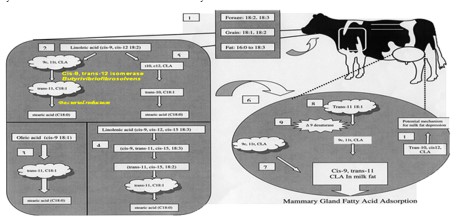
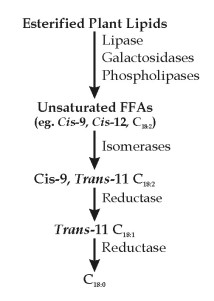
Utilization, extraction of energy and synthesis of various micronutrients through dietary lipids in ruminants is solely dependent upon rumen microbial efficacy. Rumen microbes are not only the pioneer of lipid digestion, but also the key factor to decide the physical & biochemical characteristics of input dietary lipids owing to the lipolysis and followed by biohydrogenation of dietary lipid through rumen microbes. Optimal microbial balance and proper scientific requirement of dietary lipids influences the digestibility and utilization of dietary lipids. Thus, aforesaid article developed to discuss key insight considerations of rumen microbes to utilizedietary lipidsin ruminants.
References
- 1. Bauchart, D., Legay-Carmier, F., Doreau, M. and Gaillard, B. (1990). Lipid metabolism of liquidassociated and solid-adherent bacteria in rumen contents of dairy cows offered lipid-supplemented diets. British J. Nutr.,63: 563-578.
- 2. Czerkawski, J.W. and Clapperton, J.L. (1984). Fats as energy-yielding compounds in the ruminant diet. J. Wiseman (Ed.)Fats in Animal Nutrition, Butterworths, London .pp. 249-261.
- 3. Demeyer, and Hoozee, J. (1984). Schatting van linolzuursintese in de pens van eenschaapbijeiwite nvetvrijevoedering (Estimated synthesis of linoleic acid in the rumen of a sheep fed a protein and fat free diet). De SfudiedagvoorNederlandstaligeVoedi ngsonderzockers, Utrecht, pp. 27-28.
- 4. Demeyer, Henderson, C. and Prins, R.A. (1978). Relative significance of exogenous and de novo synthesized fatty acids in the formation of rumen microbial lipids in vitro. Applied Environ. Microbiol.,35: 24-31.
- 5. Doreau, M. and Chilliard, Y. (1997). Digestion and metabolism of dietary fat in farm animals. British J. Nutr., 78: 15-35.
- 6. Emmanuel, B. (1974). On the origin of rumen protozoan fatty acids. BichimicaetBiphysicaacta. 337: 404-413.
- 7. Fay, J.P., Jakober, K.D., Cheng, K.J. and Costerton, J.W. (1990). Esterase activity of pure cultures of rumen bacteria as expressed by the hydrolysis of p-nitrophenylpalmitate. Canadian J. Microbiol.36: 585.
- 8. Gerson, T. John, A. and Sinclair, B.R. (1983). The effect of dietary N on in vitro lipolysis and fatty acid hydrogenation in rumen digesta from sheep fed diets high in starch. J. Agric. Sci. (Cambridge).101: 97.
- 9. Gerson, T., John, A. and King, A.S.D. (1985). The effects of dietary starch and fibre on the In vitro rates of lipolysis and hydrogenation by sheep rumen digesta. J. Agril. Sci., Cambridge. 105: 27-30.
- 10. Gerson, T., John, A. and King, A.S.D. (1986). Effects of feeding ryegrass of varying maturity on the metabolism and composition of lipids in the rumen of sheep. J. Agric, Sci. (Cambridge).106: 445.
- 11. Gerson, T., King, A.S.D., Kelly, K.E., and Kelly, W.J. (1988). Influence of particle size and surface area on in vitro rates of gas production, lipolysis of triacylglycerol ad hydrogenation of linoleic acid by sheep rumen digesta or Ruminococcusflavefaciens. J. Agric. Sci. (Cambridge).110: 31.
- 12. Harfoot, C.G. (1978). Lipid metabolism in the rumen. Prog. Upid Res. 17: 21-54.
- 13. Harfoot, C.G. and Hazelwood, G.P. (1988). Lipid metabolism in the rumen. In: P.N. Hobson (ed.). The Rumen Microbial Ecosystem. Elevier Applied Science, London, New York, pp. 285-322.
- 14. Hawke, J.C. and Silcock, W.R (1970). The in vitro rates of lipolysis and biohydrogenation in rumen conents. Biochim. Biophys. Acta. 218: 201.
- 15. Kemp, J., Mahyuddin, M., Ely, D.G., Fox, J.D. and Moody, W.G. (1991). Effect of feeding systems, slaughter weight and sex on organoleptic properties, and fatty acid compositon of lamb. J. Anim. Sci.51: 321.
- 16. Kemp, P., Lander, D.J. and Orpin, C.J. (1984). The lipids of the rumen fungus Piromonascommunis. J. General Microbiol.130: 27-37.
- 17. Kemp, P., White, R.W. and Lander, D.J. (1975). The hydrogenation of unsaturated fatty acids by five bacterial isolates from the sheep rumen, including a new species. J. General Microbiol.90: 100.
- 18. Kepler, C.R., Tucker, W.P. and Tove, S.B. (1970). Biohydrogenation of unsaturated fatty acids. IV. Substrate specificity and inhibition of linoleate L\ 12_cis, L\ 11-trans isomerase from Butyrivibriofibrisolvens. J. BioI. Chem. 245:3612.
- 19. Latham, M.J., Storry, J.E. and Sharpae, M.E. (1972). Effect of low roughage diets on the microflora and lipid metabolism in the rumen. App. Microbio. 24: 871.
- 20. Muller, L.D., and Delahoy, J.E., (2016). Conjugated linoeic acid (CLA) implications for animal production and human health. Penn state college of Agricultural Science acid profile Fatty. DAS 4-88.
- 21. Sukhija, P.S. and Paimquist, D.L. (1988). Rapid method for determination of total fatty acid content and composition of feedstuffs and feces. J. Agric. Food Chem. 36, 1202-1206.
- 22. Van Nevel, C.J., and Demeyer. (1995). Influence of pH on lipolysis and biohydrogenation of soybean oil by rumen contents in vitro. Reprodn. Nutr. Dev. 36: 53-63.
Data Sharing Statement
There are no additional data available. All raw data and code are available upon request.
Funding
This research received no funding.
Author Contributions
All authors contributed significantly to the work and approve its publication.
Ethics Declaration
This article does not involve any human or animal subjects, and therefore does not require ethics approval.
Acknowledgements
We would like to express our gratitude to the patients, their families, and all those who have contributed to this study.
Conflicts of Interest
No conflicts of interest in this work.
About this article

Cite this article
Ram Kumar Singh, Mala Singh, Avijit Day/Enrollment of Rumen Microbiota in Utilization of the Dietary Lipids and Synthesis of Cis 9 Trans 11 Conjugated Linoleic Acid: A Review/ Journal of Animal Feed Science and Technology 2022;10(1):15–18.
Licence:
Attribution-Non-commercial 4.0 International (CC BY-NC 4.0)This license enables reusers to distribute, remix, adapt, and build upon the material in any medium or format for noncommercial purposes only, and only so long as attribution is given to the creator.
| Received | Accepted | Published |
|---|---|---|
| March 19, 2022 | April 01, 2022 | June 30, 2022 |
DOI: https://doi.org/10.21088/jafst.2321.1628.10122.2
Keywords
RuminantsRumen microbesDietary lipidsSearch for Similar Articles
Similar Articles
- ERRATUM
- A Successful Management of Canine Dystocia by Elective C-Section: A Case Report
- Surgical Intervention for Open Cervix Pyometra in a Rottweiler: A Case Report
- Improving the Characteristics of Dairy Products Using Ultrasound Technology: A M...
- Hematological Findings in Nellore Brown Sheep Infected with Babesiosis
Article Level Metrics
Last UpdatedFriday 23 October 2026, 08:14:22 (IST)
1427
Accesses
6
192
00
Citations
NA
NA
NA
Download citation
Article Keywords
Keyword Highlighting
Highlight selected keywords in the article text.
Timeline
| Received | March 19, 2022 |
| Accepted | April 01, 2022 |
| Published | June 30, 2022 |
licence
Attribution-Non-commercial 4.0 International (CC BY-NC 4.0)
This license enables reusers to distribute, remix, adapt, and build upon the material in any medium or format for noncommercial purposes only, and only so long as attribution is given to the creator.