Full Text (PDF)
Journal of Microbiology and Related Research 11(1):p 41-50, Jan-June 2025. | DOI: https://doi.org/10.21088/jmrr.2395.6623.11125.5
Review Article
Enhancing Bakery Product Quality: Addressing Spoilage and Promoting Healthier Practices
Author Information
Licence:
Attribution-Non-commercial 4.0 International (CC BY-NC 4.0)This license enables reusers to distribute, remix, adapt, and build upon the material in any medium or format for noncommercial purposes only, and only so long as attribution is given to the creator.
Journal of Microbiology and Related Research 11(1):p 41-50, Jan-June 2025. | DOI: https://doi.org/10.21088/jmrr.2395.6623.11125.5
How Cite This Article:
Sowmya K.L, Ramalingappa B. Enhancing Bakery Product Quality: Addressing Spoilage and Promoting Healthier Practices. J Microbiol Relat Res. 2025; 11(1): 41–50.Timeline
Received : February 21, 2025
Accepted : April 25, 2025
Published : June 30, 2025
Abstract
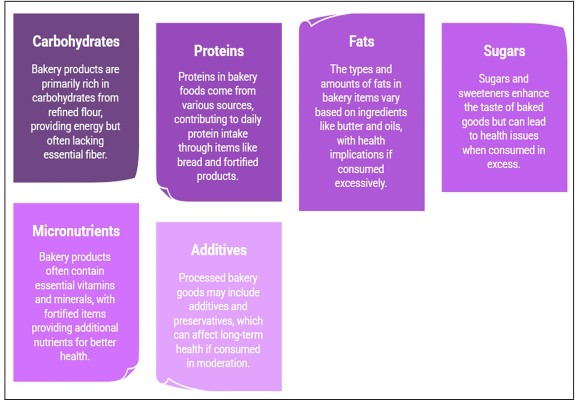
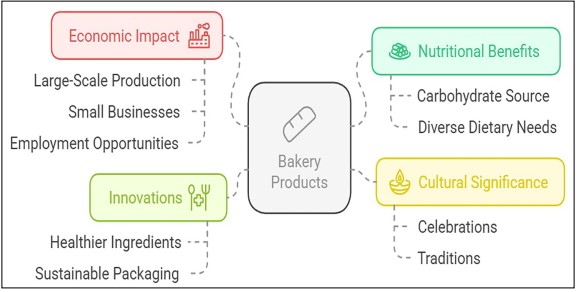
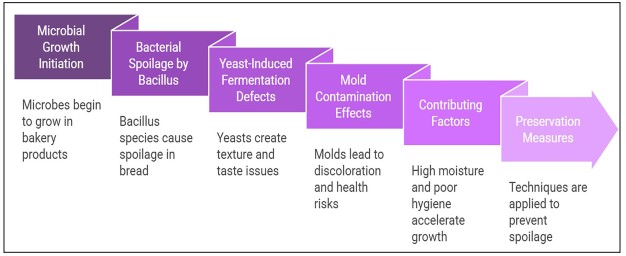
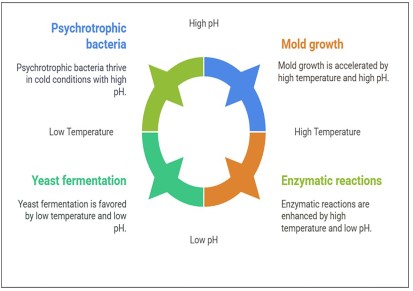
Bakery products, which encompass a wide range of items such as bread, pastries, and cakes, play a crucial role in global diets due to their convenience, nutritional value, and cultural significance. The nutritional status of these products can vary significantly based on the ingredients used, with whole grain options generally offering more health benefits compared to refined alternatives. However, the shelf life of bakery items is often compromised by spoilage caused by microorganisms such as bacteria, molds, and yeasts, necessitating effective storage solutions and the use of preservatives. Environmental factors, including temperature, pH, and moisture levels, significantly influence the rates of spoilage, highlighting the importance of proper handling and storage practices. To combat spoilage and ensure food safety, both chemical and natural preservatives are employed, allowing for extended shelf life while maintaining product quality. This study underscores the importance of understanding the nutritional aspects and spoilage mechanisms of bakery products to enhance their safety and health benefits for consumers.
References
- 1. Carla, L.G., & Maria, T. (2009). Prevention of bread mold spoilage by using lactic acid bacteria with antifungal properties. Journal of Food Science, 20, 144-148.
- 2. Gioia, L.C., Ganancio, J.R., & Steel, C. J. (2017). Food additives and processing aids used in breadmaking. Food additives, 1, 147-166.
- 3. Guynot, M.E., Ramos, A.J., Sanchis, V., & Marin, S. (2005). Study of benzoate, propionate, and sorbate salts as mould spoilage inhibitors on intermediate moisture bakery products of low pH (4.5–5.5). International journal of food microbiology, 101(2), 161-168.
- 4. Magan, N., & Aldred, D. (2006). Managing microbial spoilage in cereals and baking products. Food spoilage microorganisms, 194.
- 5. Marın, S., Abellana, M., Rubinat, M., Sanchis, V., & Ramos, A.J. (2003). Efficacy of sorbates on the control of the growth of Eurotium species in bakery products with near neutral pH. International Journal of Food Microbiology, 87(3), 251-258.
- 6. Medina, A., Lambert, R.J.W., & Magan, N. (2012). Rapid throughput analysis of filamentous fungal growth using turbidimetric measurements with the Bio screen C: a tool for screening antifungal compounds. Fungal Biology, 116, 161–169. doi: 10.1016/j. funbio.2011.11.001
- 7. Meyers, E., & Knight, S.G. (1958). Studies on the nutrition of Penicillium roqueforti. Applied Microbiology. 6, 174–178. doi: 10.1128/ AM.6.3.174-178.1958
- 8. Moon, N.J. (1983). Inhibition of the growth of acid tolerant yeasts by acetate, lactate, and propionate and their synergistic mixtures. Journal of Applied. Bacteriology. 55, 453-460. doi: 10.1111/j.1365-2672.1983.tb01685.x
- 9. Moore, M., Dalbello, F., & Arendt, E. (2008). Sourdough fermented by Lactobacillus plantarum improves the quality and shelf-life of gluten-free bread. European Food Research and Technology, 226, 1309-1316.
- 10. Parra, R., & Megan, N. (2004). Modelling of the effect of temperature and water activity on growth of Aspergillus niger strains and applications for food spoilage molds. Journal of Applied Microbiology. 97, 429-438.
- 11. Ribes, S., Fuentes, A., Talens, P., & Barat, J.M. (2017). Prevention of fungi spoilage in food products using natural compounds. A Critical Reviews in Food Science and Nutrition, 6(2), 50-110.
- 12. Sana, M., Mondher, M., & Moktar, H. (2007). Microflora distribution and species ratio of Tunision Fermented doughs for bakery industry. African Journal of Food Microbiology, 6(18), 2122-2129.
- 13. Saranraj, P., & Geetha, M. (2012). Microbial spoilage of bakery products and its control by preservatives. International Journal of Pharmaceutical & biological archives, 3(1), 38-48.
- 14. Sowmya, K. L., & Ramalingappa, B. (2022). Detection of Aflatoxigenic producing strains of Aspergillus flavus from bakery products by UV light and ammonia vapor test. International Journal of Research and Analytical Reviews, 9(4), 671-679.
- 15. Sowmya, K.L., & Ramalingappa, B. (2023). Characterization and Determination of aflatoxigenic and Non-aflatoxigenic Aspergillus flavus Isolated from Bakery Food Products from Frontier around Davangere District. Indian Journal of Pure and applied biosciences, 11(1), 32-42.
- 16. Sowmya, K.L., & Ramalingappa, B. (2023). Morphological Characterization and Determination of Mycotoxigenic and Nonmycotoxigenic Producing Penicillium SP from Bakery Food Products by UV Light and Ammonia Vapor Test. Innovations, 73, 1867-1875.
- 17. Sowmya, K.L., & Ramalingappa, B. (2024). A review Mycotoxins: Extraction, characterization and analysis. International Journal of Biotechnology and Microbiology, 5(3), 61-66.
- 18. Sowmya, K.L., & Ramalingappa, B. (2024). Qualitative Analysis of Mycotoxins by Thin Layer Chromatography (TLC). Frontiers in Environmental Microbiology, 10(1), 1-5.
- 19. Stratford, M., Plumridge, A., Nebe-von-Caron, G., & Archer, D.B. (2009). Inhibition of spoilage mould conidia by acetic acid and sorbic acid involves different modes of action, requiring modification of the classical weak-acid theory. International journal of Food Microbiology. 136, 37-43. doi: 10.1016/j.ijfoodmicro. 2009.09.025
- 20. Tzatzarakis, M., Tsatsakis, A.M., Liakou, A., & Vakalounakis, D.J. (2000). Effect of common food preservatives on mycelial growth and spore germination of Fusarium oxysporum. Journal of Environmental Science, Health, 5, 527– 537. doi: 10.1080/03601230009373288
Data Sharing Statement
There are no additional data available. All raw data and code are available upon request.
Funding
This research received no funding.
Author Contributions
All authors contributed significantly to the work and approve its publication.
Ethics Declaration
This article does not involve any human or animal subjects, and therefore does not require ethics approval.
Acknowledgements
We would like to express our gratitude to the patients, their families, and all those who have contributed to this study.
Conflicts of Interest
No conflicts of interest in this work.
About this article

Cite this article
Sowmya K.L, Ramalingappa B. Enhancing Bakery Product Quality: Addressing Spoilage and Promoting Healthier Practices. J Microbiol Relat Res. 2025; 11(1): 41–50.
Licence:
Attribution-Non-commercial 4.0 International (CC BY-NC 4.0)This license enables reusers to distribute, remix, adapt, and build upon the material in any medium or format for noncommercial purposes only, and only so long as attribution is given to the creator.
| Received | Accepted | Published |
|---|---|---|
| February 21, 2025 | April 25, 2025 | June 30, 2025 |
DOI: https://doi.org/10.21088/jmrr.2395.6623.11125.5
Keywords
Bakery food productsSpoilagePreservativesEnvironmental factorsSearch for Similar Articles
Similar Articles
- Vitiligo: A Comprehensive Review
- Seaweed-Derived Bioplastics: A Sustainable Alternative to Petroleum Based Plasti...
- Antibiogram of Bacterial Isolates from Critical Care Patients in Sharda Hospital...
- Prevalence and Antimicrobial Resistance Patterns of Staphylococcus aureus Isolat...
- Bacteriology of Burn Wound Infections and their Antibiogram
Article Level Metrics
Last UpdatedSaturday 24 October 2026, 09:09:43 (IST)
1869
Accesses
9
223
00
Citations
NA
NA
NA
Download citation
Article Keywords
Keyword Highlighting
Highlight selected keywords in the article text.
Timeline
| Received | February 21, 2025 |
| Accepted | April 25, 2025 |
| Published | June 30, 2025 |
licence
Attribution-Non-commercial 4.0 International (CC BY-NC 4.0)
This license enables reusers to distribute, remix, adapt, and build upon the material in any medium or format for noncommercial purposes only, and only so long as attribution is given to the creator.