Full Text (PDF)
Indian Journal of Biology 11(2):p 67-74, July - December 2024. | DOI: https://doi.org/10.21088/ijb.2394.1391.11224.1
Original Article
Effect of Carvacrol and Menthone as Insecticidal Tool on Red Flour Beetle, Tribolium Castaneum (Coleoptera: Tenebrionidae)
Author Information
Licence:
Attribution-Non-commercial 4.0 International (CC BY-NC 4.0)This license enables reusers to distribute, remix, adapt, and build upon the material in any medium or format for noncommercial purposes only, and only so long as attribution is given to the creator.
Indian Journal of Biology 11(2):p 67-74, July - December 2024. | DOI: https://doi.org/10.21088/ijb.2394.1391.11224.1
How Cite This Article:
Chaubey MK. Effect of Carvacrol and Menthone as Insecticidal Tool on Red Flour Beetle, Tribolium Castaneum (Coleoptera: Tenebrionidae). Indian J Biol. 2024;11(2):67-74.Timeline
Received : October 28, 2024
Accepted : December 12, 2024
Published : December 12, 2024
Abstract
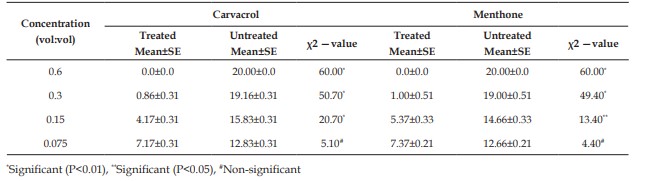
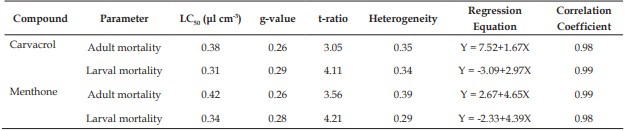
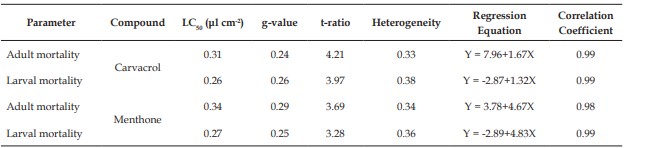
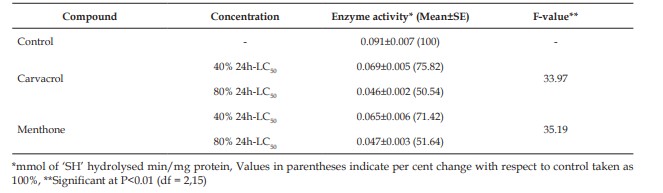
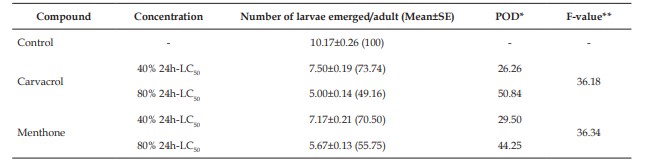
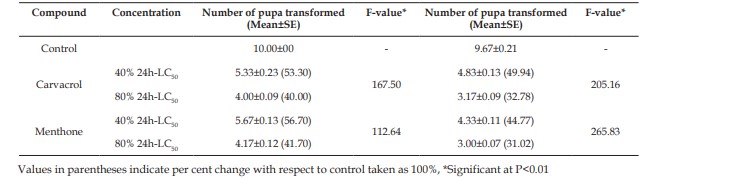
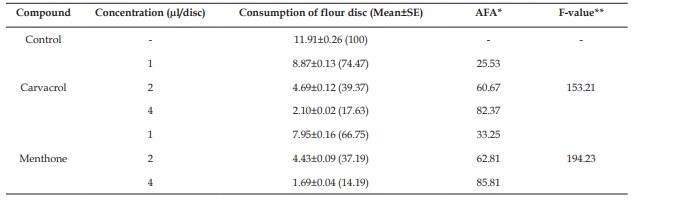
Insect pests infest and damage agricultural stored grains and processed food products both qualitatively and quantity since time long before. Several synthetic chemical have been developed and applied as insecticides to manage these losses, but, extensive uses of these on this strategy have created serious environmental and health issues. To mitigate these problems, several natural volatile organic chemicals have been explored since last three decades and received significant results. In this continuation, two volatile organic chemicals, carvacrol and menthone have been evaluated for repellent, toxic, oviposition, developmental and feeding inhibitory activities against wheat flour insect, Tribolium castaneum (Coleoptera: Tenebrionidae). These two volatile organic chemicals repelled the adults of T. castaneum in filter paper repellency assay and cause acute toxicity in larvae and adults of T. castaneum in fumigant and contact toxicity assays. These two organic chemicals reduce oviposition and interfere with the transformation of larva to pupa and pupa to adult. Besides, deterrence in feeding habit of adults has also been recorded. These two chemicals inhibit acetylcholine esterase activity in adult insects suggesting probable neurotoxic mode of action in insects. These outcomes of the study suggest carvacrol and menthone as the key components in eco-friendly insecticide formulation based on volatile organic chemicals.
References
- 1. Matthews, G.A. 1993. Insecticide application in the stores. In Matthews, G.A. and Hislop, E.C. (eds.). Application technology for crop protection. CAB, London pp. 305-315.
- 2. WMO. 1991. Scientific assessment of ozone depletion. Report No. 25, World Meterological Organization of the United States, Geneva.
- 3. Añasco, N., Uno, S., Koyama, J., Matsouka, T., Kuwahara, N. 2010. Assessment of pesticide residues in freshwater areas affected by rice paddy effluents in Southern Japan. Environmental Monitoring and Assessment, 160, pp. 371-383.
- 4. Ferencz, L., Balog, A. 2010. A pesticide survey in soil, water and foodstuffs from Central Romania. Carpathian Journal of Earth and Environmental Science, 5(1), pp. 111-118.
- 5. Relyea, R.A. 2005. The impact of insecticides and herbicides on the biodiversity and productivity of aquatic communities. Ecological Applications, 15, pp. 618-627.
- 6. Lu, F.C. 1995. A review of the acceptable daily intakes of pesticides assessed by the World Health Organization. Regulatory Toxicology and Pharmacology, 21, pp. 351-364.
- 7. UNEP. 2000. The Montreal Protocol on substances that deplete the ozone layer. United Nations Environment Programme, Nairobi.
- 8. Chaudhry, M.Q. 1997. A review of the mechanism involved in the action of phosphine as an insecticide and phosphine resistance in stored-product insects. Pest Management Science, 43(3), pp. 213-228.
- 9. DARP. 2003. Database of Arthropods Resistant to Pesticides, Resistant Pest Management at Michigan State University. http://www.pesticideresistance. org/DB.
- 10. Mostafalou, S., Abdollahi, M. 2013. Pesticides and human chronic diseases: evidences, mechanisms, and perspectives. Toxicology and Applied Pharmacology, 268(2), pp. 157-77.
- 11. Singh, P., Prakash, B., Dubey, N.K. 2014. Insecticidal activity of Ageratum conyzoides L., Coleus aromaticus Benth. and Hyptis suaveolens (L.) Poit essential oils as fumigant against storage grain insect Tribolium castaneum Herbst. Journal of Food Science and Technology, 51, pp. 2210-2215.
- 12. Bett, P.K., Deng, A.L., Ogendo, J.O., Kariuki, S.T., Kamatenesi-Mugisha, M., Mihale, J.M., Torto, B. 2016. Chemical composition of Cupressus lusitanica and Eucalyptus saligna leaf essential oils and bioactivity against major insect pests of stored food grains. Industrial Crops Production, 82, pp. 51-62.
- 13. Aggarwal, K.K., Tripathi, A.K., Ahmad, A., Prajapati, V., Verma, V., Kumar, S. 2001. Toxicity of L-menthol and its derivatives against four storage insects. International Journal of Tropican Insect Science 21(3), pp. 229-235.
- 14. Chaubey, M.K. 2012. Acute, lethal and synergistic effects of some volatile compounds against Tribolium castaneum Herbst (Coleoptera: Tenebrionidae). Ecologia Balkanica, 4(1), pp. 53-62.
- 15. Liang, J.Y., Xu, J., Yang, Y.Y., Shao, Y.Z., Zhou, F., Wang, J.L. 2020. Toxicity and synergistic effect of Elsholtzia ciliata essential oil and its main components against the adult and larval stages of Tribolium Castaneum. Foods, 9(3), pp. 345.
- 16. Howe, R.W. 1965. Losses caused by insects and mites in stored foods and foodstuffs. Nutrition Abstracts and Reviews, 35, pp. 285-302.
- 17. Alabi, T., Michaud, J.P., Arnaud, L., Haubruge, E. 2008. A comparative study of cannibalism and predation in seven species of flour beetle. Ecological Entomology, 33, pp. 716-726.
- 18. Li, L., Arbogast, R.T. 1991. The effect of grain breakage on fecundity, development, survival and population increase in maize of Tribolium castaneum (Herbst) (Coleoptera: Tenebrionidae). Journal of Stored Product Research, 27, pp. 87-94.
- 19. Zeytinoglu, M., Aydin, S., Ozturk, Y., Baser, K.H.C. 1998. Inhibitory effects of carvacrol on DMBA induced pulmonary tumorigenesis in rats. Acta Pharmaceuitica Turcica, 40, pp. 93-98.
- 20. Aydin, S., Basaran, A.A., Basaran, N. 2005. The effects of thyme volatiles on the induction of DNA damage by the heterocyclic amine IQ and mitomycin C. Mutation Research, 581, pp. 43-53.
- 21. Son, D.J., Park, Y.H., Kim, Y.M., Chung, N.H., Lee, H.S. 2005. Antiplatelet activity of Thujopsis dolabrata var. hondai derived component against platelet aggregation. Journal of Microbiology and Biotechnology, 15, pp. 425-427.
- 22. Makkar, M.K., Sharma, S., Kaur, H. 2018. Evaluation of Mentha arvensis essential oil and its major constituents for fungitoxicity. Journal of Food Science and Technology, 55(9), pp. 3840-3844.
- 23. Zaia, M.G., Cagnazzo, T.O., Feitosa, K.A., Soares, E.G., Faccioli, L.H., Allegretti, S.M., Afonso, A., Anibal, F.F. 2016. Anti-inflammatory properties of menthol and menthone in Schistosoma mansoni infection. Fronters in Pharmacology, 7, pp. 170.
- 24. Zhao, W., Yang, C., Zhang, N., Peng, Y., Ma, Y., Gu, K., Liu, X., Liu, X., Liu, Y., Li, S., Zhao, L. 2023. Menthone exerts its antimicrobial activity against methicillin resistant Staphylococcus aureus by affecting Cell membrane properties and lipid profile. Drug Design Development and Therapy, 17, pp. 219-236.
- 25. Sithisut, D., Fields, P.G., Chandrapathya, A. 2011. Contact toxicity, feeding reduction and repellency of essential oils from three plants from the ginger family (Zingiberaceae) and their major components against Sitophilus zeamais and Tribolium castaneum. Journal of Stored Product Research, 104, pp. 1445- 54.
- 26. Ellman, G.L., Courtney, K.D., Andres, Jr. V., Featherstone, R.M. (1961). A new and rapid colorimetric determination of acetylcholinesterase activity. Biochemical Pharmacology, pp. 88-95.
- 27. Sokal, R.R., Rohlf, F.J. 1973. Introduction to biostatistics. Freeman WH, San Francisco, pp. 165, 231, 289.
- 28. Russel, R.M., Robertson, J.L., Savin, S.A. 1977. POLO: A new computer programme for probit analysis. Bulletin of Entomological Society of America, 23, pp. 209-213.
- 29. Kumbhar, P.P., Dewang, P.M. 2001. Monoterpenoids: The natural pest management agents. Fragrance Flavour Association of India, 3, pp. 49-56.
- 30. Huang, Y., Ho, S.H. 1998. Toxicity and antifeedant activities of cinnamaldehyde against the grain storage insects, Tribolium castaneum (Herbst) and Sitophilus zeamais Motsch. Journal of Stored Product Research, 34, pp. 11-17.
- 31. Regnault-Roger, C., Philigene, B.J., Vincent, C. 2000. Biopesticidesd’origiuvegetales. Paris, pp. 337.
- 32. Chaubey, M.K. 2022. Insecticidal property of two terpenes against maize weevil, Sitophilus zeamais (Motschulsky). Journal of Biopesticide 15(2), pp. 92-102.
- 33. Enan, E.E. 2005. Molecular and pharmacological analysis of an octopamine receptor from American cockroach and fruit fly in response to plant essential oils. Archives of Insect Biochemistry and Physiology, 159, pp. 161-171.
- 34. Tong, F., Coats, J.R. 2012. Quantitative structureactivity relationship of monoterpenoid binding activities to the house flies GABA receptor. Pest Management Science, 68, pp. 1122-1129.
- 35. Hollingworth, R.M., Johnstone, E.M., Wright, N. 1984. Pesticide Synthesis through Rational Approaches. ACS Symposium Series No. 255, American Chemical Society, Washington, DC. pp. 103-125.
- 36. Don-Perdo, K.N. 1989. Mechanism of the action of the some vegetable oils against Sitophilus zeamais (Motsch) (Coleoptera: Curculionidae) on wheat. Journal of Stored Product Research, 25, pp. 217-223.
- 37. Fields, P., Woods, S.M., Taylor, W. 2010. Triterpenoid saponins synergize insecticidal pea peptides: effect on feeding and survival of the rice weevil, Sitophilus oryzae. Canadian Entomology, 142, pp. 501-512.
Data Sharing Statement
There are no additional data available.
Funding
This research received no funding.
Author Contributions
All authors contributed significantly to the work and approve its publication.
Ethics Declaration
This article does not involve any human or animal subjects, and therefore does not require ethics approval.
Acknowledgements
Information not provide.
Conflicts of Interest
The authors report no conflicts of interest in this work.
About this article

Cite this article
Chaubey MK. Effect of Carvacrol and Menthone as Insecticidal Tool on Red Flour Beetle, Tribolium Castaneum (Coleoptera: Tenebrionidae). Indian J Biol. 2024;11(2):67-74.
Licence:
Attribution-Non-commercial 4.0 International (CC BY-NC 4.0)This license enables reusers to distribute, remix, adapt, and build upon the material in any medium or format for noncommercial purposes only, and only so long as attribution is given to the creator.
| Received | Accepted | Published |
|---|---|---|
| October 28, 2024 | December 12, 2024 | December 12, 2024 |
DOI: https://doi.org/10.21088/ijb.2394.1391.11224.1
Keywords
CarvacrolMenthoneTribolium castaneumOviposition inhibitionAntifeedant activityAcetylcholine esteraseSearch for Similar Articles
Similar Articles
- Medicinal Mushrooms: Potent Fungi for Diverse Human Health Benefits
- Honey for Nutrition and Health Benefits - Traditional and Modern Uses in Human D...
- Foraging Behaviour of Indian Honey Bee, Apis Cerana Indica Fab, (Apidae: Hymenop...
- Role of Curcumin in Wound Healing
- Characterization of Blood cells and Comparative Analyses of Hematological Profil...
Article Level Metrics
Last UpdatedWednesday 30 September 2026, 08:33:28 (IST)
2439
Accesses
18
345
00
Citations
NA
NA
NA
Download citation
Article Keywords
Keyword Highlighting
Highlight selected keywords in the article text.
Timeline
| Received | October 28, 2024 |
| Accepted | December 12, 2024 |
| Published | December 12, 2024 |
licence
Attribution-Non-commercial 4.0 International (CC BY-NC 4.0)
This license enables reusers to distribute, remix, adapt, and build upon the material in any medium or format for noncommercial purposes only, and only so long as attribution is given to the creator.