Full Text (PDF)
Indian Journal of Waste Management 9(1):p 25-30, Jan - June 2025. | DOI: Not provide
Case Report
Eco-Friendly and Biodegradable Utensils Made from Areca Leaf by Tribal Communities of Madarihat-Birpara block, Alipurduar District, West Bengal: A Case Study Report
Debasmita Dutta Pramanick, Ruchi Yadav
Author Information
Licence:
Attribution-Non-commercial 4.0 International (CC BY-NC 4.0)This license enables reusers to distribute, remix, adapt, and build upon the material in any medium or format for noncommercial purposes only, and only so long as attribution is given to the creator.
Indian Journal of Waste Management 9(1):p 25-30, Jan - June 2025. | DOI: Not provide
How Cite This Article:
Ruchi Yadav, Debasmita Dutta Pramanick. Eco-Friendly And Biodegradable Utensils Made From Areca Leaf By Tribal Communities Of Madarihat-Birpara Block, Alipurduar District, West Bengal: A Case Study Report. Ind. Jr. Waste Manag. 2025; 9(1): 25-30.Timeline
Received : March 28, 2025
Accepted : April 08, 2025
Published : June 30, 2025
Abstract
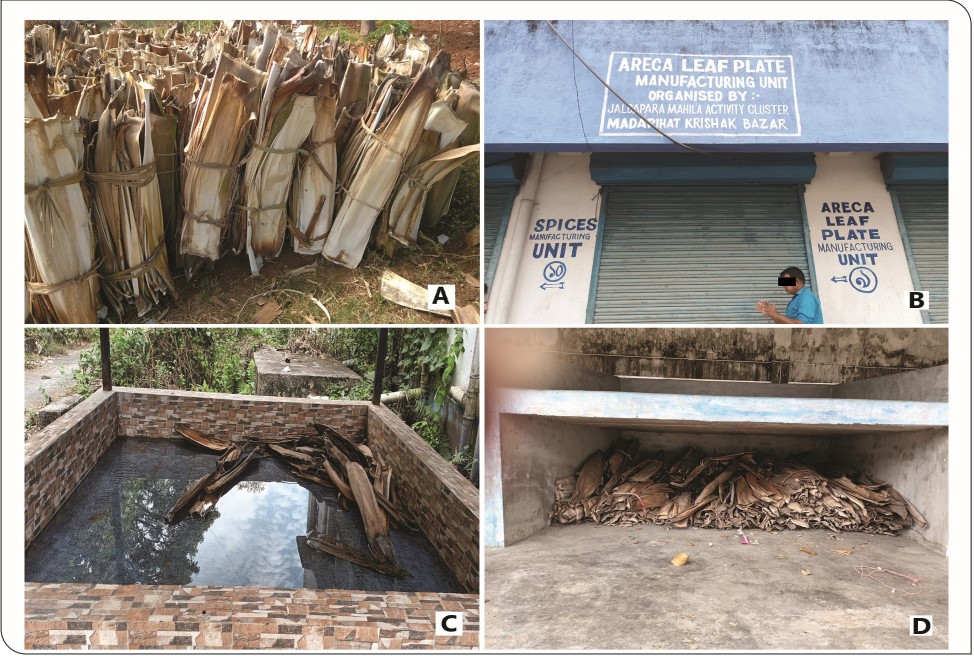
Rapid industrialization as well as urbanization have resulted production of enormous solid wastes especially plastic pollutants throughout the world since last few decades. Disposal and management of solid wastes impose a serious threat in the present-day context. With continuous efforts of eco-activists towards minimizing impacts of plastic wastes on human health and environment, many entrepreneurs, NGOs and small-scale industries are trying their best to bring alternative solutions of plastic disposable cutleries by introducing eco-friendly utensils manufactured from biodegradable plant wastes. Towards sustainable livelihood development, role of ethnic societies throughout the world as well as the country is mentionworthy. The tribal people settled at Madarihat - Birpara block areas in the Alipurduar District of West Bengal have undertaken a remarkable initiative to manufacture eco-friendly tableware from betel nut (Areca catechu L.) leaves at rural level. This project not only provides a sustainable alternative to plastic utensils but also empowers the local tribal community through economic and skill development. This communication emphasizes on the process, benefits, and challenges associated with this initiative along with showcasing how traditional ecological knowledge can be contributed towards sustainable development.
References
- 1. Ahuja S C, Ahuja U. Betel Leaf and Betel Nut in lndia: History and Uses. Asian Agri-History 2011; 15(l): 13-35.
- 2. Boro M, Devi R J, Sharma L S. Biodegradable Cutleries and Tableware as Substitute for Plastic: An Exploratory Study on Green Solutions. Int J Res Sci Innov 2020; 7 (6): 27-29.
- 3. Campanale C, Massarelli C, Savino I, Locaputo V, Uricchio V F. A Detailed Review Study on Potential Effects of Microplastics and Additives of Concern on Human Health. Int J Environ Res Public Health 2020; 17 (4): 1212. doi: 10.3390/ijerph17041212.
- 4. Hegde S, Nair L P, Chandran H, Irshad H. Traditional Indian way of eating-an overview. J Ethn Foods 2018; 5: 20-23.
- 5. Kora Aruna Jyothi. Leaves as dining plates, food wraps and food packing materials: Importance of renewable resources in Indian culture. Bull Natl Res Cent 2019; 43: 205.
- 6. Jamanal H, Murthy C. Trends in area, production and productivity of Areca. J Pharm Innov 2022; 11(12): 5200-5205.
- 7. Rane Saloni, Shivangi T. Development of Sustainable tableware from waste. Science Open Preprints 2023; 1-6, doi: 10.14293/ PR2199. 000115.v1.
- 8. Revathi R M, Adivappar N, Patil S, Sudeep, H P, Swathi H C. Studies on microbial contaminants associated with Areca leaf sheath plates. Journ Pure Appl Microb 2021; 15 (3): 1393 -1397.
- 9. Shashikumar, Shrinivasa D J, Manjunatha K, Anantachar M. Physical Properties of Areca nut Sheath. Int J Agric Sci 2016; 8 (60): 3378- 3380.
- 10. Singh Shikha, Pandey A, Mishra R., Mohanty, R L. Leaves to Rolls: An overview of innovative leaf processing machines and their applications. Journ Biosyst Eng 2024; 49 (3): 291 -312.
- 11. Tanwar M, Tanwar B, Tanwar R S, Kumar V, Goyal, A. Himachali dham: Food, culture, and heritage, J. Ethn. Foods, 2018; 5: 99–104.
- 12. https://kknexports.com/blog/manufacturingprocess-areca-leaf-plates/
Data Sharing Statement
There are no additional data available.
Funding
Not funded by any Agency.
Author Contributions
All authors contributed significantly to the work and approve its publication.
Ethics Declaration
This article does not involve any human or animal subjects, and therefore does not require ethics approval.
Acknowledgements
The authors are grateful to the Director, Botanical Survey of India for providing multifarious facilities during conducting Action Plan project. Sincere thanks are expressed to the Head of Office, ISIM, BSI for continuous inspiration and support. The senior author is thankful to all the tour members for procuring field data and photographs. Last but not least, all the fellow colleagues and technical persons of Industrial Section Indian Museum are acknowledged for their assistance and cooperation.
Conflicts of Interest
The authors report no conflicts of interest in this work.
About this article

Cite this article
Ruchi Yadav, Debasmita Dutta Pramanick. Eco-Friendly And Biodegradable Utensils Made From Areca Leaf By Tribal Communities Of Madarihat-Birpara Block, Alipurduar District, West Bengal: A Case Study Report. Ind. Jr. Waste Manag. 2025; 9(1): 25-30.
Licence:
Attribution-Non-commercial 4.0 International (CC BY-NC 4.0)This license enables reusers to distribute, remix, adapt, and build upon the material in any medium or format for noncommercial purposes only, and only so long as attribution is given to the creator.
| Received | Accepted | Published |
|---|---|---|
| March 28, 2025 | April 08, 2025 | June 30, 2025 |
DOI: Not provide
Keywords
Plastic PollutionEcofriendly And Biodegradable UtensilsAreca LeavesTribal CommunityAlipurduar DistrictSearch for Similar Articles
Similar Articles
- Waste Management in Two States & Urban areas in India
- A Study on Water Bodies of District Srinagar, their Role and Challenges
- Indus Waters Treaty Hidden Tensions, Flowing Rivers
- SWM & Agricultural Residue Management Through Case Studies
- Smart Boards as Emerging E-Waste: Challenges and Sustainable Management Strategi...
Article Level Metrics
Last UpdatedSaturday 20 June 2026, 07:55:43 (IST)
296
Accesses
13
57
00
Citations
NA
NA
NA
Download citation
Article Keywords
Keyword Highlighting
Highlight selected keywords in the article text.
Timeline
| Received | March 28, 2025 |
| Accepted | April 08, 2025 |
| Published | June 30, 2025 |
licence
Attribution-Non-commercial 4.0 International (CC BY-NC 4.0)
This license enables reusers to distribute, remix, adapt, and build upon the material in any medium or format for noncommercial purposes only, and only so long as attribution is given to the creator.