Full Text (PDF)
Indian Journal of Trauma and Emergency Pediatrics 16(3-4):p 51-55, July - Dec 2024. | DOI: 10.21088/ijtep.2348.9987.163424.3
Case Report
Drug Reaction with Eosinophilia and Systemic Symptoms (DRESS) Syndrome
Milind S. Tullu, , Radhika Ramesh1 , Manavi K.M.2 , Milind S. Tullu3 , Mukesh Agrawal4
Author Information
Licence:
Indian Journal of Trauma and Emergency Pediatrics 16(3-4):p 51-55, July - Dec 2024. | DOI: 10.21088/ijtep.2348.9987.163424.3
How Cite This Article:
Radhika Ramesh, Manavi K.M., Milind S. Tullu, et al. Drug Reaction with Eosinophilia and Systemic Symptoms (DRESS) Syndrome. Indian Journal of Trauma and Emergency Pediatrics. 2025;16(1-2): 51-55.
Timeline
Received : N/A
Accepted : N/A
Published : N/A
Abstract
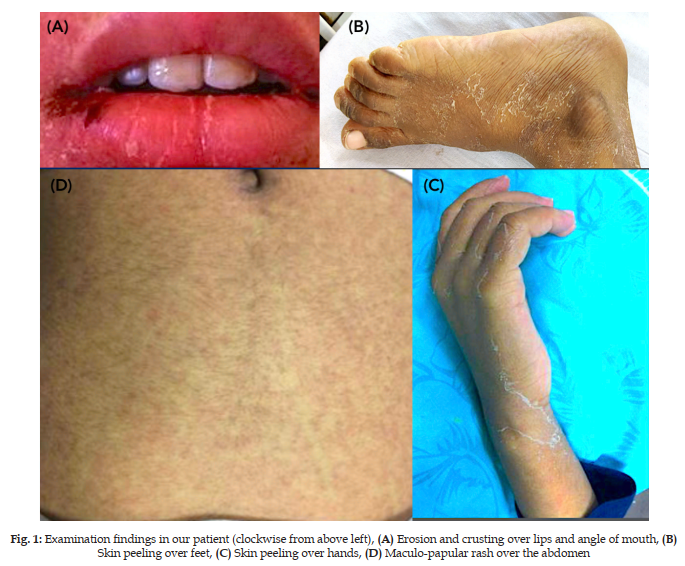
Introduction: DRESS (drug reaction with eosinophilia and systemic symptoms) syndrome is a potentially life-threatening illness with cutaneous and systemic manifestations, following exposure to an offending drug (like anti-convulsants, antimicrobials or anti-inflammatory drugs). It presents with fever, rash, hematological abnormalities & internal organ involvement. Removal of the offending agent & use of systemic glucocorticoids are the .cornerstones of treatment Case Report: An eight-years-old boy, on treatment with phenytoin (for generalized tonic-clonic seizure which had occurred 8 weeks ago), presented with- fever, rash, periorbital swelling & pedal edema. Examination revealed bilateral cervical lymphadenopathy, pedal edema & erythematous maculopapular rash (on abdomen, back, upper & lower limbs) with peeling & erosions over the lips & angle of mouth. Blood investigations showed leukocyte count of 13,600 cells/cumm with eosinophilia (absolute count- 1,632/cumm), elevated liver transaminases (SGOT- 146 IU/L; SGPT- 78 IU/L) & renal failure (elevated BUN- 18 mg/dl & creatinine- 1.1 mg/dl). Renal biopsy suggested interstitial nephritis. Phenytoin was discontinued on suspicion of DRESS syndrome. Patient was treated with oral steroids & hemo-dialysis (for the rising creatinine). Anti-epileptic drug was changed to levetiracetam. The patient recovered in 4 weeks. Parents were counselled about risk of reaction to similar drugs & advised regular follow-up to watch .for relapse Conclusion: DRESS syndrome (although rare in children) should be considered, especially if history of recent addition of potentially incriminated drugs exists. Most patients with DRESS recover completely .in few weeks to months after discontinuing the offending drug
References
No records found.
About this article

Cite this article
Radhika Ramesh, Manavi K.M., Milind S. Tullu, et al. Drug Reaction with Eosinophilia and Systemic Symptoms (DRESS) Syndrome. Indian Journal of Trauma and Emergency Pediatrics. 2025;16(1-2): 51-55.
Licence:
| Received | Accepted | Published |
|---|---|---|
| N/A | N/A | N/A |
DOI: 10.21088/ijtep.2348.9987.163424.3
Keywords
• School Anti-Seizure • School Anti-Seizure • Dermatological • Eosinophilia • Drug-Induced Hypersensitivity • Eosinophilia Phenytoin • RashArticle Level Metrics
Last UpdatedSaturday 24 October 2026, 14:53:04 (IST)
1810
Accesses
9
249
00
Citations
NA
NA
NA
Download citation
Article Keywords
Keyword Highlighting
Highlight selected keywords in the article text.
Timeline
| Received | N/A |
| Accepted | N/A |
| Published | N/A |