Full Text (PDF)
Indian Journal of Biology 12(1):p 7-14, Jan-June 2025. | DOI: https://doi.org/10.21088/ijb.2394.1391.12125.1
Original Article
Diversity of Microalgae and Aquatic Macrophytes of Damodar: Effect of Physico-chemical Parameters and Inorganic Ions
Debnath Tapash, Ray Monojit, SK Suraj
Author Information
Licence:
Attribution-Non-commercial 4.0 International (CC BY-NC 4.0)This license enables reusers to distribute, remix, adapt, and build upon the material in any medium or format for noncommercial purposes only, and only so long as attribution is given to the creator.
Indian Journal of Biology 12(1):p 7-14, Jan-June 2025. | DOI: https://doi.org/10.21088/ijb.2394.1391.12125.1
How Cite This Article:
Tapash D, Monojit R, et al. Diversity of Microalgae and Aquatic Macrophytes of Damodar: Effect of Physico-chemical Parameters and Inorganic Ions. Indian J Biol. 2025;12(1):7-14.Timeline
Received : February 03, 2025
Accepted : May 08, 2025
Published : June 10, 2025
Abstract
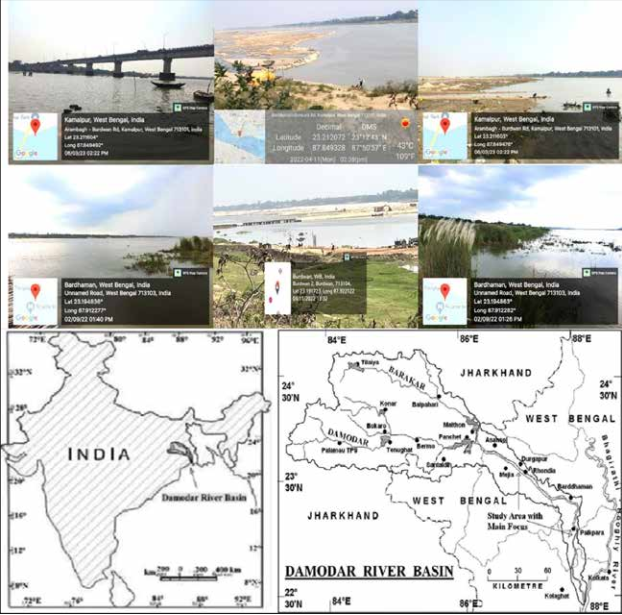
The present study is conducted to analyse the present status of the effect of physicochemical parameters and inorganic nutrient ions on the diversity of microalgae and aquatic macrophytes of the Damodar River. This study observed growth, diversity, and distribution of aquatic plants are related to the variation of physicochemical parameters and inorganic nutrient ions of river water. The extensive and exclusive study on the five different spots of Damodar River during 2022-2024 in different months of the year identified many species of aquatic flowering plants, aquatic fern, and algae. The Presence of many aquatic flora and algae indicates that the river Damodar is suitable for aquatic floral diversity. It was also observed that river water pollution inversely affected the floral and algal diversity at Damodar River. Pollutants are released from different industries located near both banks of this river. As a result of that water quality also deteriorated. Damodar river water can be characterized as slightly alkaline throughout the year. This preliminary observation identifies the status of the effect of physico-chemical parameters and inorganic nutrient ions on the biodiversity of the Damodar River.
References
- 1. Debnath T. and Ray M. 2023. Annual variation of physico-chemical parameters of Damodar river water: Feb 2022 – Jan 2023. Journal of Science and Technological Researches; 5(2). DOI: https://doi.org/10.51514/ JSTR.5.2.2023.1-8.
- 2. Ray M. 2022. Comparison of Inorganic Nutrient Ions of River Bhagirathi, Damodar, and Churni within Nadia, WB During 2020-2021. Journal of Science and Technological Researches, 4(1), 1-8. DOI: https://dx.doi.org/10.51514/ JSTR.4.1.2022.1-8.
- 3. Ray M. and Pal S. 2021. Study of aquatic biodiversity and correlation with physical parameters of Damodar River. European Journal of Biological Research; 11(2): 212-216. DOI: 10.5281/zenodo.4516528.
- 4. Ray M., Ghati A., Pant H., Negi S., and Joshi H. C, 2021. Comparison of water quality between the upper and delta course of the river Ganga during winter 2021. Journal of Science and Technological Researches; 3(2).16-22. https:// doi.org/10.51514/JSTR.3.2.2021.16-22.
- 5. Ray M. 2021. Seasonal variation of physiochemical parameters of river Churni. Nadia during 2019-2020. Journal of Science and Technological Researches; 3(1). 1-5. DOI: https://dx.doi.org/10.51514/JSTR.3.1.2021.1-5.
- 6. Ray M., 2015, Seasonal Variation of Physicochemical parameters of Jalangi River water: Relation with Water Uses and Water Pollution; MS-Academic, 2015. 5(1).82-87.
- 7. Ray M., 2015, Seasonal Variation of Different Biologically Significant ion Concentrations of the Jalangi River water, Indian Journal of Biology, 2(2), 179-183.DOI: https://dx.doi. org/10.21088/ijb.2394.1391.2215.12.
- 8. Ray M., Sengupta K., 2015, Soil composition and nutrient dynamics of some phytoplankton’s of River Jalangi, Nadia WB,Indian Journal of Biology, 2(2), 167-170.
- 9. Ray M., 2015, River Jalangi at Haranagar ghat, Nadia: A Rich Source of Green Algae Chlorococcumsp.MS-Academic, 5(2), 50-53.
- 10. Ray M., Sengupta K., Sarkar D. and Sarkar G., 2016, Primary Productivity, Algae and Physico-chemical Parameters of River Churni, MS-Academic, 6(2). 16-21. DOI: https://dx.doi. org/10.21088/ijb.2394.1391.2215.10.
- 11. Ray M., 2017, Bird Watch at Jalangi,Indian Journal of Biology, 4(1), 37-42. DOI: 10.21088/ ijb.2394.1391.4117.6
- 12. Niyoyitungiye, L., Giri, A. and Mishra, B.P. 2020. Quantitative and qualitative analysis of phytoplankton population about environmental factors at the targeted sampling stations on the Burundian littoral of Lake Tanganyika. International Journal of Fisheries and Aquatic Studies; 8(1):110 – 121.
- 13. Mondal, G.C., Singh, K.A. and Singh, T.B. Damodar River Basin: Storehouse of Indian Coal, The Indian Rivers, Springer Hydrogeology. https://doi.org/10.1007/978- 981-10-2984-4-21.
- 14. Banerjee, R. and Ghosh, A.R. 2016. Identification and Quantification of Aquatic Macrophytes with Ecological Indices in the Damodar River, International Journal of Scientific Research in Science, Engineering and Technology (IJSRSET); 2(6).
- 15. Reddy, B.M. and Chaturvedi, A. 2016. Study of Aquatic and Associated Macrophytes from the Major Rivers of the Chandrapur district, Maharashtra. International Journal of Science, Environment and Technology, Vol. 5, No 6, 3774 – 3782.
- 16. Ray, M. 2015. Seasonal Variation of Physicochemical Parameters of Damodar River Water: Relation with Water Uses and Water Pollution. MS ACADEMIC, 5(1): 82-87.
- 17. Sitre, S.R. 2013. Assessment of macrophyte biodiversity of a freshwater reservoir of Bhadrawati tehsil in Chandrapur district. Online International Interdisciplinary Research Journal. 3(3): 78-81.
- 18. Amelia, K., Ward, R. and Wetzel, G. 2008. Sodium: Some effects on blue-green algal growth. Journal of Phycology. 11(4), 357- 363.
- 19. APHA-AWWA-WPCF, 1995. Standard methods for the examination of water and wastewater, 19th edition, 459 – 463.
- 20. Margalef, R. 1958. Temporal succession and spatial heterogeneity in phytoplankton. In: Perspectives in Marine biology, BuzzatiTraverso (ed.), University of California Press, Berkeley, 323 – 347.
- 21. Shannon, C.E. and Wiener, W. 1949. The mathematical theory of communication. Urbana, University of Illinois Press, 177.
Data Sharing Statement
There are no additional data available.
Funding
This research received no funding.
Author Contributions
All authors contributed significantly to the work and approve its publication.
Ethics Declaration
This article does not involve any human or animal subjects, and therefore does not require ethics approval.
Acknowledgements
The authors are grateful to the Governing Body and Research Monitoring Committee of Barrackpore Rastraguru Surendranath College for financial support.
Conflicts of Interest
The authors report no conflicts of interest in this work.
About this article

Cite this article
Tapash D, Monojit R, et al. Diversity of Microalgae and Aquatic Macrophytes of Damodar: Effect of Physico-chemical Parameters and Inorganic Ions. Indian J Biol. 2025;12(1):7-14.
Licence:
Attribution-Non-commercial 4.0 International (CC BY-NC 4.0)This license enables reusers to distribute, remix, adapt, and build upon the material in any medium or format for noncommercial purposes only, and only so long as attribution is given to the creator.
| Received | Accepted | Published |
|---|---|---|
| February 03, 2025 | May 08, 2025 | June 10, 2025 |
DOI: https://doi.org/10.21088/ijb.2394.1391.12125.1
Keywords
Physico-chemical parametersDamodar riverBiodiversityAquaticFloraSearch for Similar Articles
Similar Articles
- Medicinal Mushrooms: Potent Fungi for Diverse Human Health Benefits
- Honey for Nutrition and Health Benefits - Traditional and Modern Uses in Human D...
- Foraging Behaviour of Indian Honey Bee, Apis Cerana Indica Fab, (Apidae: Hymenop...
- Role of Curcumin in Wound Healing
- Characterization of Blood cells and Comparative Analyses of Hematological Profil...
Article Level Metrics
Last UpdatedWednesday 30 September 2026, 08:30:13 (IST)
2436
Accesses
23
344
00
Citations
NA
NA
NA
Download citation
Article Keywords
Keyword Highlighting
Highlight selected keywords in the article text.
Timeline
| Received | February 03, 2025 |
| Accepted | May 08, 2025 |
| Published | June 10, 2025 |
licence
Attribution-Non-commercial 4.0 International (CC BY-NC 4.0)
This license enables reusers to distribute, remix, adapt, and build upon the material in any medium or format for noncommercial purposes only, and only so long as attribution is given to the creator.