Full Text (PDF)
Indian Journal of Dental Education 17(4):p 163-169, Oct-Dec 2024. | DOI: https://doi.org/10.21088/ijde.0974.6099.17424.1
Original Article
Dental Age Estimation by Modifying Nolla’s Method to Determine the Accuracy in Children in the Region of Mahe
Anusree Nair, Rena Ephraim, Ambili Ayilliath, Sharath Chandrashekhar, Dhanya K B, Sreelakshmi R
Author Information
Licence:
Attribution-Non-commercial 4.0 International (CC BY-NC 4.0)This license enables reusers to distribute, remix, adapt, and build upon the material in any medium or format for noncommercial purposes only, and only so long as attribution is given to the creator.
Indian Journal of Dental Education 17(4):p 163-169, Oct-Dec 2024. | DOI: https://doi.org/10.21088/ijde.0974.6099.17424.1
How Cite This Article:
Anusree Nair, Rena Ephraim, Ambili Ayilliath et al., Dental Age Estimation by Modifying Nolla’s Method to Determine the Accuracy in Children in the Region of Mahe. Ind J Dent Educ. 2024;17(4):163-169.Timeline
Received : December 18, 2023
Accepted : February 14, 2024
Published : December 10, 2024
Abstract
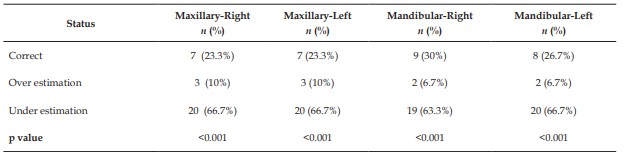
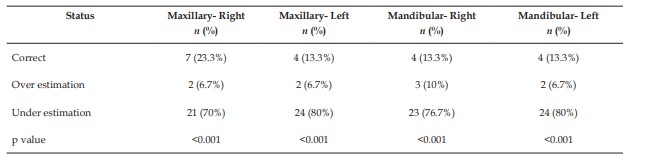
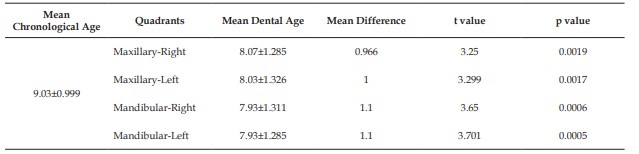
Background: Age estimation has many factors, viz, skeletal age, sexual age, chronological age (CA) and dental age (DA). Assessment of tooth development is widely being used these days for age estimation because of its reliability and ease of procedure. The tooth with its developmental phases impart non-invasive, non-destructive attributes to assess the person’s age. However, ethnicity, influence of hormonal and racial factors, environmental changes, and various diseasesmay alter the results in certain areas. Aim of the study: To estimate the Dental age of children aged 7-10 years by Nolla’s method using Orthopantomographs, in the region of Mahe. Materials and Methodology: 60 digital Orthopantomographs (OPGs) were used for the study to estimate the DA of children, using Nolla’s method of DA estimation. Seven permanent teeth in the left mandibular quadrant were assessed as per Nolla’s method. This was compared to the other quadrants and the results were analysed to determine the DA. The mean difference between the DA and CA was calculated using a paired t-test. Correlation between CA and DA was analysed using Pearson’s correlation coefficient. The statistical analysis was done using IBM SPSS Statistics for Windows, Version 26.0. Results: The DA of children of Mahe showed under estimation using Nolla’s method of age determination. Among the quadrants, the maxillary right quadrant showed the least under estimation or most accurate age estimation. Conclusion: By using a proper regression equation, the Nolla’s method can be made more accurate for age determination in the children of Mahe.
References
- 1. Masthan KMK. Textbook of Forensic Odontology. Jaypee Brothers Medical Pub; 2009.
- 2. Mohamed R, Abirami A. Age Estimation with Permanent First Molar using Nolla’s Method in Indian Population. J Popul Ther Clin Pharmacol 2023; 30:195-99.
- 3. Singh HV, Kalra N, Tyagi R et al. Dental age assessment of North Indian origin children using Nolla’s method in mandibular second molar. Egypt J Forensic Sci 2020; 10:25.
- 4. Nandlal, Bhojraj, Patil DR, Shanthraj, Ravi. Estimation of dental age by Nolla’s method using orthopantomographs among rural free residential school children. Int J Med Res Health Sci 2014; 3:273-77.
- 5. Deepthy T, Prashanth S, Lakshmikanth C, Veena KM, Prasanna KR, Rechana P et al. Age Assessment Using Nolla’s Method in a group of Mangalore Population: A Study on 25 Children. Journal of Contemporary Medicine 2014; 4:121-27.
- 6. Folayan MO. A Global Compendium of Oral Health: Tooth Eruption and Hard Dental Tissue Anomalies. Cambridge Scholars Publishing 2019; 553.
- 7. Sachan K, Sharma VP, Tandon P, Verma SL, Srivastav K. To Establish the validity of dental age assessment using Nolla’s method on comparing with skeletal age assessed by hand-wrist radiographs. J Indian OrthodSoc 2013; 47(4):438-42.
- 8. Palanisamy V, Rao A, Shenoy R, Baranya SS. Correlation of dental age, skeletal age, and chronological age among children aged 9-14 years: A retrospective study. J Indian SocPedodPrev Dent 2016; 34(4):310-14.
- 9. Bhadana S, Indushekar KR, Saraf BG, Sardana D, Sheoran N. Comparative assessment of chronological, dental, and skeletal age in children. Indian J Dent Res 2019; 30(5):687-91.
- 10. Yassin SM, Al Almai BAM, Ali Huaylah SH, Althobati MK, Al Hamdi FMA, Togoo RA. Accuracy of estimating Chronological Age from Nolla’s Method of Dental Age Estimation in a Population of Southern Saudi Arabian Children. Niger J ClinPract 2020; 23:1753-58.
- 11. Deshpande A, Pradhan N, Patel K. Accuracy of Demirjian’s, Willems, Nolla’s and Modified Cameriere’s Dental Age Estimation Methods in Young Western Indian Children- A Cross-sectional Study. Journal of Clinical and Diagnostic Research 2022; 16(2):13-20.
- 12. Duruk G, GundogduOzdal TP, Duman S. Accuracy of age estimation of Demirjian and Nolla methods in Eastern Turkish children aged 3-17 years old. Eur Oral Res 2022; 56(2):80-87.
- 13. Kirzioglu Z, Ceyhan D. Accuracy of different dental age estimation methods on Turkish children. Forensic SciInt 2012; 216:61-7.
- 14. Melo M, Ata-Ali J. Accuracy of the estimation of dental age in comparison with chronological age in a Spanish sample of 2641 living subjects using the Demirjian and Nolla methods. Forensic SciInt 2017; 270:76.
- 15. Mohammed RB, Sanghvi P, Perumalla KK, Srinivasaraju D, Srinivas J, Kalyan US, Rasool SM. Accuracy of four dental age estimation methods in southern Indian children. J ClinDiagn Res 2015; 9(1):1-8.
- 16. Noaman BR, Abdullah AO. Validity of Nolla’s method for age estimation for children in Kurdish Iraqi population – A retrospective study. Indian J Dent Res 2022; 33:393-6.
- 17. D Wen et al. Comparing the accuracy of Demirjian and Nolla methods and establishing a new method for dental age estimation in northeastern Chinese children. Forensic Sciences Research 2022; 7(4):685- 93.
- 18. Paz Cortés MM, Rojo R, MourelleMartínez MR, Dieguez Pérez M, Prados-Frutos JC. Evaluation of the accuracy of the Nolla method for the estimation of dental age of children between 4-14 years old in Spain: A radiographic study. Forensic Sci Int. 2019 Aug; 301:318-25.
Data Sharing Statement
There are no additional data available.
Funding
This research received no funding.
Author Contributions
All authors contributed significantly to the work and approve its publication.
Ethics Declaration
This article does not involve any human or animal subjects, and therefore does not require ethics approval.
Acknowledgements
Information not provide.
Conflicts of Interest
The authors report no conflicts of interest in this work.
About this article

Cite this article
Anusree Nair, Rena Ephraim, Ambili Ayilliath et al., Dental Age Estimation by Modifying Nolla’s Method to Determine the Accuracy in Children in the Region of Mahe. Ind J Dent Educ. 2024;17(4):163-169.
Licence:
Attribution-Non-commercial 4.0 International (CC BY-NC 4.0)This license enables reusers to distribute, remix, adapt, and build upon the material in any medium or format for noncommercial purposes only, and only so long as attribution is given to the creator.
| Received | Accepted | Published |
|---|---|---|
| December 18, 2023 | February 14, 2024 | December 10, 2024 |
DOI: https://doi.org/10.21088/ijde.0974.6099.17424.1
Keywords
Dental age (DA)Chronological age (CA)Nolla’s methodChildrenUnderestimationRegression equationSearch for Similar Articles
Similar Articles
- One Step Apexification using PRF as Matrix and MTA Apical Barrier
- Infective Ulcers in the Oral Cavity: A Review
- Effect of COVID-19 Lockdown on Patients Undergoing Orthodontic Therapy in Distri...
- Wire Splinting: An Effective Management Approach for Lateral Luxation: A Clinica...
- Prosthodontics in Healthy Ageing and Longevity Medicine: A Critical Narrative R...
Article Level Metrics
Last UpdatedSunday 18 October 2026, 19:24:46 (IST)
3439
Accesses
31
611
00
Citations
NA
NA
NA
Download citation
Article Keywords
Keyword Highlighting
Highlight selected keywords in the article text.
Timeline
| Received | December 18, 2023 |
| Accepted | February 14, 2024 |
| Published | December 10, 2024 |
licence
Attribution-Non-commercial 4.0 International (CC BY-NC 4.0)
This license enables reusers to distribute, remix, adapt, and build upon the material in any medium or format for noncommercial purposes only, and only so long as attribution is given to the creator.