Full Text (PDF)
Indian Journal of Trauma and Emergency Pediatrics 18(1):p 7-13, January-June 2026. | DOI: https://doi.org/10.21088/ijtep.2348.9987.18126.1
Original Article
Delayed medical Attention and care in Monsoon-related illnesses: Causes, Risk factors and Impact on the outcome
Ruchi Mishra, Mukesh Agrawal, Manavi KM
Author Information
Licence:
Attribution-Non-commercial 4.0 International (CC BY-NC 4.0)This license enables reusers to distribute, remix, adapt, and build upon the material in any medium or format for noncommercial purposes only, and only so long as attribution is given to the creator.
Indian Journal of Trauma and Emergency Pediatrics 18(1):p 7-13, January-June 2026. | DOI: https://doi.org/10.21088/ijtep.2348.9987.18126.1
How Cite This Article:
Ruchi Mishra, Mukesh Agrawal, Manavi KM. Delayed medical Attention and care in Monsoon-related illnesses: Causes, Risk factors and Impact on the outcome. Indian J Trauma Emerg Pediatr. 2026;18(1): 7–13Timeline
Received : January 29, 2025
Accepted : March 28, 2026
Published : June 30, 2026
Abstract
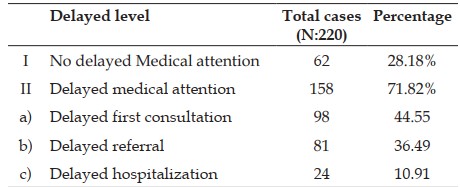
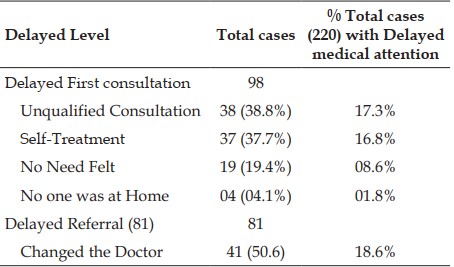
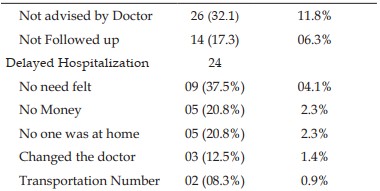
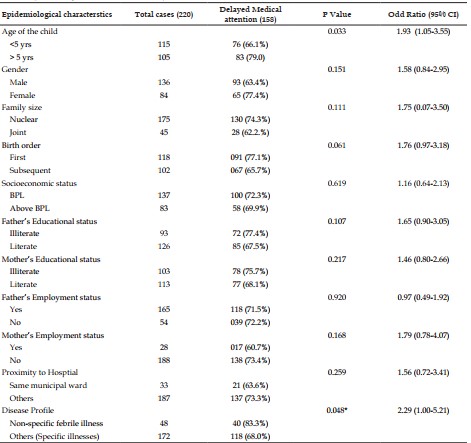
Introduction: Monsoon-related illnesses are major cause of morbidity and mortality in children during rainy season in Mumbai. Outcome of these illnesses largely depend on appropriate and timely care. Experience suggests delayed medical attention is a common problem in study population. Aims & Objectives: Present Study aimed to assess the prevalence, reasons and risk factors for delayed medical attention in children with monsoon-related illnesses as well as the impact on final outcome. Materials & Methods: This cross-sectional observational study included 220 children (1 month-12 years) hospitalized with monsoon-related illnesses in a tertiary hospital during two seasons (June-September) in 2019-2020. “Delayed medical attention” was pre-defined for study purpose as one or more of the following – a) More than 24 hours delay between onset of symptoms and first visit to qualified medical practitioner, or b) More than 72 hours delay between first consultation and referral to hospitalization,) c) More than 24 hours delay after referral and actual hospitalization. Results: Almost three-fourth of the study children (71.8%) received delayed medical attention with maximum delay at the level of first consultation (44.5%) followed by referral (36.5%). Delayed medical attention was more common in cases with initial self-treatment ( p 0.010; OR 38.58 with CI 2.33-638.84), Unqualified first consultations (p 0.003; OR 21.38 with CI95% 2.87-159.18) and Doctor-shopping (p0.0004; 21.38 with 95% CI 2.69 to 30.28). Older children beyond five years had significantly higher risk of delayed attention than under-five children (p 0.033; OR 1.93 with 95% CI 1.05-3.55) as also those with non-specific febrile illnesses (p 0.048, OR 2.29 with CI 95% 1.00 - 5.21). Conclusion: Delayed medical attention is widely prevalent in children with monsoon-illnesses among study population despite easy access to low-cost public health care in the city, largely due to inappropriate help-seeking behaviour. Older children, non-specific febrile illness, self- treatment, unqualified consultations and doctor-shopping are identified as significant risk factors for the delayed care.
References
- 1. Hogberg U. The World Health Report 2005: Make every mother and child count — including Africans. Scand J Public Health. 2005 Dec 1;33(6):409–11
- 2. Ahmed SM, Adams AM, Chowdhury M, Bhuiya A. Changing health-seeking behaviour in Matlab, Bangladesh: do development interventions matter? Health Policy Plan. 2003 Sep;18(3):306–15.
- 3. Hausmann-Muela S, Ribera J, Nyamongo I. No . 14 Health-seeking behaviour and the health system response. In 2003 [cited 2024 Aug 24]. Available from: https:// www.semanticscholar.org/paper/No-.-14- Health-seeking-behaviour-and-the-healthHausmann-Muela-Ribera/35116a3c0a88898a5 31ce214e4448861ae00e320.
- 4. Chokshi M, Patil B, Khanna R, Neogi SB, Sharma J, Paul VK, et al. Health systems in India. J Perinatol. 2016 Dec;36(s3):S9–12.
- 5. Das A, Ravindran TS. Factors affecting treatment-seeking for febrile illness in a malaria endemic block in Boudh district, Orissa, India: policy implications for malaria control. Malaria Journal. 2010 Dec 30;9(1):377.
- 6. Mathur R, Swaminathan S. National ethical guidelines for biomedical & health research involving human participants, 2017: A commentary. Indian J Med Res. 2018 Sep;148(3):279–83.
- 7. Office of the Registrar General & Census Commissioner, India Ministry of Home Affairs, Government of India. Census of India 2011, Maharashtra, District Census Handbook, Mumbai, Series 28, Part XII-B. Mumbai: Directorate of Census Operations Maharashtra. 2014.
- 8. Dávalos A. Thrombolysis in acute ischemic stroke: successes, failures, and new hopes. Cerebrovasc Dis. 2005;20 Suppl 2:135–9.
- 9. Arndt V, Stürmer T, Stegmaier C, Ziegler H, Dhom G, Brenner H. Patient delay and stage of diagnosis among breast cancer patients in Germany -- a population based study. Br J Cancer. 2002 Apr 8;86(7):1034–40.
- 10. Kassile T, Lokina R, Mujinja P, Mmbando BP. Determinants of delay in care seeking among children under five with fever in Dodoma region, central Tanzania: a cross-sectional study. Malar J. 2014 Sep 3;13:348.
- 11. Umuhoza C, Karambizi AC, Tuyisenge L, Cartledge P. Caregiver delay in seeking healthcare during the acute phase of pediatric illness, Kigali, Rwanda. The Pan African Medical Journal. 2018 Jun 22;30:160.
- 12. Kamat VR. “I thought it was only ordinary fever!” cultural knowledge and the micropolitics of therapy seeking for childhood febrile illness in Tanzania. Soc Sci Med. 2006 Jun;62(12):2945–59.
- 13. Irimu, Wamalwa, Njai4. Factors Associated With Late Presentation To Kenyatta National Hospital For Acute Severe Illness In Children Aged 2-59 Months. In 2016 [cited 2025 Jan 2]. Available from: https:// www.semanticscholar.org/paper/FactorsAssociated-With-Late-Presentation-To-For-InIrimu-Wamalwa/6415d40dbd50882beb6a3672 a8100117fa15ea89
- 14. Naaraayan SA, Rathinabalan I, Seetha V. Selfmedication pattern among children attending a tertiary hospital in South India: a cross-sectional study. International Journal of Contemporary Pediatrics. 2016 Dec 22;3(4):1267–71.
- 15. Tibdewal S, Gupta M. Mother’s use of medication in their children of preschool age. Indian J Public Health. 2005;49(1):27–9.
- 16. Biernikiewicz M, Taieb V, Toumi M. Characteristics of doctor-shoppers: a systematic literature review. Journal of Market Access & Health Policy. 2019 Mar 27;7(1):1595953.
- 17. Lungu EA, Darker C, Biesma R. Determinants of healthcare seeking for childhood illnesses among caregivers of under-five children in urban slums in Malawi: a population-based cross-sectional study. BMC Pediatr. 2020 Jan 17;20(1):20.
- 18. Garg R, Omwomo W, Witte JM, Lee LA, Deming MS. Care seeking during fatal childhood illnesses: Siaya District, Kenya, 1998. Am J Public Health. 2001 Oct;91(10):1611–3.
- 19. Hariman KW, Lam SC, Lam YWS, Luk KHK, Poon KK, Li AM. Fever as a predictor of doctor shopping in the paediatric population. Hong Kong Med J. 2013 Feb;19(1):6–12.
- 20. Padmaja K, Dr. Mary JT. An evaluation of Primary health care system in Kerala. In 2003 [cited 2025 Jan 5]. Available from: https://www.semanticscholar. org/paper/An-evaluation-of-Primaryhealth-care-system-in-Padmaja-Dr.Mary/ c5fe0975091ba0379427437a9a2ea59e81d8bb05
Data Sharing Statement
There are no additional data available. All raw data and code are available upon request.
Funding
This research received no funding.
Author Contributions
All authors contributed significantly to the work and approve its publication.
Ethics Declaration
This article does not involve any human or animal subjects, and therefore does not require ethics approval.
Acknowledgements
We would like to express our gratitude to the patients, their families, and all those who have contributed to this study.
Conflicts of Interest
No conflicts of interest in this work.
About this article

Cite this article
Ruchi Mishra, Mukesh Agrawal, Manavi KM. Delayed medical Attention and care in Monsoon-related illnesses: Causes, Risk factors and Impact on the outcome. Indian J Trauma Emerg Pediatr. 2026;18(1): 7–13
Licence:
Attribution-Non-commercial 4.0 International (CC BY-NC 4.0)This license enables reusers to distribute, remix, adapt, and build upon the material in any medium or format for noncommercial purposes only, and only so long as attribution is given to the creator.
| Received | Accepted | Published |
|---|---|---|
| January 29, 2025 | March 28, 2026 | June 30, 2026 |
DOI: https://doi.org/10.21088/ijtep.2348.9987.18126.1
Keywords
Delayed Medical AttentionMonsoon-Related IllnessesSelf-MedicationDoctor ShoppingHealth-Care Seeking BehaviourArticle Level Metrics
Last UpdatedSunday 18 October 2026, 12:56:31 (IST)
1777
Accesses
36
245
00
Citations
NA
NA
NA
Download citation
Article Keywords
Keyword Highlighting
Highlight selected keywords in the article text.
Timeline
| Received | January 29, 2025 |
| Accepted | March 28, 2026 |
| Published | June 30, 2026 |
licence
Attribution-Non-commercial 4.0 International (CC BY-NC 4.0)
This license enables reusers to distribute, remix, adapt, and build upon the material in any medium or format for noncommercial purposes only, and only so long as attribution is given to the creator.