Full Text (PDF)
Indian Journal of Emergency Medicine 10 (4):p 193-196, October - December 2024. | DOI: https://doi.org/10.21088/ijem.2395.311X.10424.1
Original Article
Comparison of REMS, MEWS, and HOTEL Scores to Prognosticate Acute Medical Patients
Author Information
Licence:
Attribution-Non-commercial 4.0 International (CC BY-NC 4.0)This license enables reusers to distribute, remix, adapt, and build upon the material in any medium or format for noncommercial purposes only, and only so long as attribution is given to the creator.
Indian Journal of Emergency Medicine 10 (4):p 193-196, October - December 2024. | DOI: https://doi.org/10.21088/ijem.2395.311X.10424.1
How Cite This Article:
Shabbir Shekhli, Comparison of REMS, MEWS, and HOTEL Scores to Prognosticate Acute Medical Patients. Ind J Emerg Med. 2024;10(4):193-196.Timeline
Received : August 16, 2024
Accepted : October 05, 2024
Published : December 25, 2024
Abstract
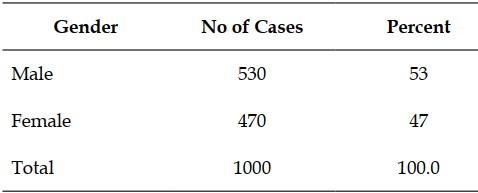
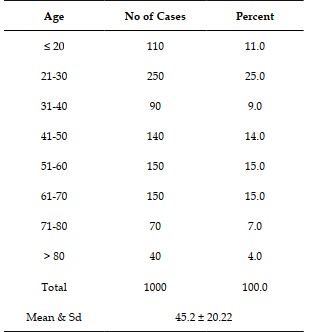
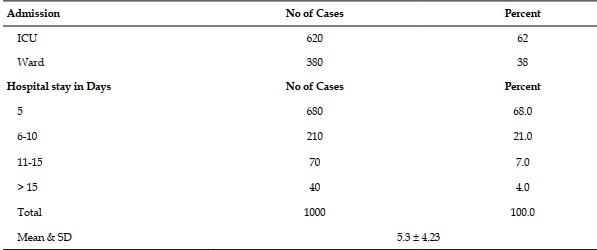
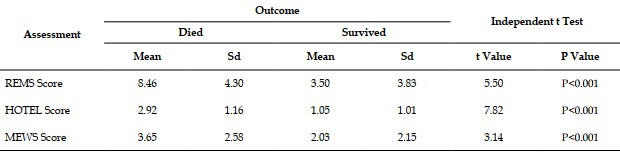
Aims: Emergency medicine is a new specialty that started in India in 2012 to treat severely ill patients as soon as possible. The main principle is triage which is useful for patient treatment and counseling of attenders regarding prognosis. Material and Methods: A prospective study was conducted in the adult ED of a 1200-bed hospital. A totalof thousandpatients presented with acute medicalconditions were included in the study. Data collected at admission includedpulse rate, respiratory rate, mean arterial pressure, mental status, pulse oximetry, age, blood pressure, and Glasgow coma scale. Aim was to investigate relationship between the scoring systems to predict in-hospital mortality. Results: In our study majority of the population was male and in the age group of 21 to 30 years. Cases admitted in ICU (62%) were higher thanin wards (38%).The HOTEL score showed a better prediction of mortality comparedwith REMS and MEWS. Conclusion: A HOTEL score of more than 1, predicts ICU admission and in-hospital mortality compared to MEWS and REMS.
References
- 1. Subbe CP, Davies RG, Williams E, et al. Effect of introducing the Modified Early Warning score on clinical outcomes, cardio-pulmonary arrests and intensive care utilisation in acute medical admissions. Anaesthesia. 2003;58:797e802.
- 2. Prytherch DR, Smith GB, Schmidt PE, et al. ViEWSdTowards a national early warning score for detecting adult inpatient deterioration. Resuscitation. 2010;81:932e937.
- 3. Crowe CA, Kulstad EB, Mistry CD, et al. Comparison of severity of illness scoring systems in the prediction of hospital mortality in severe sepsis and septic shock. J Emerg Trauma Shock. 2010;3:342e347.
- 4. Cuthbertson BH, Boroujerdi M, Prescott G. The use of combined physiological parameters in the early recognition of the deteriorating acute medical patient. J R Coll Physicians Edinb. 2010;40:19e25.
- 5. Olsson T, Terent A, Lind L. Rapid Emergency Medicine Score: a new prognostic tool for in-hospital mortality in nonsurgical emergency department patients. J Intern Med. 2004;255:579e587.
- 6. Olsson T, Lind L. Comparison of the rapid emergency medicine score and APACHE II in nonsurgical emergency department patients. Acad Emerg Med. 2003;10:1040e1048.
- 7. Bulut M, Cebicci H, Sigirli D, et al. The comparison of modified early warning score with rapid emergency medicine score: a prospective multicentre observational cohort study on medical and surgical patients presenting to emergency department. Emerg Med J. 2014;31:476e481.
- 8. Goodacre S, Turner J, Nicholl J. Prediction of mortality among emergency medical admissions. Emerg Med J. 2006; 23:372e375.
- 9. Sharma M, Szpunar S, Khatib R. Validating severity of illness scoring systems in the prediction of outcomes in Staphylococcus aureus bacteremia. Am J Med Sci.2013;346:87e91.
- 10. Kellett J, Deane B, Gleeson M. Derivation and validation of a score based on Hypotension, Oxygen saturation, low Temperature, ECG changes and Loss of independence (HOTEL) that predicts early mortality between 15 min and 24 hrs after admission to an acute medical unit. Resuscitation. 2008;78:52e58.
- 11. Wheeler I, Price C, Sitch A, et al. Early warning scores generated in developed healthcare settings are not sufficient at predicting early mortality in Blantyre, Malawi: a prospective cohort study. PLoS One. 2013;8:e59830.
- 12. Jo S, Lee JB, Jin YH, et al. Modified early warning score with rapid lactate level in critically ill medical patients: the ViEWS-L score. Emerg Med J. 2013;30:123e129.
- 13. Imhoff BF, Thompson NJ, Hastings MA, et al. Rapid Emergency Medicine Score (REMS) in the trauma population: a retrospective study. BMJ Open. 2014;4:e004738.
- 14. Kuo SH, Tsai CF, Li CR, et al. Rapid Emergency Medicine Score as a main predictor of mortality in Vibrio vulnificus-related patients. Am J Emerg Med. 2013;31:1037e1041.
- 15. Olsson T, Terént A, Lind L. Rapid Emergency Medicine Score: a new prognostic tool for in‐ hospital mortality in nonsurgical emergency department patients. Journal of internal medicine. 2004 May; 255(5):579-87.
- 16. Assess the rapid emergency medicine score (rems) and hotel score to identify among nonsurgical emergency patients [Internet]. [cited 2023 Jun 8]. Available from: https:// cardiometry.net/issues/no26-february-2023/ assess-rapid-emergency-medicine
Data Sharing Statement
There are no additional data available. All raw data and code are available upon request.
Funding
This research received no funding.
Author Contributions
All authors contributed significantly to the work and approve its publication.
Ethics Declaration
This article does not involve any human or animal subjects, and therefore does not require ethics approval.
Acknowledgements
We would like to express our gratitude to the patients, their families, and all those who have contributed to this study.
Conflicts of Interest
No conflicts of interest in this work.
About this article

Cite this article
Shabbir Shekhli, Comparison of REMS, MEWS, and HOTEL Scores to Prognosticate Acute Medical Patients. Ind J Emerg Med. 2024;10(4):193-196.
Licence:
Attribution-Non-commercial 4.0 International (CC BY-NC 4.0)This license enables reusers to distribute, remix, adapt, and build upon the material in any medium or format for noncommercial purposes only, and only so long as attribution is given to the creator.
| Received | Accepted | Published |
|---|---|---|
| August 16, 2024 | October 05, 2024 | December 25, 2024 |
DOI: https://doi.org/10.21088/ijem.2395.311X.10424.1
Keywords
REMSMEWSHOTELRAPSEmergency DepartmentMortalityScoring SystemSearch for Similar Articles
Similar Articles
- Early Recognition and Timely Intervention in Sepsis: A Cornerstone for Improved...
- REPE after Spontaneous Pneumothorax Drainage
- Autoimmune Encephalitis Unveiled: A Case Report in a 50-year Old Female
- Diet Induced Ketoacidosis in Euglycemic Patient
- A Rare Case of Hypercoagulable State Due to Combined Inherited Thrombophilia Pro...
Article Level Metrics
Last UpdatedThursday 12 November 2026, 19:55:10 (IST)
7231
Accesses
2
1128
00
Citations
NA
NA
NA
Download citation
Article Keywords
Keyword Highlighting
Highlight selected keywords in the article text.
Timeline
| Received | August 16, 2024 |
| Accepted | October 05, 2024 |
| Published | December 25, 2024 |
licence
Attribution-Non-commercial 4.0 International (CC BY-NC 4.0)
This license enables reusers to distribute, remix, adapt, and build upon the material in any medium or format for noncommercial purposes only, and only so long as attribution is given to the creator.