Full Text (PDF)
Indian Journal of Emergency Medicine 8(1):p 9-14, January–March 2022. | DOI: https://doi.org/10.21088/ijem.2395.311X.8122.1
Original Article
Comparison of Point of Care Versus Laboratory Autoanalyzer Measurements of Sodium and Potassium Levels in Patients Admitted from the Emergency Department
Sajid N A Nomani, Imran Ahmad Khan, Debasish Mishra, Amit Yadav, Sayantika Sarkar, Sonal Patnaik
Author Information
Licence:
Attribution-Non-commercial 4.0 International (CC BY-NC 4.0)This license enables reusers to distribute, remix, adapt, and build upon the material in any medium or format for noncommercial purposes only, and only so long as attribution is given to the creator.
Indian Journal of Emergency Medicine 8(1):p 9-14, January–March 2022. | DOI: https://doi.org/10.21088/ijem.2395.311X.8122.1
How Cite This Article:
Imran Ahmad Khan, Sajid N A Nomani, Debasish Mishra, et. al./ Comparison of Point of Care Versus Laboratory Autoanalyzer Measurements of Sodium and Potassium Levels in Patients Admitted from the Emergency Department/Indian J Emerg Med 2022;8(1):9–14.Timeline
Received : January 27, 2022
Accepted : February 14, 2022
Published : March 30, 2022
Abstract
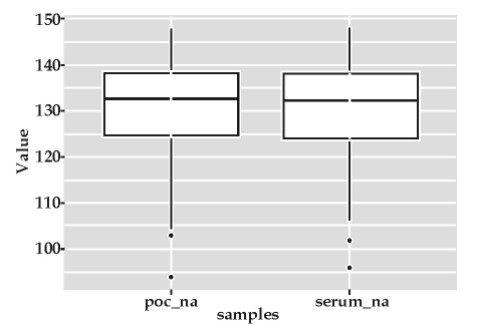
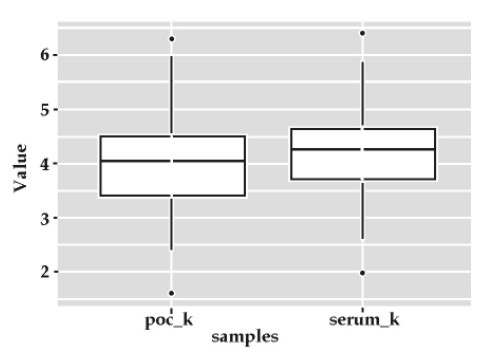
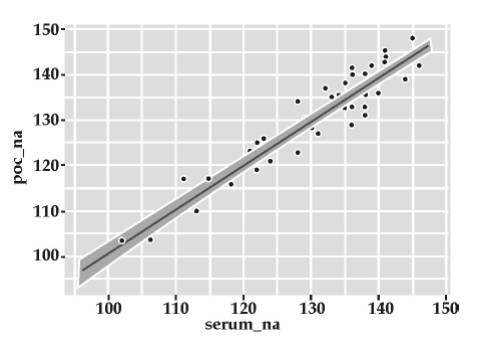
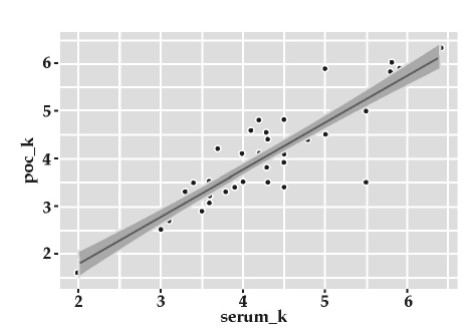
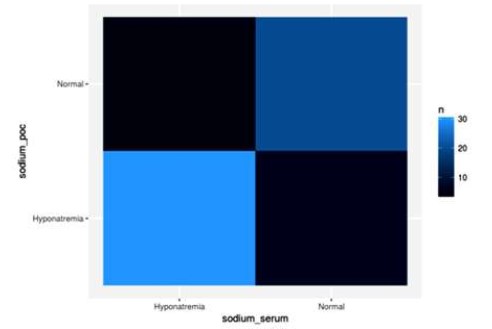
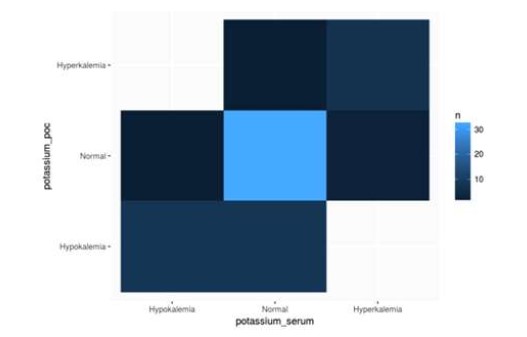
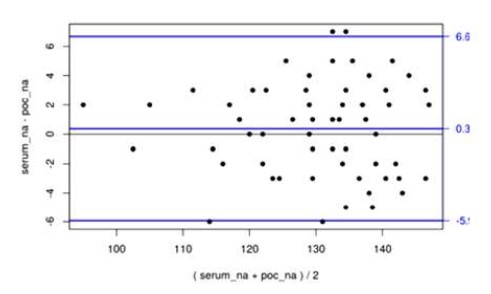
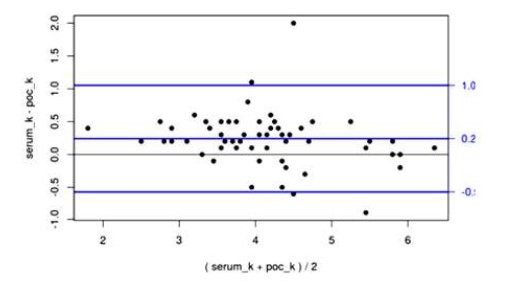
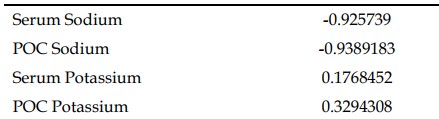
Electrolyte problems are one of the most common cause of morbidity and mortality in the sick patients coming to the Emergency. Electrolytes measured in central lab usually takes 30-60 minutes or more whereas point of care device can give results within 5 to 10 minutes, however different instruments available and their values varies accordingly. Therefore, this study was done to investigate whether electrolyte i.e. sodium and potassium levels assessed using point of care device and auto analysers were equivalent. Methods: We prospectively studied patients admitted from Emergency Department between January 2021 to October 2021. We had taken 60 paired convenience samples and analysed sodium and potassium levels in point of care device (epoc POC device, Siemens) and in Central Lab Auto Analyser (Siemens Dimension RxL Max Integrated chemistry analyzer or in Johnson & Johnson chemistry analyser model number 51 FS). Statistical method to compare the data included Boxplot view, Regression line, Spearman’s correlation coefficient’s, paired t-test for potassium and Wilcox test for sodium correlation, Regression equation, Deming regression and Bland Altman plots. Results: The mean Sodium concentration in point of care device was 130.2 mmol/l and in Auto analyser was 130.5 mmol/l. The mean potassium level in point of care device was 4.013 mmol/l and in Auto analyser was 4.255 mmol/l. The Correlation coefficient obtained for sodium was 0.92 and for potassium was 0.818. Box plot view and regression line showed a good correlation. A difference above the CLIA criteria was noted for 10 pairs in sodium values and 07 pairs for potassium values. Conclusion: Point of care sodium and potassium values can be used in the Emergency Department for critical decision making.
References
- 1. C.J. Cox, acute care testing Blood gases and electrolytes at the point of care. Clin Lab Med. 2001; 21: 321-35.
- 2. Scott MG, LeGrys VA, Klutts JS: Electrolytes and blood gases. Tietz Textbook of Clinical Chemistry and Molecular Diagnostics. Edited by: Burtis DE, Ashwood ER, Bruns DE. 2006, Elsevier, St Louis, MO, 983-1018
- 3. D’Orazio P, Miller WG, Myers GL, Doumas BT, Eckfeldt JH, Evans SA, Graham GA, Parsons PJ, Stanton NV: Standardization of Sodium and Potassium Ion-Selective Electrode Systems to the Flame Photometric Reference Method; Approved Standard—Second Edition, C29-A2 [electronic document]. CLSI. 2000, 20: 1-22.
- 4. St-Louis P: Status of point-of-care testing: promise, realities, and possibilities. ClinBiochem. 2000, 33 (6): 427-440. 10.1016/S0009-9120(00)00138-7.
- 5. Budak YU, Huysal K, Polat M. Use of a blood gas analyzer and a laboratory autoanalyzer in routine practice to measure electrolytes in intensive care unit patients. BMC Anesthesiol 2012; 12:17
- 6. Jain A, Subhan I, Joshi M: Comparison of the point-of-care blood gas analyzer versus the laboratory auto-analyzer for the measurement of electrolytes. Int J Emerg Med. 2009, 2 (2): 117-120. 10.1007/s12245-009-0091-1.
- 7. Chacko B, Peter JV, Patole S, Fleming JJ, Selvakumar R: Electrolytes assessed by pointof-care testing—Are the values comparable with results obtained from the central laboratory? Indian J Crit Care Med 2011; 15: 24–9 pmid:21633542
- 8. USA Clinical Laboratory Improvement Amendment, 2004. Regulations part 493 Laboratory Requirements, subpart I Proficiency testing programs by specialty and subspecialty, section 493.931 routine chemistry
- 9. Flegar-Mestric Z, Perkov S. Comparability of point of care whole-blood electrolyte and substrate testing using a stat profile critical care xpressanalyzer and standard laboratory methods. ClinChem Lab Med 2006; 44:898-903
- 10. Chhapola V, Kanwal SK, Sharma R, Kumar V.A comparative study on reliability of point of care sodium and potassium estimation in a pediatric intensive care unit. Indian journal of pediatrics.2013;80(9):731-5. PMID: 23392748
- 11. S Gupta, A K Gupta, A Singh Verma. Are Sodium and Potassium results on Arterial Blood gas analyser equivalent to those on electrolyte analyser?
- 12. U.S. Department of Health and Human Services: Medicare, Medicaid, and CLIA Programs: Regulations implementing the Clinical Laboratory Improvement Amendments of 1988 (CLIA). Final rule. Fed Regist 1992; 57:7002–7186 pmid:10170937
Data Sharing Statement
There are no additional data available. All raw data and code are available upon request.
Funding
This research received no funding.
Author Contributions
All authors contributed significantly to the work and approve its publication.
Ethics Declaration
This article does not involve any human or animal subjects, and therefore does not require ethics approval.
Acknowledgements
We would like to express our gratitude to the patients, their families, and all those who have contributed to this study.
Conflicts of Interest
No conflicts of interest in this work.
About this article

Cite this article
Imran Ahmad Khan, Sajid N A Nomani, Debasish Mishra, et. al./ Comparison of Point of Care Versus Laboratory Autoanalyzer Measurements of Sodium and Potassium Levels in Patients Admitted from the Emergency Department/Indian J Emerg Med 2022;8(1):9–14.
Licence:
Attribution-Non-commercial 4.0 International (CC BY-NC 4.0)This license enables reusers to distribute, remix, adapt, and build upon the material in any medium or format for noncommercial purposes only, and only so long as attribution is given to the creator.
| Received | Accepted | Published |
|---|---|---|
| January 27, 2022 | February 14, 2022 | March 30, 2022 |
DOI: https://doi.org/10.21088/ijem.2395.311X.8122.1
Keywords
Point of care devicesPOC device;point of care SodiumPotassiumSearch for Similar Articles
Similar Articles
- Covid 19 Vaccine: Associated Henoch Schonlein Purpura in Young Adult Female
- A Rare Case of Intolerance to Medically Approved Dose of Sildenafil Citrate in a...
- Acute Mesenteric Ischemia: An Unusual Cause of Hematemesis in a 48 Year Old Man
- Brachial Artery Pseudoaneurysm Related Causally to Iatrogenic Coagulopathy in a...
- Combination Therapy for Acute Management of Yellow Oleander Poisoning: A Case Re...
Article Level Metrics
Last UpdatedSunday 06 September 2026, 21:54:58 (IST)
4083
Accesses
9
922
00
Citations
NA
NA
NA
Download citation
Article Keywords
Keyword Highlighting
Highlight selected keywords in the article text.
Timeline
| Received | January 27, 2022 |
| Accepted | February 14, 2022 |
| Published | March 30, 2022 |
licence
Attribution-Non-commercial 4.0 International (CC BY-NC 4.0)
This license enables reusers to distribute, remix, adapt, and build upon the material in any medium or format for noncommercial purposes only, and only so long as attribution is given to the creator.