Full Text (PDF)
Indian Journal of Emergency Medicine 9(4):p 159-169, October-December 2023. | DOI: 10.21088/ijem.2395.311X.9423.1
Original Article
Comparision Between Provisional Diagnosis made in Emergency Department vs Final Discharge Diagnosis at Ramkrishna Care Hospital, Raipur C.G
Santosh Kumar Singh, Aishwarya Nandy, Uvesh Vaja
Author Information
Licence:
Attribution-Non-commercial 4.0 International (CC BY-NC 4.0)This license enables reusers to distribute, remix, adapt, and build upon the material in any medium or format for noncommercial purposes only, and only so long as attribution is given to the creator.
Indian Journal of Emergency Medicine 9(4):p 159-169, October-December 2023. | DOI: 10.21088/ijem.2395.311X.9423.1
How Cite This Article:
Nandy A, Singh SK, Vaja U. Comparision Between Provisional Diagnosis made in Emergency Department vs Final Discharge Diagnosis at Ramkrishna Care Hospital, Raipur C.G. Indian J Emerg Med. 2023;9(4):159-69.Timeline
Received : May 22, 2023
Accepted : June 30, 2023
Published : May 09, 2023
Abstract
Objective/Hypothesis: Objective of this study was to find out the diagnostic accuracy made by emergency physician, this will ensure improvement in patients care and will help to implement better accuracy in determining diagnostic accuracy.
Background: Department of emergency medicine is a specialized care facility in tertiary health care centre whose main function is to take care of patients with immediate and emergent health issues. In view limited literature in EM in India a study between PD vs FD was performed for future reference in continuous quality improvement.
Methods: A prospective, observational study was done among 200 patients between provisonal diagnosis made in emergency department vs final discharge diagnosis.
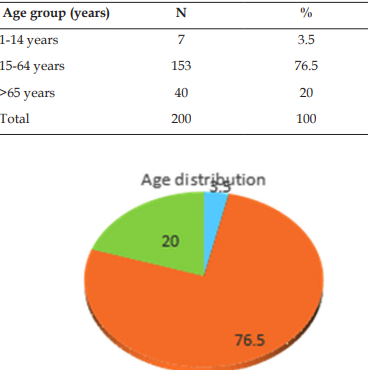
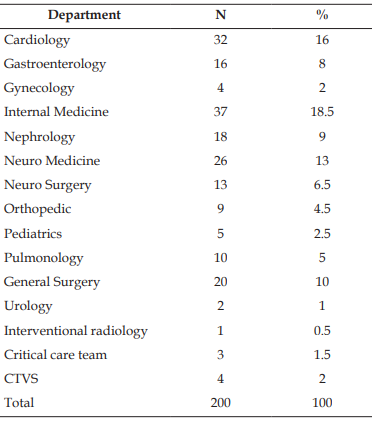
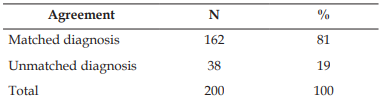
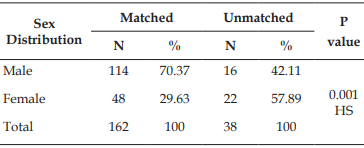
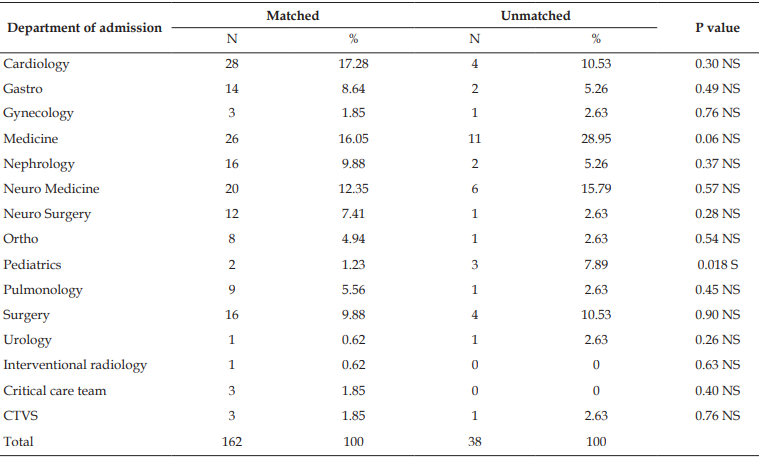
Results: Majority of the patients (n=153, 76.5%) were from the age group of patients between 15-64 followed by (n=40, 20%) in the age group with patients of >65 years age, followed by (n= 7, 3.5%) in the age group of 1-14 years. Most matched diagnosis were from department of internal medicine (18.5%) followed by department of cardiology (16%), followed by department of neuromedicine (13%). It was found that 81% (n=162) cases were accurately matched) diagnosed during Emergency department admission, while there was unmatched diagnosis of 19% cases (n=38).
Conclusion: Result obtained suggests that the provisional diagnosis was made by the emergency physicians were mostly matched with final discharge diagnosis that was made by the concerned specialist doctors. This shows that the choice of treatment done in the ER were a prompt and accurate treatment. This has a positive effect on the prognosis, mortality and outcome in patients. Department of internal medicine had more diagnostic errors. Improving history taking of patients with proper clinical evaluation correct diagnosis in the ER. Early availability in blood reports during emergency stay will help as a better diagnostic interpretation of disease. it is required to upgrade clinical skills of emergency physicians in diagnosing pediatric age group.
References
- 1. Sharma M, Brandler ES. Emergency medical services in India: the present and future. Prehosp Disaster Med. 2014;29(3):307–10. doi:10.1017/S1049023X14000296.
- 2. Rahman NH, Holliman CJ. Emergency medicine in Malaysia. Hong Kong J Emerg Med. 2005 Oct;12(4):246-51.
- 3. Platt H. Report of The Standing Medical Advisory Committee, Accident And Emergency Services. London: HMSO; 1962.
- 4. Kirsch TD. Emergency medicine around the world. Ann Emerg Med. 1998;32:237–8.
- 5. Widgren BR, Jourak M. Medical Emergency Triage and Treatment System (METTS): a new protocol in primary triage and secondary priority decision in emergency medicine. J Emerg Med. 2011;40(6):623–8. doi:10.1016/j.jemermed.2008.04.003.
- 6. Eames J, Eisenman A, Schuster RJ. Disagreement between emergency department admission diagnosis and hospital discharge diagnosis: mortality and morbidity. Diagnosis. 2016 Mar 1;3(1):23-30.
- 7. Chattopadhyay A, Ghosh R, Das T, Chakroborty A, Paul S, Lahiri SK. Gap analysis between provisional diagnosis on admission and final diagnosis during discharge – A comparative study. IOSR J Dent Med Sci. 2013;8:28-31.
- 8. Hussain F, Cooper A, Carson-Stevens A, Donaldson L, Hibbert P, Hughes T, et al. Diagnostic error in the emergency department: Learning from national patient safety incident report analysis. BMC Emerg Med. 2019;19:77.
- 9. Chatterjee S, Ray K, Das AK. Gap analysis between provisional diagnosis and final diagnosis in government and private teaching hospitals: A record-linked comparative study. J Family Med Prim Care. 2016;5:637-40.
- 10. McNutt R, Johnson T, Kane J, Ackerman M, Odwazny R, Bardhan J. Cost and quality implications of discrepancies between admitting and discharge diagnoses. Qual Manag Health Care. 2012;21:220-7.
- 11. Hockberger RS, Force CC. The model of the clinical practice of emergency medicine. Acad Emerg Med. 2001;8(6):660–81.
- 12. Hussain F, Cooper A, Carson-Stevens A, et al. Diagnostic error in the emergency department: learning from national patient safety incident report analysis. BMC Emerg Med. 2019 Dec 4;19(1):77. doi: 10.1186/s12873-019-0289-3. PMID: 31801474.
- 13. National Quality Forum. Improving Diagnostic Quality and Safety Final Report. 2017
- 14. Goh SH, Masayu MM, Teo PS, Tham AH, Low BY. Unplanned returns to the accident and emergency department – why do they come back? Ann Acad Med Singap. 1996;25(4):541–6.
- 15. Hussain F, Cooper A, Carson-Stevens A, et al. Diagnostic error in the emergency department: learning from national patient safety incident report analysis. BMC Emerg Med. 2019 Dec 4;19(1):77. doi: 10.1186/s12873-019-0289-3. PMID: 31801474.
- 16. Chiu HS, Chan KF, Chung CH, Ma K, Au KW. A comparison of emergency department admission diagnoses and discharge diagnoses: retrospective study. Hong Kong J Emerg Med. 2003;10(2):70–5.
- 17. Pope JH, Aufderheide TP, Ruthazer R, Woolard RH, Feldman JA, Beshansky JR, et al. Missed diagnoses of acute cardiac ischemia in the emergency department. N Engl J Med. 2000;342(16):1163–70.
- 18. Kothari RU, Brott T, Broderick JP, Hamilton CA. Physicians: accuracy in the diagnosis of stroke. Stroke. 1995;26(12):2238–41.
- 19. Patel P, Ashta KK, Subramani Y, Ghosh SK. A comparative study between emergency department provisional diagnoses and final discharge diagnoses in tertiary and quaternary health centers of India. Panacea J Med Sci. 2022;12(1):17–22.
Data Sharing Statement
There are no additional data available. All raw data and code are available upon request.
Funding
This research received no funding.
Author Contributions
All authors contributed significantly to the work and approve its publication.
Ethics Declaration
This article does not involve any human or animal subjects, and therefore does not require ethics approval.
Acknowledgements
Information not provided.
Conflicts of Interest
The authors report no conflicts of interest in this work.
About this article

Cite this article
Nandy A, Singh SK, Vaja U. Comparision Between Provisional Diagnosis made in Emergency Department vs Final Discharge Diagnosis at Ramkrishna Care Hospital, Raipur C.G. Indian J Emerg Med. 2023;9(4):159-69.
Licence:
Attribution-Non-commercial 4.0 International (CC BY-NC 4.0)This license enables reusers to distribute, remix, adapt, and build upon the material in any medium or format for noncommercial purposes only, and only so long as attribution is given to the creator.
| Received | Accepted | Published |
|---|---|---|
| May 22, 2023 | June 30, 2023 | May 09, 2023 |
DOI: 10.21088/ijem.2395.311X.9423.1
Keywords
Provisional DiagnosisEmergency DepartmentFinal DiagnosisEmergency RoomSearch for Similar Articles
Similar Articles
- Covid 19 Vaccine: Associated Henoch Schonlein Purpura in Young Adult Female
- A Rare Case of Intolerance to Medically Approved Dose of Sildenafil Citrate in a...
- Acute Mesenteric Ischemia: An Unusual Cause of Hematemesis in a 48 Year Old Man
- Brachial Artery Pseudoaneurysm Related Causally to Iatrogenic Coagulopathy in a...
- Combination Therapy for Acute Management of Yellow Oleander Poisoning: A Case Re...
Article Level Metrics
Last UpdatedSunday 06 September 2026, 22:55:57 (IST)
4083
Accesses
12
922
00
Citations
NA
NA
NA
Download citation
Article Keywords
Keyword Highlighting
Highlight selected keywords in the article text.
Timeline
| Received | May 22, 2023 |
| Accepted | June 30, 2023 |
| Published | May 09, 2023 |
licence
Attribution-Non-commercial 4.0 International (CC BY-NC 4.0)
This license enables reusers to distribute, remix, adapt, and build upon the material in any medium or format for noncommercial purposes only, and only so long as attribution is given to the creator.