Full Text (PDF)
Indian Journal of Dental Education 19(2):p 59-69, May - Aug 2026. | DOI: 10.21088/ijde.0974.6099.19226.2
Original Article
Comparative Susceptibility of Streptococcus Mutans and Lactobacilli to Antimicrobial Photodynamic Therapy Around Orthodontic Brackets: An in Vitro Study
Anil Kumar, Thomas Abraham, Simran Naik, Nikhith Kumar, Srinath Havaldar
Author Information
Licence:
Attribution-Non-commercial 4.0 International (CC BY-NC 4.0)This license enables reusers to distribute, remix, adapt, and build upon the material in any medium or format for noncommercial purposes only, and only so long as attribution is given to the creator.
Indian Journal of Dental Education 19(2):p 59-69, May - Aug 2026. | DOI: 10.21088/ijde.0974.6099.19226.2
How Cite This Article:
Thomas Abraham, Anil Kumar, Simran Naik et. al, Comparative Susceptibility of Streptococcus mutans and Lactobacilli to Antimicrobial Photodynamic Therapy Around Orthodontic Brackets: An In Vitro Study. Ind J Dent Educ. 2026 • 19(2): 59-69.Timeline
Received : July 30, 2026
Accepted : August 05, 2026
Published : August 30, 2026
Abstract
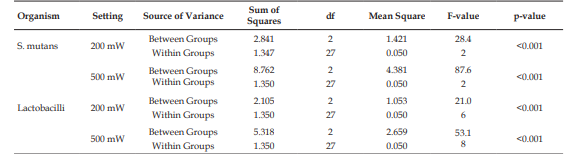
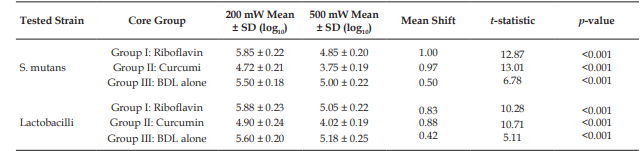
Background: Fixed orthodontic brackets introduce structural niches that promote the accumulation of cariogenic biofilms. While Streptococcus mutans initiates enamel demineralization, Lactobacilli drive the progression of cavitated lesions. Traditional antimicrobials present significant clinical limitations. Antimicrobial photodynamic therapy (aPDT) offers a compelling, resistance-free alternative, yet the relative, intrinsic susceptibility of these two key pathogens to natural photosensitizer-mediated aPDT around orthodontic hardware remains poorly characterized. Objective: To systematically evaluate and compare the intrinsic susceptibility of Streptococcus mutans and Lactobacilli biofilms formed around stainless steel orthodontic brackets to aPDT mediated by curcumin or riboflavin activated by a 445 nm blue diode laser (BDL) at varying power densities. Methods: One hundred twenty extracted human premolars bonded with stainless steel brackets were inoculated with either S. mutans (n=60) or Lactobacilli (n=60) to establish 72-hour mature single-species biofilms. Within each bacterial division, specimens were randomized into three core experimental blocks (each): Group I (100 µM Riboflavin), Group II (40 µM Curcumin), or Group III (Laser/Compound Controls). These were further subdivided (n=10) to undergo 30-second irradiation with a 445 nm BDL at either a low-power output (200 mW •) or high-power output (500 mW •). Surviving sessile colonies were liberated, serially diluted, cultured, and quantified as CFU/mL. Data were analyzed via Shapiro-Wilk testing, oneway ANOVA with Tukey’s post hoc test, and independent t-tests (α =0.05) Results: Baseline unexposed control loads were equivalent for S. mutans (5.98 ± 0.12log10 CFU/mL) and Lactobacilli (5.97 ± 0.13log10 CFU/mL). Under highefficacy configurations, S. mutans consistently exhibited significantly greater susceptibility to photodynamic eradication than Lactobacilli (p < 0.05). Curcumin aPDT at 500 mW generated the maximum bacterial reduction, yielding a 99.4% clearance (3.75 ± 0.19log10CFU/mL) for S. mutans compared to a 98.9% clearance (4.02 ± 0.22log10 CFU/mL) for Lactobacilli (p < 0.01 relative to baseline controls). boflavinaPDTachievedacceptableclinicalreductiononlyat500mW,resultingin a 92.6% reduction (4.85 ± 0.20log10 CFU/mL) in S. mutans versus an 88.0% reduction (5.05 ± 0.22log10 CFU/mL) in Lactobacilli (p < 0.31). Increasing the BDL output from 200 mW to 500 mW significantly amplified bactericidal kinetics across all protocols (p < 0.01), though the interspecies susceptibility gap was preserved throughout. Conclusions: Streptococcus mutans is intrinsically more susceptible to blue light-mediated photodynamic inactivation than Lactobacilli around orthodontic brackets. Lactobacilli exhibit higher tolerance, requiring elevated photodynamic energy thresholds to achieve comparable logs of reduction. Curcumin-mediated aPDT at 500 mW delivers superior bactericidal efficacy against both target pathogens compared to riboflavin, supporting organism-specific, targeted aPDT regimens in orthodontic patients.
References
- 1. Pordel, E., Ghasemi, T., Afrasiabi, S., Benedicenti, S., Signore, A., & Chiniforush, N. (2023). The Effect of Different Output Powers of Blue Diode Laser along with Curcumin and Riboflavin against Streptococcus mutans around Orthodontic Brackets: An In Vitro Study. Biomedicines, 11(8), 2248. https://doi. org/10.3390/biomedicines11082248
- 2. Wang, X., Wang, L., Fekrazad, R., Zhang, L., Jiang, X., He, G., & Wen, X. (2023). Polyphenolic natural products as photosensitizers for antimicrobial photodynamic therapy: recent advances and future prospects. Frontiers in Immunology, 14, 1275859.
- 3. Paschoal, M. A., Tonon, C. C., Spolidorio, D. M., Bagnato, V. S., Giusti, J. S., & Santos-Pinto, L. (2013). Photodynamic potential of curcumin and blue LED against Streptococcus mutans in a planktonic culture. Photodiagnosis and Photodynamic Therapy, 10(3), 313–319.
- 4. Kamran, M. A., Qasim, M., Udeabor, S. E., Hameed, M. S., Mannakandath, M. L., & Alshahrani, I. (2021). Impact of riboflavin mediated photodynamic disinfection around fixed orthodontic system infected with oral bacteria. Photodiagnosis and Photodynamic Therapy, 34, 102232.
- 5. Araújo, N. C., Fontana, C. R., Bagnato, V. S., & Gerbi, M. E. M. (2014). Photodynamic antimicrobial therapy of curcumin in biofilms and carious dentine. Lasers in Medical Science, 29(2), 629–635.
- 6. Maclean, M., MacGregor, S. J., Anderson, J. G., & Woolsey, G. (2009). Inactivation of bacterial pathogens following exposure to light from a 405-nanometer light-emitting diode array. Applied and Environmental Microbiology, 75(7), 1932–1937.
- 7. Picco, D. C. R., Cavalcante, L. L. R., Trevisan, R. L. B., Souza-Gabriel, A. E., Borsatto, M. C., & Corona, S. A. M. (2019). Effect of curcumin-mediated photodynamic therapy on Streptococcus mutans and Candida albicans: a systematic review of in69 IJDE, Volume 19 Number 2, May-August 2026 vitro studies. Photodiagnosis and Photodynamic Therapy, 27, 455–461.
- 8. Afrasiabi, S., Partoazar, A., Chiniforush, N., & Goudarzi, R. (2022). The Potential Application of Natural Photosensitizers Used in Antimicrobial Photodynamic Therapy against Oral Infections. Pharmaceuticals, 15(6), 767.
- 9. Paschoal, M. A., Lin, M., Santos-Pinto, L., & Duarte, S. (2015). Photodynamic antimicrobial chemotherapy on Streptococcus mutans using curcumin and toluidine blue activated by a novel LED device. Lasers in Medical Science, 30(2), 885–890.
- 10. Mohamad, S. A., Megson, I. L., & Kean, A. H. (2023). Blue light photoinhibition of Streptococcus mutans: potential chromophores and mechanisms. Lasers in Dental Science, 7(4), 195–205.
- 11. Takahashi, N., & Nyvad, B. (2011). The role of bacteria in the caries process: ecological perspectives. Journal of Dental Research, 90(3), 294–303.
- 12. Marsh, P. D. (2006). Dental plaque as a biofilm and a microbial community – implications for health and disease. Journal of Dentistry, 34(6), 429–436.
- 13. Bowen, W. H., & Koo, H. (2011). Biology of Streptococcus mutans-derived glucosyltransferases: role in extracellular matrix formation of cariogenic biofilms. Caries Research, 45(1), 69–86.
- 14. Warakomska, A., Kępa, M., Fiegler-Rudol, J., Latusek-Kotyczka, K., Skaba, D., & Wiench, R. (2025). In Vitro Antifungal Efficacy of BlueLight Photodynamic Therapy with Curcumin and Riboflavin Formulation Activated by 450 nm Diode Laser Against Candida albicans Biofilm on Titanium Implants. Pharmaceutics, 17(11), 1437.
- 15. Gomez, G. F., Huang, R., MacPherson, M., Ferreira Zandona, A. G., & Gregory, R. L. (2016). Photo inactivation of Streptococcus mutans biofilm by violet-blue light. Current Microbiology, 73(3), 426–433.
Data Sharing Statement
There are no additional data available. All raw data and code are available upon request.
Funding
This research received no funding.
Author Contributions
All authors contributed significantly to the work and approve its publication.
Ethics Declaration
This article does not involve any human or animal subjects and therefore does not require ethics approval.
Acknowledgements
We would like to express our gratitude to the patients, their families, and all those who have contributed to this study.
Conflicts of Interest
No conflicts of interest in this work.
About this article

Cite this article
Thomas Abraham, Anil Kumar, Simran Naik et. al, Comparative Susceptibility of Streptococcus mutans and Lactobacilli to Antimicrobial Photodynamic Therapy Around Orthodontic Brackets: An In Vitro Study. Ind J Dent Educ. 2026 • 19(2): 59-69.
Licence:
Attribution-Non-commercial 4.0 International (CC BY-NC 4.0)This license enables reusers to distribute, remix, adapt, and build upon the material in any medium or format for noncommercial purposes only, and only so long as attribution is given to the creator.
| Received | Accepted | Published |
|---|---|---|
| July 30, 2026 | August 05, 2026 | August 30, 2026 |
DOI: 10.21088/ijde.0974.6099.19226.2
Keywords
Orthodontic BracketsAntimicrobial Photodynamic TherapyCurcuminRiboflavin •Blue Diode LaserStreptococcus MutansLactobacilliBacterial SusceptibilitySearch for Similar Articles
Similar Articles
- One Step Apexification using PRF as Matrix and MTA Apical Barrier
- Infective Ulcers in the Oral Cavity: A Review
- Effect of COVID-19 Lockdown on Patients Undergoing Orthodontic Therapy in Distri...
- Wire Splinting: An Effective Management Approach for Lateral Luxation: A Clinica...
- Prosthodontics in Healthy Ageing and Longevity Medicine: A Critical Narrative R...
Article Level Metrics
Last UpdatedSaturday 17 October 2026, 09:22:25 (IST)
3426
Accesses
22
611
00
Citations
NA
NA
NA
Download citation
Article Keywords
Keyword Highlighting
Highlight selected keywords in the article text.
Timeline
| Received | July 30, 2026 |
| Accepted | August 05, 2026 |
| Published | August 30, 2026 |
licence
Attribution-Non-commercial 4.0 International (CC BY-NC 4.0)
This license enables reusers to distribute, remix, adapt, and build upon the material in any medium or format for noncommercial purposes only, and only so long as attribution is given to the creator.