Full Text (PDF)
Journal of Clinical Forensic Sciences 03(01):p 34-39, Jan–June 2025. | DOI: 10.21088/jcfs.3107.6874.3125.6
Original Article
Comparative Studies on Physical Properties of the Soil, Artificial and Natural Sand in Forensic Application
Mahantappa Limbitot, Chandarashekhara null, Venkatesh G.N
Author Information
Licence:
Attribution-Non-commercial 4.0 International (CC BY-NC 4.0)This license enables reusers to distribute, remix, adapt, and build upon the material in any medium or format for noncommercial purposes only, and only so long as attribution is given to the creator.
Journal of Clinical Forensic Sciences 03(01):p 34-39, Jan–June 2025. | DOI: 10.21088/jcfs.3107.6874.3125.6
How Cite This Article:
Chandarashekhara, Venkatesh G.N., Mahantappa Limbitot. Comparative Studies on Physical Properties of the Soil, Artificial and Natural Sand in Forensic Application. Int Jr of Forensic Sci. 2025; 8(1): 34–39.Timeline
Received : November 11, 2024
Accepted : December 05, 2024
Published : June 30, 2025
Abstract
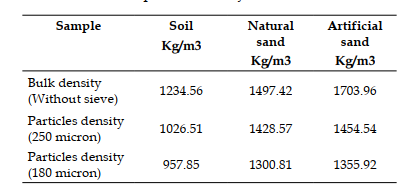
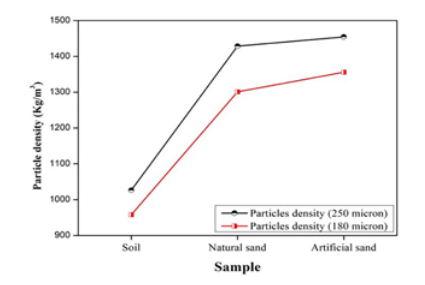
Background: Sand plays a very important role in the construction of industry and many buildings, which require massive amounts of natural sand for their projects. Sand is the compound material having components of both organic and inorganic with different proportions. In most of the states of India, the natural sand mining was prohibited due to the dredging of rivers beyond a safe capacity. Due to the shortage of natural sand, most of the industries are utilising artificial sand for the construction purpose. Many of the mining companies transport natural sand for completion of their project illegally, which is prohibited for transportation and construction. This study was taken up to identify whether the transport vehicle is carrying soil, artificial sand, or natural sand. Aim: The forensic comparison of the soil, natural sand, and artificial sand plays a very important role in confirming whether the transporting sandy soil was natural or artificial. Objectives: The physical properties play a very important role in the identification and comparison of the soil, natural and artificial sand in forensic applications. Materials: The present article reports the physical properties such as bulk density, particle density, specific gravity, porosity, and particle size distribution of soil, artificial sand, and natural sand. Particle size distribution of the sample was performed using 355 micron, 250 micron, and 180 micron sieve mesh, respectively. Results: The specific gravity, bulk and particle densities of the artificial sand were found to be high compared to soil and natural sand. The percentage of porosity of the natural sand was found to be high compared to soil and artificial sand.
References
- 1. Lorna A. Dawson, and Stephen Hillier, Measurement of soil characteristics for forensic applications. Surface and Interface Analysis, 2010, 42(1), 363-377.
- 2. Rob W. Fitzpatrick, Soil: Forensic Analysis. In Wiley Encyclopedia of Forensic Science, 2013, 1-12, DOI: 10.1002/9780470061589.fsa096.pub2.
- 3. Chisum, W. and Turvey, B, Evidence dynamics: Locard’s exchange principle and crime reconstruction, Journal of Behavioral Profiling, 2000, 1(1), 1–15.
- 4. Ruffell, A., and McKinley, J., Forensic Geoscience: applications of geology, geomorphology and geophysics to criminal investigations, Earth-Science Reviews, 2005, 69(3-4), 235-247, DOI:https://doi. org/10.1016/ j.earscirev.2004.08.002.
- 5. Toky Siddiquee, what is sand Composition, Color and Types of Sand, Available from: https://civiltoday.com/civilengineeringmaterials/sand/233-sand-composition-types, 2020.
- 6. Quiroga P.N. and Fowler D.W., The effects of aggregate characteristics on the performance of portland cement concrete. International Center for Aggregates Research, University of Texas at Austin, 2004, 1-358.
- 7. J.P. Goncalves, L.M. Tavares, R.D. Toledo, E.M.R. Fairbairn and E.R. Cunha, Comparison of natural and manufactured fine aggregates in cement. Cement and Concrete Research, 2007, 1(37), 924-932.
- 8. Yang Zhenguo, Shen Weiguo and Shen Weiguo et al. Characteristics of limestone manufacture sand, International Conference on Material Science and Environmental Engineering, 2013, 1-5, DOI: https://www.researchgate.net/ publication/277327895
- 9. Weiguo Shen, Zhenguo Yang, Lianghong Cao, Liu Cao, Yi Liu, Hui Yang, Zili Lu and Jian Bai, Characterization of manufactured sand: Particle shape, surface texture and behavior in concrete. Construction and Building Materials, 2016, 114(1), 595–601.
- 10. C. Srividya, Shruti K.N., Venkatesh G.N., Mahantappa Limbitot and Prakash, “Analogous studies on composition, morphology and density of natural and artificial soil in forensic application”, Research Journal of Forensic Sciences , 2020, 8(2), 20-24.
- 11. IS: 2386 (Part-III)-1963, Indian Standard Methods of Test for Aggregates for Concrete, Part III specific gravity, density, voids, absorption and bulking, March 1997. Bureau of Indian Standards, New Delhi.
- 12. IS: 2720 (Part III/Sec 1)–1980, Indian Standard Methods of Test for Soils, Section 1 Fine grains soils, April 1989, Bureau of Indian Standards, New Delhi.
- 13. IS: 2386 (Part-III)-1963, Indian Standard Methods of Test for Aggregates for Concrete, Part III specific gravity, density, voids, absorption and bulking, March 1997. Bureau of Indian Standards, New Delhi.
Data Sharing Statement
There are no additional data available. All raw data and code are available upon request.
Funding
This research received no funding.
Author Contributions
All authors contributed significantly to the work and approve its publication.
Ethics Declaration
This article does not involve any human or animal subjects and therefore does not require ethics approval.
Acknowledgements
We would like to express our gratitude to the patients, their families, and all those who have contributed to this study.
Conflicts of Interest
No conflicts of interest in this work
About this article

Cite this article
Chandarashekhara, Venkatesh G.N., Mahantappa Limbitot. Comparative Studies on Physical Properties of the Soil, Artificial and Natural Sand in Forensic Application. Int Jr of Forensic Sci. 2025; 8(1): 34–39.
Licence:
Attribution-Non-commercial 4.0 International (CC BY-NC 4.0)This license enables reusers to distribute, remix, adapt, and build upon the material in any medium or format for noncommercial purposes only, and only so long as attribution is given to the creator.
| Received | Accepted | Published |
|---|---|---|
| November 11, 2024 | December 05, 2024 | June 30, 2025 |
DOI: 10.21088/jcfs.3107.6874.3125.6
Keywords
SandSoilDensitySpecific gravity •PorositySearch for Similar Articles
Similar Articles
- Bullet Shaped Artificial Penile Implant in an Alleged Case of DeathDue to Firear...
- A Systematic Review on Repercussions of the SARS COV-2 on Neural System
- Forensic Techniques for Android Devices Using Logical Extraction and Temporary R...
- Need of Artificial Intelligence for Identification of Unknown Dead Bodies: An In...
- Advancements in Glycomics: Enhancing Forensic Serology for Improved Blood Typing...
Article Level Metrics
Last UpdatedSaturday 17 October 2026, 07:34:52 (IST)
2920
Accesses
16
355
00
Citations
NA
NA
NA
Download citation
Article Keywords
Keyword Highlighting
Highlight selected keywords in the article text.
Timeline
| Received | November 11, 2024 |
| Accepted | December 05, 2024 |
| Published | June 30, 2025 |
licence
Attribution-Non-commercial 4.0 International (CC BY-NC 4.0)
This license enables reusers to distribute, remix, adapt, and build upon the material in any medium or format for noncommercial purposes only, and only so long as attribution is given to the creator.