Full Text (PDF)
Journal of Forensic Chemistry and Toxicology 10(1):p 21-25, January – June 2024. | DOI: http://dx.doi.org/10.21088/jfct.2454.9363.10124.3
Original Article
Comparative Analysis of DNA Extraction Techniques and their Analysis from Blood Stained Clothes
Rajesh Kumar, Vaishali Vardiya, Anita Yadav, Tanushree Dheer
Author Information
Licence:
Attribution-Non-commercial 4.0 International (CC BY-NC 4.0)This license enables reusers to distribute, remix, adapt, and build upon the material in any medium or format for noncommercial purposes only, and only so long as attribution is given to the creator.
Journal of Forensic Chemistry and Toxicology 10(1):p 21-25, January – June 2024. | DOI: http://dx.doi.org/10.21088/jfct.2454.9363.10124.3
How Cite This Article:
Vardiya V, Yadav A, Dheer T, Kumar R. Comparative analysis of DNA extraction techniques and their analysis from blood stained clothes. J Forensic Chem Toxicol. 2024;10(1):21–25.Timeline
Received : March 04, 2024
Accepted : June 17, 2024
Published : June 29, 2024
Abstract
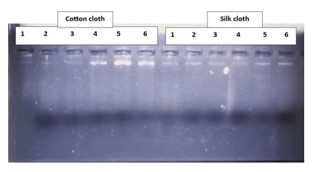
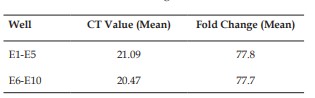
The advancement of forensic DNA analysis has revolutionized criminal investigations, providing crucial evidence for identifying suspects and establishing their involvement in various crimes. The extraction of DNA from blood stains is a fundamental step in forensic investigations, enabling the profiling of individuals for identification and genetic analysis. The objective of this research is to evaluate and compare the DNA extraction methods on different fabric types, which is cotton, and silk. Blood stains were spotted in both the cloths and incubated for a certain period of time. After which, DNA extraction was done using phenol chloroform method. The quality and quantity of the extracted DNA are assessed using established techniques such as Gel electrophoresis and qPCR amplification. The results of the experiments indicate variations in the efficiency of DNA extraction methods depending on the fabric type. Ideally both the fabrics have shown similar pattern of DNA recovery but Cotton fabrics demonstrate higher DNA recovery rates, of DNA recovery but Cotton fabrics demonstrate higher DNA recovery rates, compared to silk fabric but this is non-significant. In conclusion, provides valuable insights into the challenges and opportunities associated with DNA extraction from blood stains on different fabrics for forensic investigation profiling. The research findings contribute to the advancement of forensic DNA analysis and offer practical guidance for forensic scientists to optimize their methods when handling blood-stained fabric evidence. Further research and development in this field will undoubtedly strengthen the forensic community’s ability to solve crimes and administer justice with greater accuracy and reliability.
References
- 1. Anzai EK, Ozaki A, Nunes FD, Hirata M, Oliveira RN. Extração de DNA de saliva humanadepositadasobre a pele e suaaplicabilidadeaosprocessos de identificação individual. Odontol Soc. 2001;3(1/2):5-7.
- 2. Anzai EK, Hirata MH, Hirata RDC, Nunes FD, Melani RFA, Oliveira RN. DNA extraction from human saliva deposited on skin and its use in forensic identification procedures. Braz Oral Res. 2005;19(3):216- 22.
- 3. Wickenheiser RA (2002) Trace DNA: a review, discussion of theory, and application of the transfer of trace quantities of DNA through skin contact. J Fig. 3. Melting curve of qPCR Forensic Sci 47:442–450.
- 4. Goray M, van Oorschot RA (2015) The complexities of DNA transfer during a social setting. Leg Med (Tokyo) 17:82–91.
- 5. Phipps M, Petricevic S (2007) The tendency of individuals to transfer DNA to handled items. Forensic SciInt 168:162–168.
- 6. Van Oorschot RA, McArdle R, Goodwin WH, Ballantyne KN (2014) DNA transfer: The role of temperature and drying time. Leg Med (Tokyo) 16:161–163.
- 7. Kamphausen T, Fandel SB, Gutmann JS, Bajanowski T, Poetsch M (2015) Everything clean? Transfer of DNA traces between textiles in the washtub. Int J Legal Med 129:709–714.
- 8. van den Berge M, Ozcanhan G, Zijlstra S, Lindenbergh A, Sijen T (2016) Prevalence of human cell material: DAN and RNA profiling of public and private objects and after activity scenarios. Forensic SciInt Genet 21:81–89.
- 9. van Oorschot RA, Glavich G, Mitchell RJ (2014) Persistence of DNA deposited by the original user on objects after subsequent use by a second person. Forensic SciInt Genet 8:219–225.
- 10. Voskoboinik L, Amiel M, Reshef A, Gafny R, Barash M (2017) Laundry in a washing machine as a mediator of secondary and tertiary DNA transfer. Int J Legal Med. https://doi.org/10.1007/ s00414 017-1617-3.
- 11. Ensenberger, M. G., Hill, C. R., McLaren, R. S., Sprecher, C. J., &Storts, D. R. (2014). Developmental validation of the PowerPlex® 21 system. Forensic Science International: Genetics, 9, 169–178. https://doi.org/10.1016/J.FSIGEN.2013.12.005.
- 12. Park, S. J., Kim, J. Y., Yang, Y. G., & Lee, S. H. (2008). Direct STR amplification from whole blood and blood- or saliva-spotted FTA without DNA purification. Journal of Forensic Sciences, 53(2), 335–341. https://doi.org/10.1111/j.1556 4029.2008.00666.x.
- 13. Waye, J. S., and Willard, H. F. (1986). Structure, organization, and sequence of alpha satellite DNA from human chromosome 17: evidence for evolution by unequal crossing-over and an ancestral pentamer repeat shared with the human X chromosome. Mol. Cell Biol. 6, 3156–3165.
- 14. Waye, J. S., Presley, L. A., Budowle, B., Shutler, G. G., and Fourney, R. M. (1989). A simple and sensitive method for quantifying human genomic DNA in forensic specimen extracts. BioTechniques 7, 852–855.
- 15. Walsh, P. S., Varlaro, J., and Reynolds, R. (1992). A rapid chemiluminescent method for quantitation of human DNA. Nucleic Acids Res. 20, 5061–5065.
- 16. Heid, C. A., Stevens, J., Livak, K. J., and Williams, P. M. (1996). Real time quantitative PCR. Genome Res. 6, 986–994
- 17. Holland, P. M., Abramson, R. D., Watson, R., and Gelfand, D. H. (1991). Detection of specific polymerase chain reaction product by utilizing the 5’–3’ exonuclease activity of Thermusaquaticus DNA polymerase. Proc. Natl. Acad. Sci. USA. 88, 7276–7280.
- 18. Livak, K. J., Flood, S. J., Marmaro, J., Giusti, W., and Deetz, K. (1995). Oligonucleotides with fluorescent dyes at opposite ends provide a quenched probe system useful for detecting PCR product and nucleic acid hybridization. PCR Methods Appl. 4, 357–362.
- 19. Lyamichev, V., Brow, M. A., and Dahlberg, J.E. (1993). Structure-specific endonucleolytic cleavage of nucleic acids by eubacterial DNA polymerases. Science 260, 778–783.
- 20. J.A. Glasel, Validity of nucleic acid purities monitored by 260 nm/280 nm absorbanceratios, Biotechniques 18 (1995) 62–63
Data Sharing Statement
There are no additional data available.
Funding
This research received no funding.
Author Contributions
All authors contributed significantly to the work and approve its publication.
Ethics Declaration
This article does not involve any human or animal subjects, and therefore does not require ethics approval
Acknowledgements
Information Not Provided
Conflicts of Interest
No conflicts of interest in this work.
About this article

Cite this article
Vardiya V, Yadav A, Dheer T, Kumar R. Comparative analysis of DNA extraction techniques and their analysis from blood stained clothes. J Forensic Chem Toxicol. 2024;10(1):21–25.
Licence:
Attribution-Non-commercial 4.0 International (CC BY-NC 4.0)This license enables reusers to distribute, remix, adapt, and build upon the material in any medium or format for noncommercial purposes only, and only so long as attribution is given to the creator.
| Received | Accepted | Published |
|---|---|---|
| March 04, 2024 | June 17, 2024 | June 29, 2024 |
DOI: http://dx.doi.org/10.21088/jfct.2454.9363.10124.3
Keywords
DNA ExtractionHuman DNAForensic DNA.Search for Similar Articles
Similar Articles
- Lethal Poisoning Cases: The Poisoning Cases of India: A Review Study
- Deciphering the Secrets of Magic Pen Inks: A Review
- From Effluents to Exposure: Wastewater-Based Epidemiology in Occupational and En...
- Sub Standard and Falsified Drugs Toxicity: An Alarming Concern of Today
- Detection and Identification of Kerosene in Turpentine Oil: A Review
Article Level Metrics
Last UpdatedTuesday 21 July 2026, 23:41:19 (IST)
890
Accesses
6
94
00
Citations
NA
NA
NA
Download citation
Article Keywords
Keyword Highlighting
Highlight selected keywords in the article text.
Timeline
| Received | March 04, 2024 |
| Accepted | June 17, 2024 |
| Published | June 29, 2024 |
licence
Attribution-Non-commercial 4.0 International (CC BY-NC 4.0)
This license enables reusers to distribute, remix, adapt, and build upon the material in any medium or format for noncommercial purposes only, and only so long as attribution is given to the creator.