Full Text (PDF)
RFP Indian Journal of Medical Psychiatry 9(2):p 74-78, July - Dec. 2026. | DOI: 10.21088/ijmp.2582.1415.9226.5
Review Article
Clozapine for Persistent Manic Agitation Following Haloperidol-Associated Neuroleptic Malignant Syndrome: A Case Report
Suprakash Chaudhury, Dhrithi Mushthi
Author Information
Licence:
Attribution-Non-commercial 4.0 International (CC BY-NC 4.0)This license enables reusers to distribute, remix, adapt, and build upon the material in any medium or format for noncommercial purposes only, and only so long as attribution is given to the creator.
RFP Indian Journal of Medical Psychiatry 9(2):p 74-78, July - Dec. 2026. | DOI: 10.21088/ijmp.2582.1415.9226.5
How Cite This Article:
Dhrithi Mushthi, Suprakash Chaudhury. Clozapine for Persistent Manic Agitation Following HaloperidolAssociated Neuroleptic Malignant Syndrome: A Case Report. RFP Ind Jr of Med Psy. 2025; 9(2): 74-78.Timeline
Received : September 25, 2026
Accepted : October 30, 2026
Published : December 30, 2026
Abstract
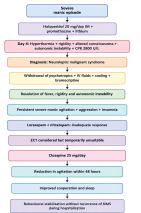
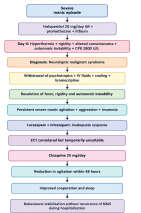
A 35-year-old man with bipolar affective disorder presented during a manic episode and was treated with intramuscular haloperidol 20 mg/day and promethazine 100 mg/day in divided doses, along with lithium 800 mg/day. On the fourth day of treatment, he developed high-grade fever, generalized rigidity, tremors, mutism, echolalia, altered consciousness, and marked autonomic instability, including tachycardia and labile blood pressure. Serum creatine phosphokinase was 2800 U/L, with leukocytosis and elevated CK-MB; troponin I was normal. A diagnosis of Neuroleptic malignant syndrome (NMS) was made, and all psychotropic medications were discontinued. He was treated with intravenous fluids, external cooling, and bromocriptine 15 mg/day. The fever, rigidity, and autonomic abnormalities improved over approximately 72 hours. However, after resolution of the acute NMS manifestations, severe agitation, aggression, and insomnia persisted. Lorazepam and nitrazepam provided inadequate behavioural control, while electroconvulsive therapy was considered unsuitable because of ongoing autonomic instability. Clozapine was initiated at 25 mg/day with close clinical and laboratory monitoring. Within 48 hours, marked reduction in agitation was observed, followed by improved cooperation and sleep. By the fifth day, behavioural stabilization was evident, without recurrence of fever, rigidity, autonomic instability, or clinically significant CPK elevation. This case illustrates the therapeutic challenge of persistent manic agitation following NMS. Clozapine may be considered in carefully selected patients when conventional antipsychotic treatment is considered unsuitable and other interventions are ineffective or temporarily contraindicated. However, clozapine itself can cause NMS Its use following NMS should therefore involve complete clinical resolution of the acute syndrome, conservative dosing, and close monitoring.
References
- 1. Berman B. D. Neuroleptic malignant syndrome: a review for neurohospitalists. The Neurohospitalist, 2011; 1(1): 41–47. https:// doi.org/10.1177/1941875210386491
- 2. Simon LV, Hashmi MF, Callahan AL. Neuroleptic Malignant Syndrome. 2023 Apr 24. In: StatPearls [Internet]. Treasure Island (FL): StatPearls Publishing; 2025.
- 3. Eelco F.M. Wijdicks, Ropper AH. Neuroleptic Malignant Syndrome. New England Journal of Medicine. 2024 Sep 25;391(12):1130–8.
- 4. Levenson JL. Neuroleptic malignant syndrome. Am J Psychiatry. 1985;142(10):1137–1145.
- 5. Belvederi Murri M, Guaglianone A, Bugliani M, Calcagno P, Respino M, Serafini G, Innamorati M, Pompili M, Amore M. Second-generation antipsychotics and neuroleptic malignant syndrome: systematic review and case report analysis. Drugs R D. 2015 Mar;15(1):45-62. doi: 10.1007/s40268-014-0078-0.
- 6. Lally J, McCaffrey C, O Murchu C, Krivoy A, Guerandel A, MacCabe JH, Gaughran F. Clozapine Rechallenge Following Neuroleptic Malignant Syndrome: A Systematic Review. J Clin Psychopharmacol. 2019 Jul/Aug;39(4):372 - 379. doi: 10.1097/JCP.0000000000001048. PMID: 31205196.
- 7. Li XB, Tang YL, Wang CY, de Leon J. Clozapine for treatment-resistant bipolar disorder:a systematic review. Bipolar Disord. 2015 May;17(3):235-47. doi: 10.1111/bdi.12272.
Data Sharing Statement
There are no additional data available. All raw data and code are available upon request."
Funding
"This research received no funding."
Author Contributions
All authors contributed significantly to the work and approve its publication.
Ethics Declaration
This article does not involve any human or animal subjects, and therefore does not require ethics approval."
Acknowledgements
We would like to express our gratitude to the patients, their families, and all those who have contributed to this study.
About this article

Cite this article
Dhrithi Mushthi, Suprakash Chaudhury. Clozapine for Persistent Manic Agitation Following HaloperidolAssociated Neuroleptic Malignant Syndrome: A Case Report. RFP Ind Jr of Med Psy. 2025; 9(2): 74-78.
Licence:
Attribution-Non-commercial 4.0 International (CC BY-NC 4.0)This license enables reusers to distribute, remix, adapt, and build upon the material in any medium or format for noncommercial purposes only, and only so long as attribution is given to the creator.
| Received | Accepted | Published |
|---|---|---|
| September 25, 2026 | October 30, 2026 | December 30, 2026 |
DOI: 10.21088/ijmp.2582.1415.9226.5
Keywords
Neuroleptic malignant syndrome • CNeuroleptic malignant syndromeClozapine • mania •Bipolar disorderAntipsychotic rechallengeAgitationAggressionTreatment-resistant maniaSearch for Similar Articles
Similar Articles
- Early-Onset Major Neurocognitive Disorder Presenting as SchizophreniaLike Psycho...
- Traditional Synchronicity – Syndrome is not Illness
- Nurse-Led Interventions for Depression Management: A Review
- Mental Health and Well-Being in India
- Pathological Laughter as a Manifestation of Left Frontal and Right Pons Stroke
Article Level Metrics
Last UpdatedFriday 13 November 2026, 04:42:25 (IST)
1572
Accesses
6
262
00
Citations
NA
NA
NA
Download citation
Article Keywords
Keyword Highlighting
Highlight selected keywords in the article text.
Timeline
| Received | September 25, 2026 |
| Accepted | October 30, 2026 |
| Published | December 30, 2026 |
licence
Attribution-Non-commercial 4.0 International (CC BY-NC 4.0)
This license enables reusers to distribute, remix, adapt, and build upon the material in any medium or format for noncommercial purposes only, and only so long as attribution is given to the creator.