Full Text (PDF)
Indian Journal of Trauma and Emergency Pediatrics 15(1):p 9-17, January – March 2023. | DOI: https://doi.org/10.21088/ijtep.2348.9987.15123.1
Original Article
Clinico-Bacteriological study of Nosocomial Infections in the Paediatric Intensive Care Unit (PICU)
Patil Vinod V, Sonawane Shivhar V., Aher Pranjali V., Joshi Sanjay S
Author Information
Licence:
Attribution-Non-commercial 4.0 International (CC BY-NC 4.0)This license enables reusers to distribute, remix, adapt, and build upon the material in any medium or format for noncommercial purposes only, and only so long as attribution is given to the creator.
Indian Journal of Trauma and Emergency Pediatrics 15(1):p 9-17, January – March 2023. | DOI: https://doi.org/10.21088/ijtep.2348.9987.15123.1
How Cite This Article:
Sonawane Shivhar V., Patil Vinod V, Aher Pranjali V., et al./Clinico-Bacteriological study of Nosocomial Infections in the Paediatric Intensive Care Unit (PICU)/Indian J Trauma Emerg Pediatr.2023;15(1):9–17.Timeline
Received : December 08, 2022
Accepted : January 10, 2023
Published : March 30, 2023
Abstract
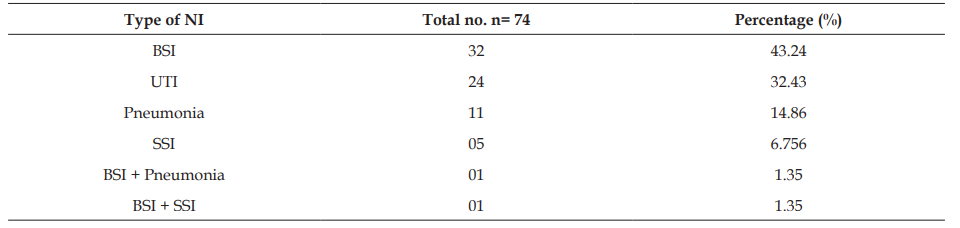
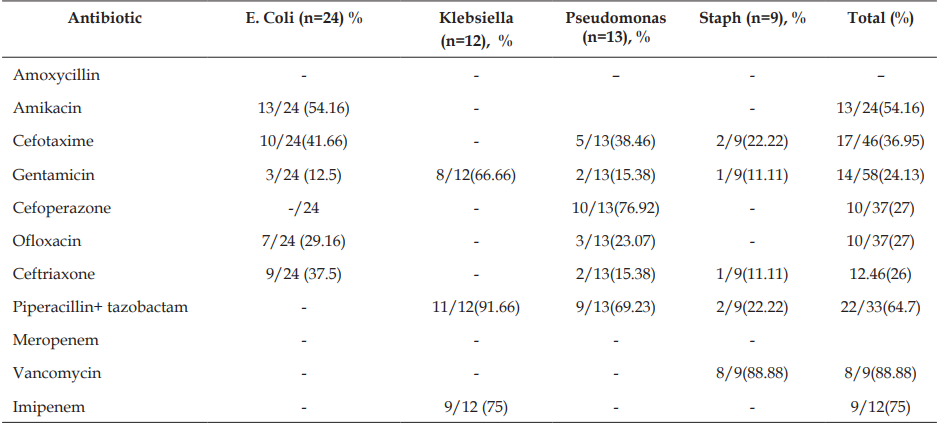
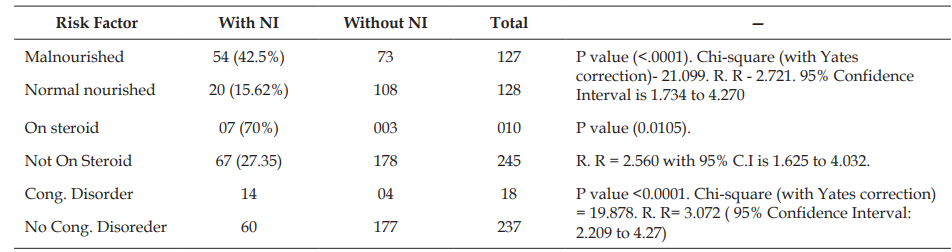
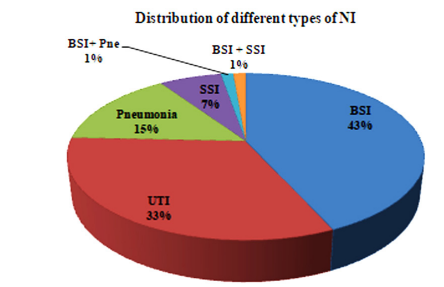
Background: In this study, we wanted to study the incidence, risk factors and clinical and bacteriological pattern of nosocomial infections in PICU.Methods: This study was conducted in the PICU of 900 bedded Tertiary hospital. 74 suspected cases of nosocomial infections were studied prospectively, identified as per the guidelines laid down by CDC. Results: The incidence of nosocomial infections was 29% (N=255). Bloodstream infections were the most commonly observed in the present study (43.24%, 32/74) followed by Urinary Tract Infection (UTI) (32.43%, 24/74), Nosocomial pneumonia (16.21%, 12/74), and SSI (8.1%, 6/74). There were two patients with more than one nosocomial infections. The average duration of stay in children with NI the overall length of stay was 589 days with an average of 7.95 days compared to 4.63 days in children without NI. Conclusions: The risk of nosocomial infection was directly related to the duration of stay in the PICU and the duration of placement of indwelling catheters /tubes. Age and sex were the important independent risk factors for causing nosocomial infections as the incidence was more in the 2 months age group. BSI occurred more commonly in males while UTI in females. Other risk factors like malnutrition, immuno-compromised status and underlying illness were also associated with nosocomial infections. The most common organism was E. coli (sensitive to amikacin) followed by klebsiella and maximum sensitivity to piperacillin-tazobactam. Length of stay in PICU more in children with NI. There was no significance in mortality between both groups. Abbreviations: NI- Nosocomial infections. PICU- Pediatric intensive care unit. UTI- Urinary tract infections.
References
- 1. Garner JS, Jarvis WR, Emori TG, Horan TC, Hughes JM. CDC definitions for nosocomial infections, 1988. Am J Infect Control. 1988;16(3):128–40.
- 2. Horan TC, Gaynes RP. Surveillance of nosocomial infections. In: Mayhall CG, editor. Hospital epidemiology and infection control. 3rd ed. Philadelphia: Lippincott Williams & Wilkins; 2004. p. 1659–702.
- 3. Richards MJ, Edwards JR, Culver DH, Gaynes RP. Nosocomial infections in pediatric intensive care units in the United States. National Nosocomial Infections Surveillance System. Pediatrics. 1999;103(4 Pt 1):e39.
- 4. El-Nawawy AA, Abd El-Fattah MM, Metwally HA, Barakat SS, Hassan IA. One year study of bacterial and fungal nosocomial infections among patients in pediatric intensive care unit (PICU) in Alexandria. J Trop Pediatr. 2006;52(3):185–91.
- 5. Deep A, Ghildiyal R, Kandian S, Shinkre N. Clinical and microbiological profile of nosocomial infections in the pediatric intensive care unit (PICU). Indian Pediatr. 2004;41(12):1238–46.
- 6. Mehta A, Rosenthal VD, Mehta Y, Chakravarthy M, Todi SK, Sen N, et al. Device-associated nosocomial infection rates in intensive care units of seven Indian cities. Findings of the International Nosocomial Infection Control Consortium (INICC). J Hosp Infect. 2007;67(2):168–74.
- 7. Lodha R, Natchu UC, Nanda M, Kabra SK. Nosocomial infections in the pediatric intensive care unit. Indian J Pediatr. 2001;68(11):1063–70.
- 8. Delgado-Rodriguez M, Bueno-Cavanillas A, Lopez-Gigosos R, de Dios-Luna J, Guillen-Solvas J, Rodriguez-Contreras R. Hospital stay length as an effect modifier of other risk factors for nosocomial infection. Eur J Epidemiol. 1990;6(1):34–9.
- 9. Freeman J, McGowan JE Jr. Risk factors for nosocomial infection. J Infect Dis. 1978;138(6):811–9.
- 10. Ganguly P, Yunus M, Khan A, Ganguly S. A study of nosocomial infection in relation to different host factors in an Indian teaching hospital. J R Soc Health. 1995;115(4):244–6.
- 11. Isaack M, Mbise RL, Hirji KF. Nosocomial bacterial infections among children with severe protein energy malnutrition. East Afr Med J. 1992;69(8):433–6.
- 12. Donowitz LG. High risk of nosocomial infection in the pediatric critical care patient. Crit Care Med. 1986;14(1):26–8.
- 13. Bergmans DC, Bonten MJ. Nosocomial pneumonia. In: Mayhall CG, editor. Hospital epidemiology and infection control. 3rd ed. Philadelphia: Lippincott Williams & Wilkins; 2004. p. 317–38.
- 14. Darbyshire PJ, Weightman NC, Speller DC. Problems associated with indwelling central venous catheters. Arch Dis Child. 1985;60(2):129–34.
- 15. Narendran V, Gupta G, Todd DA. Bacterial colonization of indwelling vascular catheters in newborn infants. J Paediatr Child Health. 1996;32(5):391–6.
- 16. Tacconelli E, Tumbarello M, Cauda R. Central venous catheters and blood stream infection. JAMA. 2000;283(4):470–1.
- 17. Lakshmi KS, Jayashree M, Singhi S, Ray P. Study of nosocomial primary bloodstream infections in a pediatric intensive care unit. J Trop Pediatr. 2007;53(2):87–92.
- 18. Lohr JA, Downs SM, Dudley S, Donowitz LG. Hospital-acquired urinary tract infections in the pediatric patient: a prospective study. Pediatr Infect Dis J. 1994;13(1):8–12.
- 19. Tullu MS, Deshmukh CT, Baveja SM. Urinary catheter related nosocomial infections in paediatric intensive care unit. J Postgrad Med. 1998;44(2):35–9.
- 20. Schaeffer AJ, Chmiel J. Urethral meatal colonization in the pathogenesis of catheter-associated bacteriuria. J Urol. 1983;130(6):1096–9.
- 21. Patra PK, Jayashree M, Singhi S, Ray P, Saxena AK. Nosocomial pneumonia in a pediatric intensive care unit. Indian Pediatr. 2007;44(7):511–8.
- 22. Singh-Naz N, Sprague BM, Patel KM, Pollack MM. Risk factors for nosocomial infection in critically ill children: a prospective cohort study. Crit Care Med. 1996;24(5):875–80.
- 23. Tullu MS, Deshmukh CT, Baveja SM. Bacterial profile and antimicrobial susceptibility pattern in catheter related nosocomial infections. J Postgrad Med. 1998;44(1):7–13
Data Sharing Statement
There are no additional data available. All raw data and code are available upon request.
Funding
This research received no funding.
Author Contributions
All authors contributed significantly to the work and approve its publication.
Ethics Declaration
This article does not involve any human or animal subjects, and therefore does not require ethics approval.
Acknowledgements
We would like to express our gratitude to the patients, their families, and all those who have contributed to this study.
Conflicts of Interest
No conflicts of interest in this work.
About this article

Cite this article
Sonawane Shivhar V., Patil Vinod V, Aher Pranjali V., et al./Clinico-Bacteriological study of Nosocomial Infections in the Paediatric Intensive Care Unit (PICU)/Indian J Trauma Emerg Pediatr.2023;15(1):9–17.
Licence:
Attribution-Non-commercial 4.0 International (CC BY-NC 4.0)This license enables reusers to distribute, remix, adapt, and build upon the material in any medium or format for noncommercial purposes only, and only so long as attribution is given to the creator.
| Received | Accepted | Published |
|---|---|---|
| December 08, 2022 | January 10, 2023 | March 30, 2023 |
DOI: https://doi.org/10.21088/ijtep.2348.9987.15123.1
Keywords
Nosocomial infectionsPICUArticle Level Metrics
Last UpdatedSunday 25 October 2026, 08:03:30 (IST)
1811
Accesses
18
249
00
Citations
NA
NA
NA
Download citation
Article Keywords
Keyword Highlighting
Highlight selected keywords in the article text.
Timeline
| Received | December 08, 2022 |
| Accepted | January 10, 2023 |
| Published | March 30, 2023 |
licence
Attribution-Non-commercial 4.0 International (CC BY-NC 4.0)
This license enables reusers to distribute, remix, adapt, and build upon the material in any medium or format for noncommercial purposes only, and only so long as attribution is given to the creator.