Full Text (PDF)
Journal of Cardiovascular Medicine and Surgery 12(2):p 47-54, May-August 2026. | DOI: https://doi.org/10.21088/jcms.2454.7123.12226.1
Original Article
Clinical Profile of Patients with Angiographically Proven Myocardial bridging
M Sudhakar Rao, Kanhai Lalani, Rameswar Reddy, Tom Devasia
Author Information
Licence:
Attribution-Non-commercial 4.0 International (CC BY-NC 4.0)This license enables reusers to distribute, remix, adapt, and build upon the material in any medium or format for noncommercial purposes only, and only so long as attribution is given to the creator.
Journal of Cardiovascular Medicine and Surgery 12(2):p 47-54, May-August 2026. | DOI: https://doi.org/10.21088/jcms.2454.7123.12226.1
How Cite This Article:
Kanhai Lalani, Rameswar Reddy, M Sudhakar Rao et. al, Clinical Profile of Patients with Angiographically Proven Myocardial bridging. Indian J Cardiovasc Med Surg.2026;12(2): 47–54.Timeline
Received : June 19, 2026
Accepted : July 22, 0206
Published : August 30, 2026
Abstract
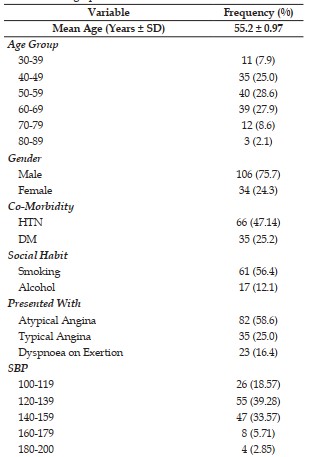
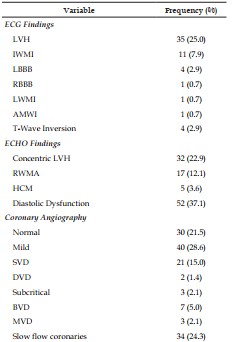
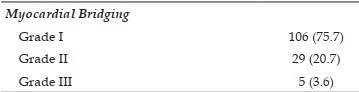
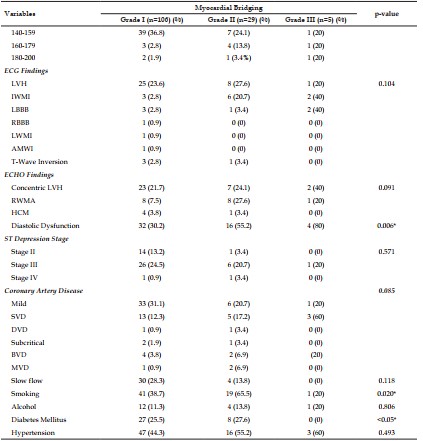
Background: Myocardial bridging (MB) is a frequently encountered coronary anomaly, and its prevalence varies, ranging from 1.5% to 16%. The present study evaluates the clinical profile of MB in patients undergoing coronary angiography at a tertiary care center in coastal Karnataka, India. Methodology: This prospective study was performed among patients presenting to the Department of Cardiology and Department of Emergency Medicine from July-2017 to May-2018. All the patients presenting with chest pain, dyspnoea, or fatigue; and planned for coronary angiography (CAG) of age 30 and above who had MB were included in the study. Patient data, including electrocardiogram(ECG), echocardiography(ECHO), and routine blood investigations, were recorded in the pre-designed form. The study was carried out after attaining Institutional ethical clearance. Results: The patient cohort was predominantly composed of males (75.7%) with an average age of 55.2±0.97 years. Among 140 patients with MB, 75.7% of cases were classified as grade I, 20.7% as grade II, and 3.6% as grade III. Significant association was observed between MB grades and clinical factors, such as diastolic dysfunction, active smoking, and diabetes. Electrocardiographic abnormalities included left ventricular hypertrophy (25%), inferior wall myocardial infarction(8%), left bundle branch block (2.9%), and T-wave inversion (2.9%). Echocardiographic findings included concentric LVH (22.9%), regional wall motion abnormality (12.1%), and hypertrophic cardiomyopathy(3.6%). CAG unveiled various pathologies, including mild coronary artery disease(28.6%), single vessel disease(15%), double vessel disease(1.4%), branch vessel disease(5%), and multivessel disease(2.1%). Conclusion: MB was prevalent among patients undergoing CAG. Significant association was found between grades of MB and diastolic dysfunction, active smoking, and diabetes mellitus.
References
- 1. Rossi L, Dander B, Nidasio GP, et al. Myocardial bridges and ischemic heart disease. Eur Heart J. 1980;1(4):239–45.
- 2. Tauth J, Thompson Sullebarger J. Myocardial Infarction Associated With Myocardial Bridging: Case History and Review of the Literature. 1997 [cited 2024 Mar 17];40:364–7. Available from: https://onlinelibrary.wiley. com/doi/10.1002/
- 3. Feld H, Guadanino V, Hollander G, et al. Exercise-induced ventricular tachycardia in association with a myocardial bridge. Chest [Internet]. 1991 [cited 2024 Mar 17];99(5):1295– 6. Available from: https://pubmed.ncbi.nlm. nih.gov/2019202/
- 4. Hansen BF. Myocardial covering on epicardial coronary arteries. Prevalence, localization and significance. Scand J Thorac Cardiovasc Surg [Internet]. 1982 [cited 2024 Mar 17];16(2):151–5. Available from: https://pubmed.ncbi.nlm.nih. gov/7156925/
- 5. Ferreira AG, Trotter SE, Konig B, et al. Myocardial bridges: morphological and functional aspects. Heart [Internet]. 1991 Nov 1 [cited 2024 Mar 17];66(5):364–7. Available from: https://heart.bmj.com/content/66/5/364
- 6. Juillière Y, Berder V, Suty-Selton C, et al. Isolated myocardial bridges with angiographic milking of the left anterior descending coronary artery: A long-term follow-up study. Am Heart J. 1995 Apr 1;129(4):663–5.
- 7. Noble J, Bourassa MG, Petitclerc R, et al. Myocardial bridging and milking effect of the left anterior descending coronary artery: normal variant or obstruction? Am J Cardiol [Internet]. 1976 [cited 2024 Mar 17];37(7):993–9. Available from: https://pubmed.ncbi.nlm.nih. gov/1274883/
- 8. Kosiński A, Grzybiak M. Myocardial bridges in the human heart: morphological aspects. Folia Morphol [Internet]. 2001;60(1):65–8. Available from: www.fm.viamedica.pl
- 9. Gibbons RJ, Balady GJ, Bricker JT, et al. ACC/ AHA 2002 guideline update for exercise testing: Summary article. A report of the American College of Cardiology/American Heart Association task force on practice guidelines (committee to update the 1997 exercise testing guidelines). Circulation [Internet]. 2002 Oct 1 [cited 2024 Mar 17];106(14):1883–92. Available from: www.acc.org
- 10. Beltrame JF. Defining the coronary slow flow phenomenon. Circulation Journal. 2012;76(4):818–20.
- 11. Gibbons RJ, Balady GJ, Beasley JW, et al. ACC/AHA Guidelines for Exercise Testing: Executive Summary. Circulation [Internet]. 1997 Jul 1 [cited 2024 Mar 17];96(1):345–54. Available from: https://www.ahajournals. org/doi/abs/10.1161/01.cir.96.1.345.
- 12. Uusitalo V, Saraste A, Pietilä M, et al. The Functional Effects of Intramural Course of Coronary Arteries and its Relation to Coronary Atherosclerosis. JACC Cardiovasc Imaging. 2015 Jun 1;8(6):697–704.
- 13. Bourassa MG, Butnaru A, Lespérance J, et al. Symptomatic myocardial bridges: overview of ischemic mechanisms and current diagnostic and treatment strategies. J Am Coll Cardiol. 2003 Feb 5;41(3):351–9.
- 14. Schwarz ER, Klues HG, vom Dahl J, et al. Functional characteristics of myocardial bridging: A combined angiographic and intracoronary Doppler flow study. Eur Heart J [Internet]. 1997 Mar 1 [cited 2024 Mar 20];18(3):434–42. Available from: https:// dx.doi.org/10.1093/oxfordjournals.eurheartj. a015263
- 15. Haager PK, Schwarz ER, Vom Dahl J, et al. Long term angiographic and clinical follow up in patients with stent implantation for symptomatic myocardial bridging. Heart [Internet]. 2000 Oct 1 [cited 2024 Mar 20];84(4):403–8. Available from: https://heart. bmj.com/content/84/4/403
- 16. Huang WS, Chang HD, Yang SP, et al. Abnormal 201Tl myocardial single photon emission computed tomography in energetic male patients with myocardial bridge. Nucl Med Commun [Internet]. 2002 [cited 2024 Mar 20];23(11):1123–8. Available from: https:// pubmed.ncbi.nlm.nih.gov/12411842/
- 17. Corban MT, Hung OY, Eshtehardi P, et al. Myocardial Bridging: Contemporary Understanding of Pathophysiology with Implications for Diagnostic and Therapeutic Strategies. J Am Coll Cardiol [Internet]. 2014 Jun 6 [cited 2024 Mar 20];63(22):2346. Available from: /pmc/articles/PMC4065198/
- 18. Santucci A, Jacoangeli F, Cavallini S, et al. The myocardial bridge: incidence, diagnosis, and prognosis of a pathology of uncertain clinical significance. European Heart Journal Supplements [Internet]. 2022 Nov 12 [cited 2024 Mar 20];24(Supplement_I):I61–7. Available from: https://dx.doi.org/10.1093/ eurheartjsupp/suac075
- 19. Lee MS, Chen CH. Myocardial Bridging: An Up-to-Date Review. J Invasive Cardiol [Internet]. 2015 Nov 1 [cited 2024 Mar 20];27(11):521. Available from: /pmc/articles/ PMC4818117/
- 20. Ge J, Erbel R, Görge G, et al. High wall shear stress proximal to myocardial bridging and atherosclerosis: intracoronary ultrasound and pressure measurements. Br Heart J [Internet]. 1995 [cited 2024 Mar 20];73(5):462. Available from: /pmc/articles/ PMC483864/?report=abstract
- 21. Yano K, Yoshino H, Taniuchi M, et al. Myocardial bridging of the left anterior descending coronary artery in acute inferior wall myocardial infarction. Clin Cardiol [Internet]. 2001 [cited 2024 Mar 20];24(3):202. Available from: /pmc/articles/PMC6655235/
- 22. Brolin EB, Brismar TB, Collste O, et al. Prevalence of Myocardial Bridging in Patients with Myocardial Infarction and Nonobstructed Coronary Arteries. American Journal of Cardiology [Internet]. 2015 Dec 15 [cited 2024 Mar 20];116(12):1833–9. Available from: http://www.ajconline.org/article/ S0002914915019967/fulltext
- 23. Cakmak M, Tanriverdi H, Cakmak N, et al. Simvastatin May Improve Myocardial Perfusion Abnormality in Slow Coronary Flow. Cardiology [Internet]. 2008 Apr 1 [cited 2024 Mar 20];110(1):39–44. Available from: https://dx.doi.org/10.1159/000109405.
Data Sharing Statement
There are no additional data available. All raw data and code are available upon request.
Funding
This research received no funding.
Author Contributions
All authors contributed significantly to the work and approve its publication.
Ethics Declaration
This article does not involve any human or animal subjects, and therefore does not require ethics approval.
Acknowledgements
We would like to express our gratitude to the patients, their families, and all those who have contributed to this study.
Conflicts of Interest
No conflicts of interest in this work.
About this article

Cite this article
Kanhai Lalani, Rameswar Reddy, M Sudhakar Rao et. al, Clinical Profile of Patients with Angiographically Proven Myocardial bridging. Indian J Cardiovasc Med Surg.2026;12(2): 47–54.
Licence:
Attribution-Non-commercial 4.0 International (CC BY-NC 4.0)This license enables reusers to distribute, remix, adapt, and build upon the material in any medium or format for noncommercial purposes only, and only so long as attribution is given to the creator.
| Received | Accepted | Published |
|---|---|---|
| June 19, 2026 | July 22, 0206 | August 30, 2026 |
DOI: https://doi.org/10.21088/jcms.2454.7123.12226.1
Keywords
Myocardial BridgingCoronary AngiographyEchocardiographyAcute Coronary SyndromeSearch for Similar Articles
Similar Articles
- Cardioembolic Stroke as an Initial Presentation of Carney's Complex: A Case Repo...
- Simultaneous Atrioventricular Valve Repair Compelling Creation of Unconventional...
- Iatrogenic Right Radial Arteriovenous Fistula Post Percutaneous Coronary Interve...
- Revascularization in Chronic Coronary Disease: A Comparison between AHA/ACC (202...
- Improvement in Qualitative Indices with Novel Therapy of Nicorandil in Patients...
Article Level Metrics
Last UpdatedSunday 18 October 2026, 16:52:14 (IST)
2264
Accesses
14
263
00
Citations
NA
NA
NA
Download citation
Article Keywords
Keyword Highlighting
Highlight selected keywords in the article text.
Timeline
| Received | June 19, 2026 |
| Accepted | July 22, 0206 |
| Published | August 30, 2026 |
licence
Attribution-Non-commercial 4.0 International (CC BY-NC 4.0)
This license enables reusers to distribute, remix, adapt, and build upon the material in any medium or format for noncommercial purposes only, and only so long as attribution is given to the creator.