Full Text (PDF)
Indian Journal of Anesthesia and Analgesia 12(4):p 285-294, Oct. - Dec. 2025. | DOI: https://doi.org/10.21088/ijaa.2349.8471.12425.3
Original Article
“Burn-Out” An Occupational Phenomenon Amongst Indian Anaesthesiology Residents
Suresh Kumar N null, K.R. Namratha null
Author Information
Licence:
Attribution-Non-commercial 4.0 International (CC BY-NC 4.0)This license enables reusers to distribute, remix, adapt, and build upon the material in any medium or format for noncommercial purposes only, and only so long as attribution is given to the creator.
Indian Journal of Anesthesia and Analgesia 12(4):p 285-294, Oct. - Dec. 2025. | DOI: https://doi.org/10.21088/ijaa.2349.8471.12425.3
How Cite This Article:
Namratha KR, Suresh KN. “Burn-out” an occupational phenomenon amongst Indian anaesthesiology residents. Ind J Anesth Analg. 2025;12(4):285-94.Timeline
Received : June 03, 2025
Accepted : July 10, 2025
Published : December 30, 2025
Abstract
Context: Residency training, particularly in anaesthesiology, is known for its high demands and stress, potentially leading to burnout. This study aimed to assess the levels of perceived stress and burnout among anaesthesiology residents in India.
Aims: This study aimed to assess the levels of perceived stress and burnout among anaesthesiology residents in tertiary care hospitals in India.
Settings and Design:
• Study Design: cross-sectional, observational study
•Study Participants: Indian Anaesthesiology residents working in tertiary care hospitals
•Sampling Method: convenience sampling
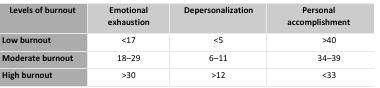
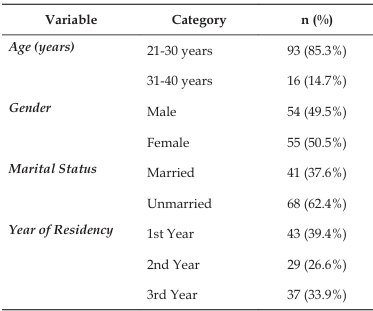
Methods and Material: A total of 109 anaesthesiology residents participated in this study. The Perceived Stress Scale (PSS-10) was used to assess perceived stress, while burnout was measured using the Maslach Burnout Inventory (MBI), focusing on emotional exhaustion, depersonalization, and personal accomplishment. Data were analysed to examine the relationship between stress and burnout with demographic variables such as age, gender, marital status, and year of residency.
Statistical analysis used: The sample size was determined using the formula proposed by Hulley et al. (2013), with parameters such as Z_α = 1.96 (Standard normal value at α = 0.05) and Z_β = 0.8416 (Standard normal value for β = 20%). The sample sizes for different correlation values were calculated, and 103 participants were determined to be the minimum required number for the study. A final of 109 participants were considered in this study. (Hulley SB, 2013) The collected data will be coded and entered into an Excel database for analysis. Qualitative variables will be expressed as frequencies and percentages, while quantitative variables will be reported as means and standard deviations. Spearman’s rank correlation will be used to assess the relationship between perceived stress and occupational burnout, with a significance level set at p<0.05.
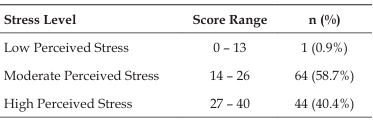
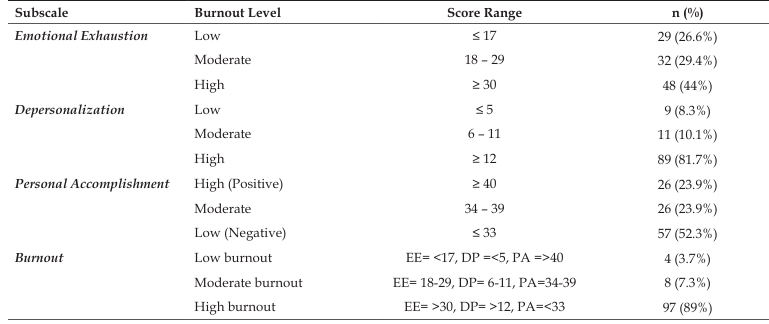
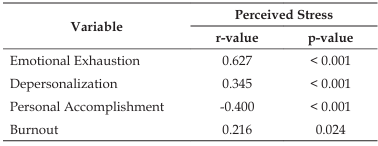
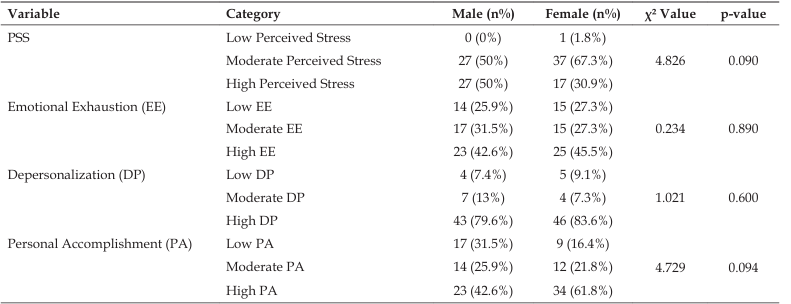
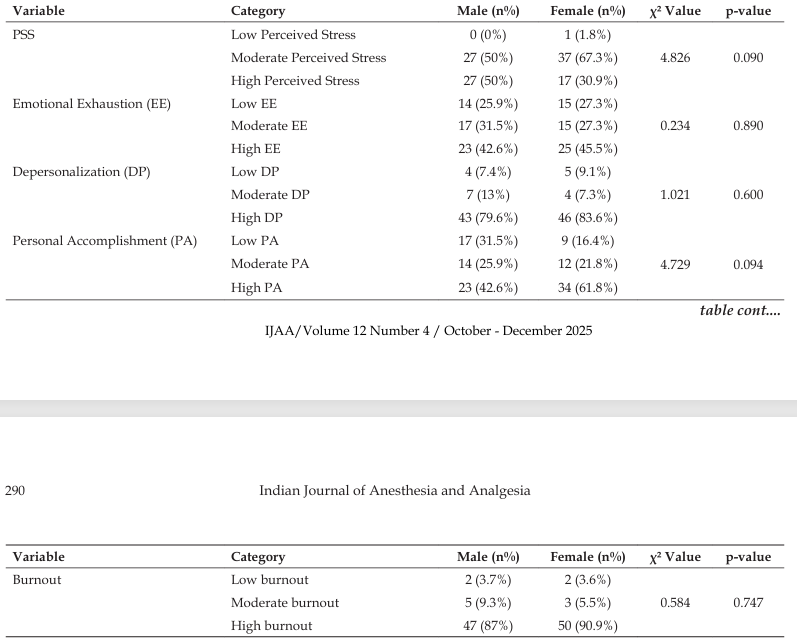
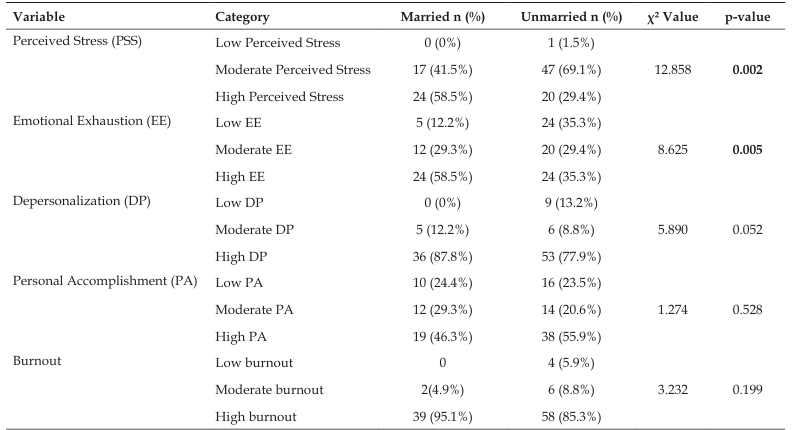
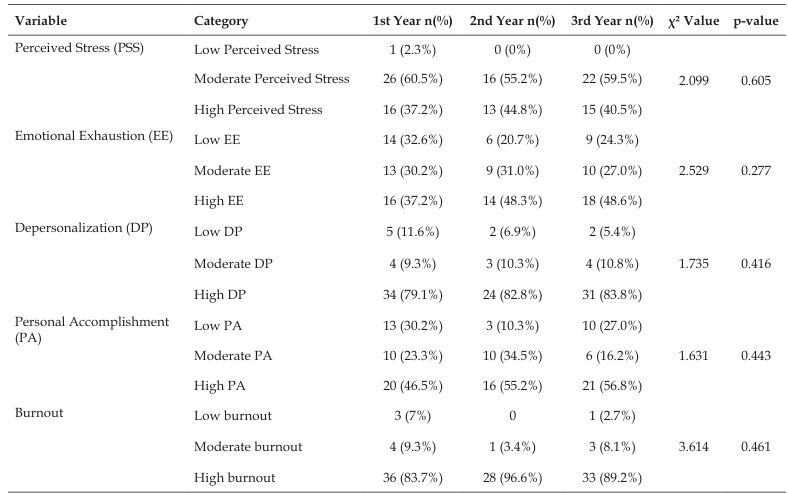
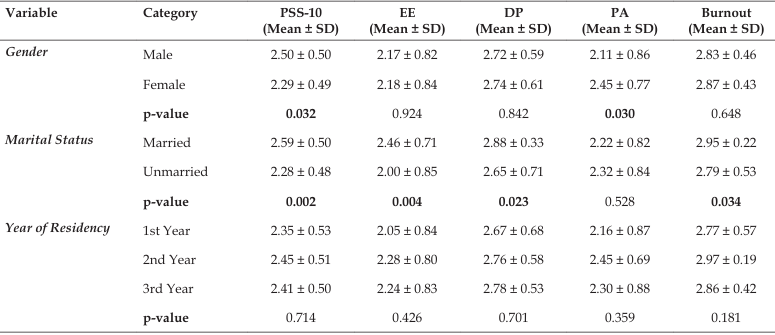
Results: The majority of participants (58.7%) reported moderate stress, with 40.4% experiencing high stress. Nearly 89% of residents were categorized as having high burnout. A significant positive correlation was found between perceived stress and emotional exhaustion (r = 0.627, p < 0.001) and a moderate correlation with depersonalization (r = 0.345, p < 0.001). Married residents reported higher levels of stress and emotional exhaustion than unmarried residents (p = 0.002 and p = 0.005, respectively). No significant differences were observed between genders or across years of residency in terms of stress or burnout.
Conclusions: The findings indicate that anaesthesiology residents in India experience high levels of perceived stress and burnout, with married residents being more susceptible. This highlights the need for targeted interventions, such as mental health support and wellness programs, to address stress and burnout during residency training.
References
- 1. De Hert S. Burnout in healthcare workers: prevalence, impact and preventative strategies. Local Reg Anesth. 2020 Oct 28;13:171-83.
- 2. Edú-Valsania S, Laguía A, Moriano JA. Burnout: a review of theory and measurement. Int J Environ Res Public Health. 2022 Feb 4;19(3):1780.
- 3. Ungur AP, Bârsan M, Socaciu AI, et al. A narrative review of burnout syndrome in medical personnel. Diagnostics (Basel). 2024 Sep 6;14(17):1971.
- 4. World Health Organization. Burn-out an “occupational phenomenon”: International Classification of Diseases. Geneva: WHO; 2019
- 5. Morse G, Salyers MP, Rollins AL, et al. Burnout in mental health services: a review of the problem and its remediation. Adm Policy Ment Health. 2012 Sep;39(5):341-52.
- 6. Gupta L. The silent threat: fatigue, burnout, and patient safety in anaesthesia. 2024.
- 7. Verma R, Mohan B, Attri JP, et al. Anesthesiologist: the silent force behind the scene. Anesth Essays Res. 2015 Sep-Dec;9(3):293-7.
- 8. Berger-Estilita J, Salvisberg D, Köselerli E, et al. Impact of burnout on anaesthesiologists. Turk J Anaesthesiol Reanim. 2024 May 3;52(2):54-9.
- 9. Koutsimani P, Montgomery A, Georganta K. The relationship between burnout, depression, and anxiety: a systematic review and meta-analysis. Front Psychol. 2019 Mar 13;10:284.
- 10. Romito BT, Okoro EN, Ringqvist JRB, et al. Burnout and wellness: the anesthesiologist’s perspective. Am J Lifestyle Med. 2020 Mar 15;15(2):118-25.
- 11. Ayoğlu H, Ayoğlu FN. Occupational risks for anaesthesiologists and precautions. Turk J Anaesthesiol Reanim. 2021 Apr;49(2):93-9.
- 12. Kaur A, Kallakuri S, Mukherjee A, et al. Mental health related stigma, service provision and utilization in Northern India: situational analysis. Int J Ment Health Syst. 2023 Apr 27;17(1):10.
- 13. Dhoon T, McCartney K, Yeung B. Anesthesiology residency: understanding the role of failure. J Educ Perioper Med. 2023 Dec 27;25(4):E716.
- 14. Cohen S, Kamarck T, Mermelstein R. A global measure of perceived stress. J Health Soc Behav. 1983 Dec;24(4):385-96.
- 15. Ishak WW, Lederer S, Mandili C, et al. Burnout during residency training: a literature review. J Grad Med Educ. 2009 Dec;1(2):236-42.
- 16. Maslach C, Jackson SE, Leiter MP. Maslach Burnout Inventory manual. 3rd ed. Palo Alto (CA): Consulting Psychologists Press; 1996.
- 17. Hulley SB, Cummings SR, Browner WS, et al. Designing clinical research: an epidemiologic approach. 4th ed. Philadelphia (PA): Wolters Kluwer/Lippincott Williams & Wilkins; 2013.
- 18. Chong MYF, Lin SHX, Lim WY, et al. Burnout in anaesthesiology residents: a systematic review of its prevalence and stressors. Eur J Anaesthesiol. 2022 Apr 1;39(4):368-77.
- 19. John AS, Kumar TS. Burnout among anaesthesiologists in India: a questionnaire-based study. Asian J Pharm Clin Res. 2021;14(7):93–7.
- 20. Rotenstein LS, Torre M, Ramos MA, et al. Prevalence of burnout among physicians: a systematic review. JAMA. 2018 Sep 18;320(11):1131-50.
- 21. Leiter MP, Maslach C. Burnout and gender: the role of gender in the experience of burnout. Int J Stress Manag. 2005;12(2):70-89.
- 22. Gandhi K, Sahni N, Padhy SK, et al. Comparison of stress and burnout among anesthesia and surgical residents in a tertiary care teaching hospital in North India. J Postgrad Med. 2018 Jul-Sep;64(3):145-9.
Data Sharing Statement
There are no additional data available. All raw data and code are available upon request.
Funding
This research received no funding.
Author Contributions
Whether all authors contributed significantly to the work and approve its publication.
Ethics Declaration
This article does not involve any human or animal subjects, and therefore does not require ethics approval.
Acknowledgements
We would like to express our gratitude to the patients, their families, and all those who have contributed to this study.
Conflicts of Interest
The authors report no conflicts of interest in this work.
About this article

Cite this article
Namratha KR, Suresh KN. “Burn-out” an occupational phenomenon amongst Indian anaesthesiology residents. Ind J Anesth Analg. 2025;12(4):285-94.
Licence:
Attribution-Non-commercial 4.0 International (CC BY-NC 4.0)This license enables reusers to distribute, remix, adapt, and build upon the material in any medium or format for noncommercial purposes only, and only so long as attribution is given to the creator.
| Received | Accepted | Published |
|---|---|---|
| June 03, 2025 | July 10, 2025 | December 30, 2025 |
DOI: https://doi.org/10.21088/ijaa.2349.8471.12425.3
Keywords
AnaesthesiologyBurnoutMaslach burnout inventoryPerceived stress scaleaResidencyStress.Search for Similar Articles
Similar Articles
- Awake Fibreoptic Intubation for Airway Management in Massive Thyroid Enlargement...
- A Case of Thoracotomy with One Lung Ventilation for Carcinoma Oesophagus
- A Case of Empyema for Thoracotomy and Decortication-Anaesthesia Management
- Full Mouth Rehabilitation in a 3-Year-Old Female Child with Repaired Tetralogy o...
- Do Gel Manicures Affect SpO2 Readings ? A Clinical Investigation
Article Level Metrics
Last UpdatedMonday 13 July 2026, 10:31:48 (IST)
5649
Accesses
22
678
00
Citations
NA
NA
NA
Download citation
Article Keywords
Keyword Highlighting
Highlight selected keywords in the article text.
Timeline
| Received | June 03, 2025 |
| Accepted | July 10, 2025 |
| Published | December 30, 2025 |
licence
Attribution-Non-commercial 4.0 International (CC BY-NC 4.0)
This license enables reusers to distribute, remix, adapt, and build upon the material in any medium or format for noncommercial purposes only, and only so long as attribution is given to the creator.