Full Text (PDF)
Journal of Psychiatric Nursing 12(1):p 19-23, January-April 2023. | DOI: http://dx.doi.org/10.21088/jpn.2277.9035.12123.2
Original Article
Astudy to assess the Effect of Laughter Therapy on Anxiety
Yashpreet Kaur , Yashpreet Kaur
Author Information
Licence:
Journal of Psychiatric Nursing 12(1):p 19-23, January-April 2023. | DOI: http://dx.doi.org/10.21088/jpn.2277.9035.12123.2
How Cite This Article:
Yashpreet Kaur/Astudy to assess the Effect of Laughter therapy on Anxiety/J Psychiatr Nurs. 2023;12(1):19–23.
Timeline
Received : N/A
Accepted : N/A
Published : N/A
Abstract
Life is running fast; everyone is on toes to win the race. No one have free time to stop and care for themselves. Though today’s world is overloaded with hi-tech facilities, yet people are not happy. They are attaching more value to personal achievement and trying to seek material pleasure in life, most of which are temporary and do not make anyone happy. Laughter therapy is a breakthrough technique allowing laughter to actually be prescribed as part of a daily routine in order to realize all of the health benefits. It enables everyone to laugh, even those who are serious, introverted and uncomfortable being funny.
Objective: To assess effectiveness of laughter therapy on anxiety among people.
Aim of Study: The present study aimed to add some more humor in life of people to reduce anxiety.
Methodology: Quasi-experiment non-equivalent control group pre-test post-test design was used to study the effectiveness of laughter therapy. Study was conducted at Shiva ji Park, Rani Ka Bagh (experimental group) and Jallianwala Bagh, (control group) Amritsar, Punjab. 30 participants for experiment group and other 30 for control group with the help of convenient sampling technique. The Hamilton Anxiety Rating Scale (HAM-A) developed by Max Hamilton administered to study participantsto assess anxiety before and after laughter therapy.
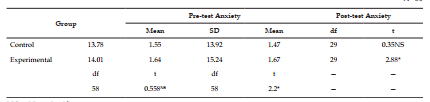
Results: Paired t-test applied on mean values of experimental group in pre-test ( X = 14.01, SD = 1.64) and post-test ( X = 15.24, SD = 1.67) and found statistically significant difference (t = 2.88*, df = 29) at 0.05 level of significance. Hence, study results revealed that laughter therapy was significantly effective to lower the anxiety among people.
Conclusion: After statistical analysis this study leads the conclusion that a considerable part of adult population survives with mild or moderate anxiety. The present study findings also revealed that laughter therapy does have a significant effect on anxiety. Thus, it is clear that simulation laughter i.e., laughter therapy helps to lower anxiety.
References
No records found.
Data Sharing Statement
There are no additional data available
Funding
This research received no funding
Author Contributions
All authors contributed significantly to the work and approve its publication
Ethics Declaration
This article does not involve any human or animal subjects, and therefore does not require ethics approval
Acknowledgements
Information Not Provided
Conflicts of Interest
No conflicts of interest in this work
About this article

Cite this article
Yashpreet Kaur/Astudy to assess the Effect of Laughter therapy on Anxiety/J Psychiatr Nurs. 2023;12(1):19–23.
Licence:
| Received | Accepted | Published |
|---|---|---|
| N/A | N/A | N/A |
DOI: http://dx.doi.org/10.21088/jpn.2277.9035.12123.2
Keywords
Laughter Therapy; Anxiety; people.Search for Similar Articles
Similar Articles
- Effectiveness of Psychoeducation on Knowledge of Extrapyramidal Symptoms among C...
- A Comprehensive Review of Depression and Future Directions
- A Study to Develop and Evaluate the Impact of Planned Instructional Module for P...
- Psychosocial Challenges among Home-Dwelling Elderly in Rural Gonda: A Community-...
- Challenges Faced by Caregivers of Palliative Care Patients: A Qualitative Study
Article Level Metrics
Last UpdatedMonday 22 June 2026, 01:42:48 (IST)
573
Accesses
2
90
00
Citations
NA
NA
NA
Download citation
Article Keywords
Keyword Highlighting
Highlight selected keywords in the article text.
Timeline
| Received | N/A |
| Accepted | N/A |
| Published | N/A |