Full Text (PDF)
International Journal of Neurology and Neurosurgery 16(1-2):p 7-16, January-June 2024. | DOI: http://dx.doi.org/10.21088/ijnns.0975.0223.161224.1
Review Article
Artificial Intelligence in Decoding ADHD (Attention Deficit Hyperactivity Disorder)
Prachi Srivastava, , Prachi Srivastava1 , Amaan Arif2 , Shrijal Singh3
Author Information
Licence:
International Journal of Neurology and Neurosurgery 16(1-2):p 7-16, January-June 2024. | DOI: http://dx.doi.org/10.21088/ijnns.0975.0223.161224.1
How Cite This Article:
Prachi Srivastava, Amaan Arif, Shrijal Singh. Artificial Intelligence in Decoding ADHD (Attention Deficit Hyperactivity Disorder). International Journal of Neurology and Neurosurgery. 2024;16(1-2):07-16.
Timeline
Received : N/A
Accepted : N/A
Published : N/A
Abstract
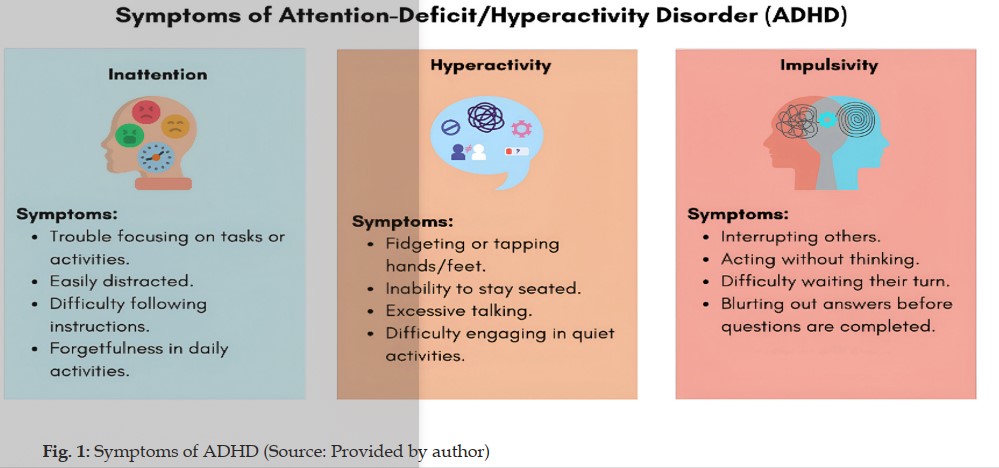
Attention Deficit Hyperactivity Disorder (ADHD) is a common neurodevelopmental disorder that affects both children and adults, is characterized by symptoms of inattention, hyperactivity, and impulsivity. Globally, ADHD affects approximately 5-7% of children and adolescents, as well as 2.5% of adults. The condition significantly impacts daily functioning, social relationships or interactions, and academic or professional performance. ADHD appears differently in different age groups, with classroom disruptions and difficulty in social interactions being common in children, while adults may struggle with time management, organizing, and maintaining interpersonal connections. The disorder is categorized into three main types: mainly inattentive, mostly hyperactive-impulsive, and combination presentation, which are defined by dominant symptom patterns. Diagnosis involves ongoing symptom assessment, with treatment options including medications, behavioural therapies, and management strategies tailored to individual needs. The growing use of Artificial Intelligence (AI) in healthcare has significantly improved ADHD diagnosis and treatment, offering higher precision, efficiency, and personalization. AI algorithms enhance diagnostic accuracy by analyzing large datasets and identifying complex patterns in medical images, enabling early detection of ADHD and related conditions. Moreover, AI-driven treatment plans personalize therapeutic techniques based on individual patient data, improving outcomes and reducing adverse side effects. Benefits of AI include improved diagnostic accuracy, increased efficiency through automation, development of personalized medicine, and reduced healthcare costs. This review explores the role of AI in ADHD diagnosis and treatment, focusing on its transformative potential in improving patient care and advancing precision medicine. Understanding AI applications in healthcare can lead to way for more effective ADHD therapy management and improved patient quality of life.
References
No records found.
About this article

Cite this article
Prachi Srivastava, Amaan Arif, Shrijal Singh. Artificial Intelligence in Decoding ADHD (Attention Deficit Hyperactivity Disorder). International Journal of Neurology and Neurosurgery. 2024;16(1-2):07-16.
Licence:
| Received | Accepted | Published |
|---|---|---|
| N/A | N/A | N/A |
DOI: http://dx.doi.org/10.21088/ijnns.0975.0223.161224.1
Keywords
ADHD; Neurodevelopmental disorder; Inattention; Hyperactivity; Impulsivity; Diagnosis; treatment; Children; AdultsSearch for Similar Articles
Similar Articles
- Intramedullary Capillary Hemangioma of Conus Medullaris: Case Report and Review...
- Atypical Miller Fisher Syndrome
- Therapeutic Potential of Passiflora incarnata in the Management of Neurological...
- Central or Axial Atlantoaxial Dislocation: Redefining Instability at the Craniov...
- Assessment of Neurocognitive Functions in Post-Acute Stroke Patients Undergoing...
Article Level Metrics
Last UpdatedWednesday 30 September 2026, 10:42:35 (IST)
2221
Accesses
15
275
00
Citations
NA
NA
NA
Download citation
Article Keywords
Keyword Highlighting
Highlight selected keywords in the article text.
Timeline
| Received | N/A |
| Accepted | N/A |
| Published | N/A |