Full Text (PDF)
Gastroenterology International 8(2):p 52-55, july-dcec 2023. | DOI: 10.21088/gi.2456-5458.8223.2
Case Report
Angiodysplasia of the Caecum Treated by Embolization with PVA (Polyvinyl Alcohol)
Author Information
Licence:
Attribution-Non-commercial 4.0 International (CC BY-NC 4.0)This license enables reusers to distribute, remix, adapt, and build upon the material in any medium or format for noncommercial purposes only, and only so long as attribution is given to the creator.
Gastroenterology International 8(2):p 52-55, july-dcec 2023. | DOI: 10.21088/gi.2456-5458.8223.2
How Cite This Article:
Naveen Kumar. Angiodysplasia of the Caecum Treated by Embolization with PVA (Polyvinyl Alcohol). Gastroenterology International. 2023;8(2):51-54.Timeline
Received : September 16, 2023
Accepted : October 30, 2023
Published : November 21, 2023
Abstract
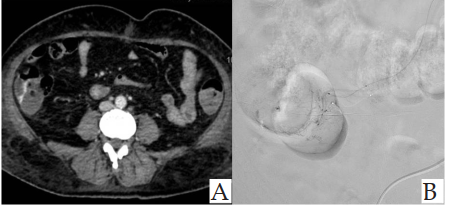
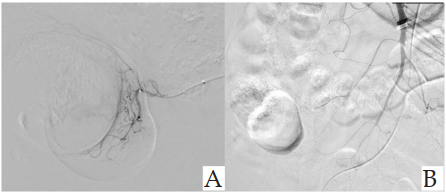
Background: Angiodysplasia of the caecum is a common vascular abnormality that causes gastrointestinal bleeding, especially in elderly patients. Characterized by abnormal, dilated blood vessels, angiodysplasia can lead to intermittent or acute haemorrhage. Embolization with Polyvinyl Alcohol (PVA) particles is a minimally invasive technique gaining popularity for managing bleeding from caecal angiodysplasia when endoscopy fails or is not possible. Objective: To evaluate the use of PVA embolization in the treatment of caecal angiodysplasia, focusing on its effectiveness in controlling gastrointestinal bleeding and its advantages and risks compared to other treatment options. Results: PVA embolization has shown high success rates in controlling gastrointestinal bleeding associated with caecal angiodysplasia. The procedure is minimally invasive, with most patients experiencing significant improvement in symptoms and a reduction in recurrent bleeding episodes. Conclusion: Embolization with PVA is an effective and minimally invasive treatment for caecal angiodysplasia, particularly in patients who do not respond to or are not candidates for endoscopic therapies.
References
- 1. Baum S, Athanasoulis CA, Waltman AC, Galdabini J, Schapiro RH, Warshaw AL, et al. Angiodysplasia of the right colon: a cause of gastrointestinal bleeding. Am J Roentgenol. 1977;129:789-794.
- 2. Boley SJ, DiBiase A, Brandt LJ, Sammartano RJ. Lower intestinal bleeding in the elderly. Am J Surg. 1979;137(2):57-64.
- 3. Athanasoulis CA, Galdabini JJ, Waltman AC, Novelline RA, Greenfield AJ, Ezpeleta ML. Angiodysplasia of the colon: a cause of rectal bleeding. Cardiovasc Radiol. 1978;1(2):53-63.
- 4. Browder W, Cerise EJ, Litwin MS. Impact of emergency angiography in massive lower gastrointestinal bleeding. Ann Surg. 1986;204(5):530-536.
- 5. Bookstein JJ, Naderi MJ, Walter JF. Transcatheter embolization for lower gastrointestinal bleeding. Radiology. 1978;127(2):345-349.
- 6. Chuang VP, Wallace S, Zornoza J, Davis LJ. Transcatheter arterial occlusion in the management of rectosigmoid bleeding. Radiology. 1979;133(3):605-609.
- 7. Tadavarthy SM, Moller JH, Amplatz K. Polyvinyl alcohol (Ivalon) - a new embolic material. Am J Roentgenol. 1975;125(3):609-616.
- 8. Gerlock AJ Jr, Muhletaler CA, Berger JL, Halter SA, O'Leary JP, Avant GA. Infarction after embolization of the ileocolic artery. Cardiovasc Intervent Radiol. 1981;4(3):202-205.
- 9. Triadafilopoulos G. Management of lower gastrointestinal bleeding in older adults. Drugs Aging. 2012;29(9):707-715.
- 10. Brown C, Subramanian V, Wilcox CM, Peter S. Somatostatin analogues in the treatment of recurrent bleeding from gastrointestinal vascular malformations: an overview and systematic review of prospective observational studies. Dig Dis Sci. 2010;55(9):2129-2134.
Data Sharing Statement
There are no additional data available
Funding
This research received no funding.
Author Contributions
All authors contributed significantly to the work and approve its publication.
Ethics Declaration
All the ethics followed to prepare the article.
Acknowledgements
Information Not provided.
Conflicts of Interest
The authors report no conflicts of interest in this work.
About this article

Cite this article
Naveen Kumar. Angiodysplasia of the Caecum Treated by Embolization with PVA (Polyvinyl Alcohol). Gastroenterology International. 2023;8(2):51-54.
Licence:
Attribution-Non-commercial 4.0 International (CC BY-NC 4.0)This license enables reusers to distribute, remix, adapt, and build upon the material in any medium or format for noncommercial purposes only, and only so long as attribution is given to the creator.
| Received | Accepted | Published |
|---|---|---|
| September 16, 2023 | October 30, 2023 | November 21, 2023 |
DOI: 10.21088/gi.2456-5458.8223.2
Keywords
AngiodysplasiaPolyvinylEmbolizationAlcoholSearch for Similar Articles
Similar Articles
- Radiation-Free Ultrasound-Guided ERCP in Pregnancy: A Case Series of Three Pati...
- Factors Predicting Gangrenous Changes in Acute Calculus Cholecystitis
- Constipation Looks Git Problem and Creates Heart Trouble: An Exploratory Study
- Case-Control Study to Determine the Number Pancreatitis and NonPancreatitis Case...
- Chronic Constipation: A Unseen Pandemic – Root Cause of All Disorders
Article Level Metrics
Last UpdatedFriday 23 October 2026, 22:02:42 (IST)
1784
Accesses
45
90
00
Citations
NA
NA
NA
Download citation
Article Keywords
Keyword Highlighting
Highlight selected keywords in the article text.
Timeline
| Received | September 16, 2023 |
| Accepted | October 30, 2023 |
| Published | November 21, 2023 |
licence
Attribution-Non-commercial 4.0 International (CC BY-NC 4.0)
This license enables reusers to distribute, remix, adapt, and build upon the material in any medium or format for noncommercial purposes only, and only so long as attribution is given to the creator.