Full Text (PDF)
Indian Journal of Anesthesia and Analgesia 11(4):p 226-229, Oct - Dec. 2024. | DOI: https://doi.org/10.21088/ijaa.2349.8471.11424.10
Case Report
Anaesthetic Management of Pregnant Patient with Supraventricular Tachycardia posted for Emergency Caesarean Section
Bharath C J, Suresh Kumar N, Gagan M
Author Information
Licence:
Attribution-Non-commercial 4.0 International (CC BY-NC 4.0)This license enables reusers to distribute, remix, adapt, and build upon the material in any medium or format for noncommercial purposes only, and only so long as attribution is given to the creator.
Indian Journal of Anesthesia and Analgesia 11(4):p 226-229, Oct - Dec. 2024. | DOI: https://doi.org/10.21088/ijaa.2349.8471.11424.10
How Cite This Article:
Bharath CJ, Suresh Kumar N, Gagan M. Anaesthetic management of pregnant patient with supraventricular tachycardia posted for emergency caesarean section. Ind J Anesth Analg. 2024;11(4):226-9.Timeline
Received : September 16, 2024
Accepted : October 16, 2024
Published : December 20, 2024
Abstract
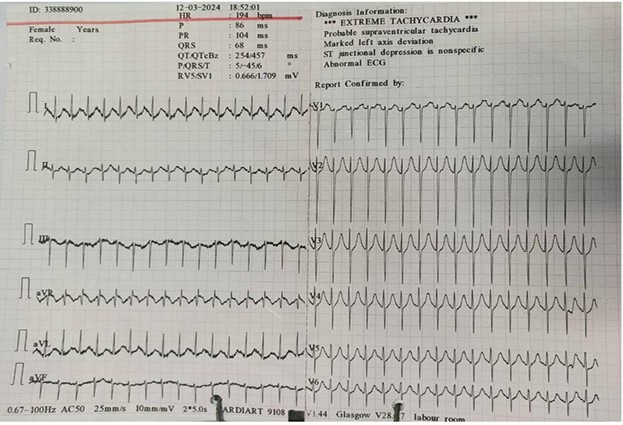
Introduction: This case report details the anaesthetic management of a pregnant patient with supraventricular tachycardia (SVT) undergoing an emergency caesarean section. SVT, a common arrhythmia in pregnancy, is initially treated with adenosine. When adenosine fails, calcium channel blockers like diltiazem are used, and amiodarone is considered as a third-line option before electrical cardioversion. Case Report: In this case, a 19-year-old primigravida at 40 weeks 4 days presented with palpitations and SVT with a heart rate of 201 bpm despite adenosine and diltiazem. Amiodarone was successfully administered, reducing the heart rate to 143 bpm with visible P waves on ECG. Subsequently, she underwent an emergency caesarean section under spinal anaesthesia with 0.5% bupivacaine and fentanyl. Hypotension following the spinal anaesthesia was managed using phenylephrine and IV fluids, maintaining a stable intraoperative heart rate of 120-130 bpm. Throughout the surgery, phenylephrine was used to prevent hypotension associated sympathetic stimulation, which could exacerbate SVT. Post-operatively, the patient maintained normal sinus rhythm, and after evaluation by a cardiologist and echocardiogram, no significant abnormalities were found. She was discharged after 7 days of postnatal care without recurrence of SVT or other arrhythmias. This case highlights the complexity of managing SVT during pregnancy, necessitating a multidisciplinary approach involving anaesthesiologists and cardiologists. The choice of spinal anaesthesia over general anaesthesia was made based on its minimal cardiovascular impact and effective management of hemodynamic stability with vasoactive medications. Careful consideration of pharmacological interventions and their potential effects on both maternal and fetal health is crucial in such cases. Conclusion: effective management of SVT during pregnancy involves tailored anaesthetic techniques and vigilant monitoring to ensure optimal maternal and fetal outcomes while addressing the arrhythmia and its associated hemodynamic challenges.
References
- 1. Kim KO, Chang EJ, Han J, Cho H. Emergency cesarean delivery in a parturient who had an intractable paroxysmal supraventricular tachycardia-A case report. Korean Journal of Anesthesiology. 2012 Oct;63(4):360.
- 2. Conti E, Cascio ND, Paluan P, Racca G, Longhitano Y, Savioli G, Tesauro M, Leo R, Racca F, Zanza C. Pregnancy Arrhythmias: Management in the Emergency Department and Critical Care. Journal of Clinical Medicine. 2024 Feb 15;13(4):1095.
- 3. Andrianto A, Amadis MR, Mulia EP, Azmi Y. Paroxysmal supraventricular tachycardia in pregnancy: A case report. Bali Journal of Anesthesiology. 2023 Jul 1;7(3):179-82.
- 4. Robins K, Lyons G. Supraventricular tachycardia in pregnancy. British Journal of Anaesthesia. 2004 Jan 1;92(1):140-3.
- 5. Ramlakhan KP, Kauling RM, Schenkelaars N, Segers D, Yap SC, Post MC, Cornette J, RoosHesselink JW. Supraventricular arrhythmia in pregnancy. Heart. 2022 Nov 1;108(21):1674-81.
Data Sharing Statement
There are no additional data available.
Funding
This research received no funding.
Author Contributions
All authors contributed significantly to the work and approve its publication.
Ethics Declaration
This article does not involve any human or animal subjects, and therefore does not require ethics approval.
Acknowledgements
Information not provided.
Conflicts of Interest
The authors report no conflicts of interest in this work.
About this article

Cite this article
Bharath CJ, Suresh Kumar N, Gagan M. Anaesthetic management of pregnant patient with supraventricular tachycardia posted for emergency caesarean section. Ind J Anesth Analg. 2024;11(4):226-9.
Licence:
Attribution-Non-commercial 4.0 International (CC BY-NC 4.0)This license enables reusers to distribute, remix, adapt, and build upon the material in any medium or format for noncommercial purposes only, and only so long as attribution is given to the creator.
| Received | Accepted | Published |
|---|---|---|
| September 16, 2024 | October 16, 2024 | December 20, 2024 |
DOI: https://doi.org/10.21088/ijaa.2349.8471.11424.10
Keywords
Supraventricular Tachycardia (SVT)Pregnant womenSubarachnoid blockAdenosineAmiodaroneSearch for Similar Articles
Similar Articles
- Awake Fibreoptic Intubation for Airway Management in Massive Thyroid Enlargement...
- A Case of Thoracotomy with One Lung Ventilation for Carcinoma Oesophagus
- A Case of Empyema for Thoracotomy and Decortication-Anaesthesia Management
- Full Mouth Rehabilitation in a 3-Year-Old Female Child with Repaired Tetralogy o...
- Do Gel Manicures Affect SpO2 Readings ? A Clinical Investigation
Article Level Metrics
Last UpdatedTuesday 14 July 2026, 17:01:59 (IST)
5702
Accesses
12
679
00
Citations
NA
NA
NA
Download citation
Article Keywords
Keyword Highlighting
Highlight selected keywords in the article text.
Timeline
| Received | September 16, 2024 |
| Accepted | October 16, 2024 |
| Published | December 20, 2024 |
licence
Attribution-Non-commercial 4.0 International (CC BY-NC 4.0)
This license enables reusers to distribute, remix, adapt, and build upon the material in any medium or format for noncommercial purposes only, and only so long as attribution is given to the creator.