Full Text (PDF)
Ophthalmology and Allied Sciences 9(3):p 59-61, September - December 2023. | DOI: https://doi.org/10.21088/oas.2454.7816.9323.4
Case Report
An Approach to a Case of Ankyloblepharon
Vijay Kumar Maurya, Aparajita Chaudhary, Kriti Bhatt
Author Information
Licence:
Attribution-Non-commercial 4.0 International (CC BY-NC 4.0)This license enables reusers to distribute, remix, adapt, and build upon the material in any medium or format for noncommercial purposes only, and only so long as attribution is given to the creator.
Ophthalmology and Allied Sciences 9(3):p 59-61, September - December 2023. | DOI: https://doi.org/10.21088/oas.2454.7816.9323.4
How Cite This Article:
Aparajita Chaudhary, Vijay Kumar Maurya, Kriti Bhatt. An Approach to a Case of Ankyloblepharon. Ophthalmol Allied Sci. 2023;9(3): 59–61.Timeline
Received : October 28, 2023
Accepted : November 30, 2023
Published : December 25, 2023
Abstract
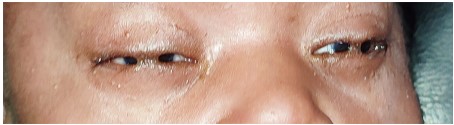
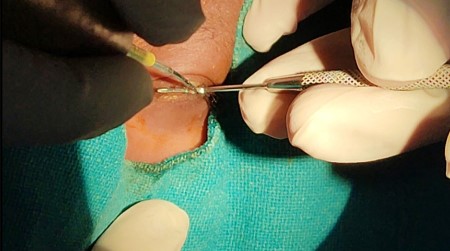
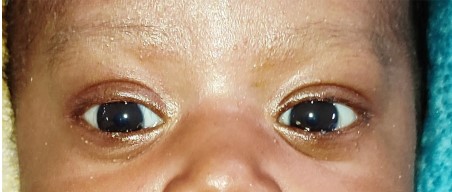
Ankyloblepharon is a rare congenital abnormality consisting of partial or complete adhesion of the upper and lower eyelids by single or multiple bands. Ankyloblepharon is potentially amblyogenic condition. It is generally isolated but can present with systemic diseases. Its presence should alert the need for a detailed systemic evaluation. We present a 1 month old baby who presented to our institute with bilateral adhesions of the upper and lower eyelids, and then patient is evaluated systemically and then surgery was planned. The adhesion was excised with the use of Radio-Frequency cauteryundershort sedation. The separation of the lidsbefore the development of visual milestones is potentially important to prevent the onset of stimulus deprivation amblyopia.
References
- 1. Gupta S, Saxena H. Isolated ankyloblepharon filiforme adnatum in a newborn. Int J Ophthalmol Clin Res 2018; 5:086. doi: 10.23937/2378- 346X/1410086.
- 2. Sarowa S, Jain K, Agarwal R. A newborn with an kylo blepharon filiforme adnatum. J Clin Ophthalmol Res 2018; 6:63 5.
- 3. Bordin G, Valerio E, Cutrone M. Ankyloblepharon filiforme adnatum in a newborn. AJP Rep 2015; 5:e12-3.
- 4. Judge H, Mott W, Gabriels J. Ankyloblepharon filiforme adnatum. Arch Ophthalmol. 1929; 2: 702- 8. PubMed | Google Scholar
- 5. Scott MH, Richard JM, Farris BK. Ankyloblepharon filiforme adnatum associated with infantile glaucoma and iridogoniodysgenesis. J Pediatr Ophthalmol Strabismus. 1994 Mar-Apr; 31(2):93-5. PubMed | Google Scholar
- 6. Bacal DA, Nelson LB, Zackai EH, Lavrich JB, Kousseff BG, McDonald-McGinn D. Ankyloblepharon filiforme adnatum in trisomy 18. J Pediatr Ophthalmol Strabismus. 1993 Sep Oct; 30(5):337-9. PubMed | Google Scholar
- 7. Long JC, Blandford SE. Ankyloblepharon filiforme adnatum with cleft lip and palate. Am J Ophthalmol. 1962 Jan; 53:126-9. PubMed | Google Scholar
- 8. Vanderhooft SL, Stephan MJ, Sybert VP. Severe skin erosions and scalp infections in AEC syndrome. Pediatr Dermatol. 1993 Dec; 10(4):334-40. PubMed| Google Scholar
- 9. Anna Maria Gruener, Manjit S Mehat. A newborn with ankyloblepharon filiforme adnatum: a case report. Cases J. 2009 Aug 14; 2:8146. PubMed | Google Scholar
- 10. Amusini P, Bruel H, Chabrolle JP et al. Ankyloblépharon filiforme adnatum. Arch Pédiatr. 2000; 7: 1009-13. PubMed | Google Scholar
- 11. Rosenman Y, Ronen S, Eidelman AI, Schimmel MS. Ankyloblepharon filiforme adnatum: congenital eyelid-band syndromes. Am J Dis Child. 1980 Aug; 134(8):751-3. PubMed | Google Scholar
Data Sharing Statement
There are no additional data available. All raw data and code are available upon request.
Funding
This research received no funding.
Author Contributions
All authors contributed significantly to the work and approve its publication.
Ethics Declaration
This article does not involve any human or animal subjects, and therefore does not require ethics approval.
Acknowledgements
We would like to express our gratitude to the patients, their families, and all those who have contributed to this study.
Conflicts of Interest
No conflicts of interest in this work.
About this article

Cite this article
Aparajita Chaudhary, Vijay Kumar Maurya, Kriti Bhatt. An Approach to a Case of Ankyloblepharon. Ophthalmol Allied Sci. 2023;9(3): 59–61.
Licence:
Attribution-Non-commercial 4.0 International (CC BY-NC 4.0)This license enables reusers to distribute, remix, adapt, and build upon the material in any medium or format for noncommercial purposes only, and only so long as attribution is given to the creator.
| Received | Accepted | Published |
|---|---|---|
| October 28, 2023 | November 30, 2023 | December 25, 2023 |
DOI: https://doi.org/10.21088/oas.2454.7816.9323.4
Keywords
AnkyloblepharonCongenital abnormalityEyelid bandsAmblyopiaSearch for Similar Articles
Similar Articles
- Study of Ocular Manifestations in ICU Patients
- A Prospective Study to Evaluate Filtering Blebs after Trabeculectomy using Anter...
- Eye Flu Epidemic: Modes of Presentation and Deciding its Management
- Conjunctivitis Nursing Care: A Comprehensive Review of Evidence -Based Practice
- Etiological Analysis of Pale Optic Disc and its Correlation with Visual Outcome
Article Level Metrics
Last UpdatedSaturday 28 November 2026, 15:00:08 (IST)
2295
Accesses
13
173
00
Citations
NA
NA
NA
Download citation
Article Keywords
Keyword Highlighting
Highlight selected keywords in the article text.
Timeline
| Received | October 28, 2023 |
| Accepted | November 30, 2023 |
| Published | December 25, 2023 |
licence
Attribution-Non-commercial 4.0 International (CC BY-NC 4.0)
This license enables reusers to distribute, remix, adapt, and build upon the material in any medium or format for noncommercial purposes only, and only so long as attribution is given to the creator.