Full Text (PDF)
Indian Journal of Trauma and Emergency Pediatrics 14(1):p 9-16, January – March 2022. | DOI: https://doi.org/10.21088/ijtep.2348.9987.14122.1
Original Article
Acute Febrile Encephalopathy in Children: Etiology, Clinical Presentation and Outcome
Milind S. Tullu, Mudita A Arora
Author Information
Licence:
Attribution-Non-commercial 4.0 International (CC BY-NC 4.0)This license enables reusers to distribute, remix, adapt, and build upon the material in any medium or format for noncommercial purposes only, and only so long as attribution is given to the creator.
Indian Journal of Trauma and Emergency Pediatrics 14(1):p 9-16, January – March 2022. | DOI: https://doi.org/10.21088/ijtep.2348.9987.14122.1
How Cite This Article:
Mudita A Arora, Milind S Tullu/Acute Febrile Encephalopathy in Children: Etiology, Clinical Presentation and Outcome/ Indian J Trauma Emerg Pediatr. 2022;14(1):9–16.Timeline
Received : January 27, 2022
Accepted : February 26, 2022
Published : March 30, 2022
Abstract
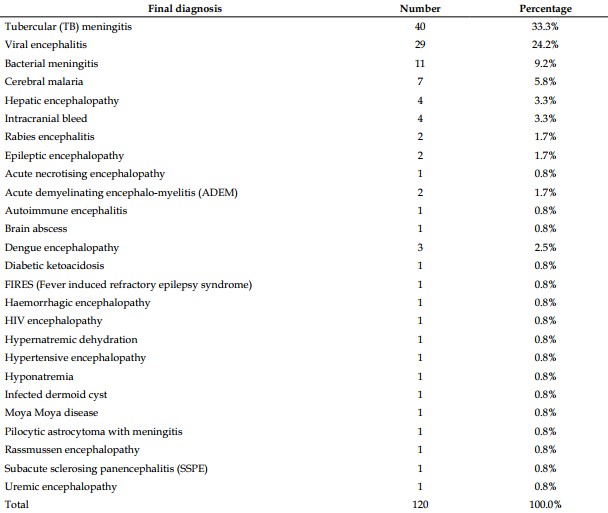
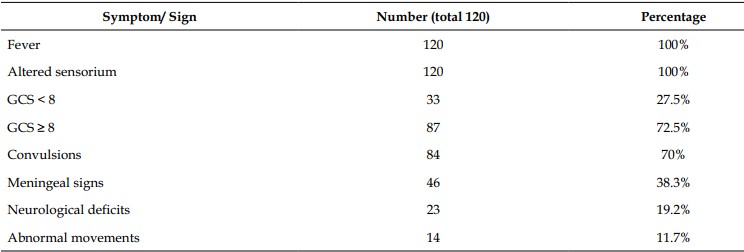
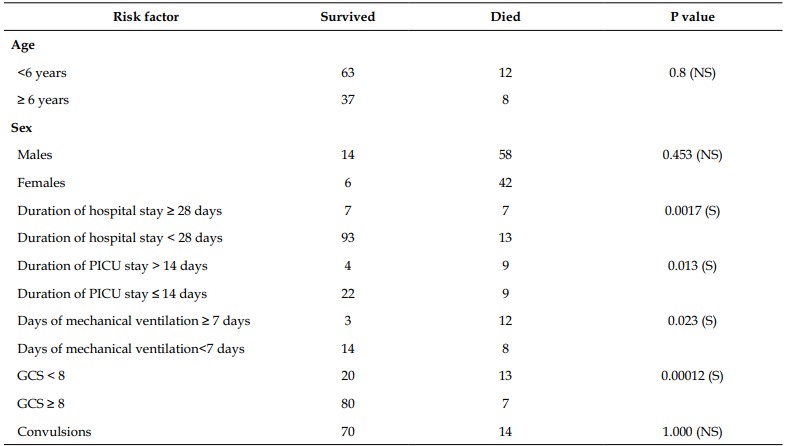
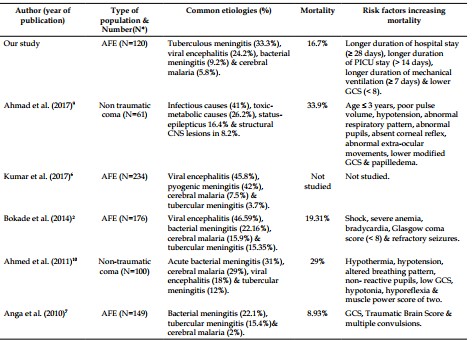
Background: Fever and altered sensorium constitute a medical emergency in children. Early recognition, accurate diagnosis and timely management may help in reducing the morbidity and mortality in acute febrile encephalopathy (AFE). Aim: To study etiology, clinical presentation and outcome in children presenting with acute febrile encephalopathy. Methods: This prospective observational cohort study was conducted in a tertiary care centre over the duration of one year (2016 to 2017). Consecutive patients (age group of one month to 12 years) presenting with fever of ≤ 2 weeks duration and altered mental status were enrolled. The clinical features were noted and patients were followed up through the duration of hospital stay (wards & intensive care unit). Etiology and clinical features were listed as percentage of total cases. Risk factors for mortality were determined using chi-square test. Results: 120 children were enrolled. Besides fever and altered sensorium, convulsions (70%) and meningeal signs (38.3%) were common clinical features. Tubercular meningitis (33.3%) was the most common cause followed by viral encephalitis (24.2%), bacterial meningitis (9.2%) and cerebral malaria (5.8%). Mortality was 16.7% with neuro-morbidity seen in 45% of the cases. Longer duration of hospital stay (≥ 28 days), longer duration of PICU stay (> 14 days), longer duration of mechanical ventilation (≥ 7 days) and low Glasgow coma score (GCS< 8) were risk factors associated with higher mortality. Conclusions: Infectious causes were the commonest cause of AFE. AFE has a high rate of neuro-morbidity. Early identification of high risk factors may help to reduce the mortality. Key Message: Most common etiology for children presenting with acute febrile encephalopathy (to our institute) was tubercular meningitis (TBM) followed by viral encephalitis, bacterial meningitis and cerebral malaria. The mortality was 16.7% with 45% neuromorbidity.
References
- 1. Modi M, Goyal M. Acute Onset Fever and Altered Sensorium: Acute febrile encephalopathy. In: Bhalla A (editor). Update on Tropical Fever. India, Indian College of Physicians; 2015: Pp 60-74.
- 2. Bokade CM, Gulhane RR, Bagul AS, Thakre SB. Acute febrile encephalopathy in children and predictors of mortality. Journal of Clinical and Diagnostic Research JCDR. 2014; 8(8):PC09- PC11.
- 3. Karmarkar SA, Aneja S, Khare S, Saini A, Seth A, Chauhan BK. A study of acute febrile encephalopathy with special reference to viral etiology. The Indian Journal of Pediatrics. 2008; 75(8):801-5.
- 4. Sharma P, Sarmah BK, Kayastha P, Shrestha A, Tiwari D. Clinical profile of children with acute febrile encephalopathy in a tertiary health care center of Nepal. Journal of Nepal Paediatric Society. 2016; 35(3):224-30.
- 5. Bansal A, Singhi SC, Singhi PD, Khandelwal N, Ramesh S. Non traumatic coma.Indian Journal of Pediatrics. 2005; 72(6):467-73.
- 6. Kumar S, Kumar B. A study on clinical prole of children with acute febrile encephalopathy in a tertiary care centre in Eastern Bihar. Indian Journal of Applied Research. 2017; 7(6):120-121.
- 7. Anga G, Barnabas R, Kaminiel O, Tefuarani N, Vince J, Ripa P, et al. The aetiology, clinical presentations and outcome of febrile encephalopathy in children in Papua New Guinea. Annals of Tropical Paediatrics. 2010; 30(2):109-18.
- 8. Singh RR, Chaudhary SK, Bhatta NK, Khanal B, Shah D. Clinical and etiological profile of acute febrile encephalopathy in eastern Nepal. Indian Journal of Pediatrics. 2009; 76(11):1109-11.
- 9. Ahmad I, Ahmed K, Gattoo IA, Mir MY, Maqbool M, Baba AR. Non traumatic coma in children: a prospective observational study. International Journal of Contemporary Pediatrics. 2017; 2(2):77-84.
- 10. Ahmed S, Ejaz K, Shamim MS, Salim MA, Khan MU. Non-traumatic coma in paediatric patients: etiology and predictors of outcome. Journal of Pakistan Medical Association. 2011; 61(7):671.
- 11. Jain SK, Ordonez A, Kinikar A, Gupte N, Thakar M, Mave V, et al. Pediatric tuberculosis in young children in India: A prospective study. BioMed Research International. 2013: Article ID 783698. Available from: https://www. hindawi.com/journals/bmri/2013/783698/. Accessed on 1st September 2020.
- 12. National strategic plan for tuberculosis: 2017- 25 elimination by 2025. Revised National Tuberculosis Control Program. Available from: https://tbcindia.gov.in/WriteReadData/ National%20Strategic%20Plan%202017-25.pdf. Accessed on 1st September 2020.
- 13. Index-TB Guidelines. Guidelines on extra pulmonary tuberculosis for India. Global Health Advocates India [Initiative of Central TB Division, Ministry of Health and Family Welfare, Government of India]. WHO 2016 [World Health Organization: Country Office for India]. Available from: https://apps.who.int/ iris/bitstream/handle/10665/278953/IND-tbguidelines-eng.pdf?sequence=5&isAllowed=y. Accessed on 1st September 2020.
Data Sharing Statement
There are no additional data available. All raw data and code are available upon request.
Funding
This research received no funding.
Author Contributions
All authors contributed significantly to the work and approve its publication.
Ethics Declaration
This article does not involve any human or animal subjects, and therefore does not require ethics approval.
Acknowledgements
The authors thank Dr. Hemant Deshmukh, Dean of Seth G.S. Medical College & KEM Hospital for granting Permission to Publish this manuscript.
Conflicts of Interest
No conflicts of interest in this work.
About this article

Cite this article
Mudita A Arora, Milind S Tullu/Acute Febrile Encephalopathy in Children: Etiology, Clinical Presentation and Outcome/ Indian J Trauma Emerg Pediatr. 2022;14(1):9–16.
Licence:
Attribution-Non-commercial 4.0 International (CC BY-NC 4.0)This license enables reusers to distribute, remix, adapt, and build upon the material in any medium or format for noncommercial purposes only, and only so long as attribution is given to the creator.
| Received | Accepted | Published |
|---|---|---|
| January 27, 2022 | February 26, 2022 | March 30, 2022 |
DOI: https://doi.org/10.21088/ijtep.2348.9987.14122.1
Keywords
Altered sensoriumChildEncephalitisMeningitisNeuromorbidityTubercularArticle Level Metrics
Last UpdatedSaturday 24 October 2026, 16:42:58 (IST)
1810
Accesses
16
249
00
Citations
NA
NA
NA
Download citation
Article Keywords
Keyword Highlighting
Highlight selected keywords in the article text.
Timeline
| Received | January 27, 2022 |
| Accepted | February 26, 2022 |
| Published | March 30, 2022 |
licence
Attribution-Non-commercial 4.0 International (CC BY-NC 4.0)
This license enables reusers to distribute, remix, adapt, and build upon the material in any medium or format for noncommercial purposes only, and only so long as attribution is given to the creator.