Full Text (PDF)
International Journal of Practical Nursing 13(1):p 07-14, January-April 2025. | DOI: https://doi.org/10.21088 ijpn.2347.7083.13125.1
Original Article
A Study to assess the Effectiveness of Carrot Juice Upon Dysmenorrhea among Adolecents Girls in Selected Government School Gwalior
Author Information
Licence:
Attribution-Non-commercial 4.0 International (CC BY-NC 4.0)This license enables reusers to distribute, remix, adapt, and build upon the material in any medium or format for noncommercial purposes only, and only so long as attribution is given to the creator.
International Journal of Practical Nursing 13(1):p 07-14, January-April 2025. | DOI: https://doi.org/10.21088 ijpn.2347.7083.13125.1
How Cite This Article:
Anugya Gaur. A Study to assess the Effectiveness of Carrot Juice Upon Dysmenorrhea among Adolecents Girls in Selected Government School Gwalior. Int J Practical Nurs. 2025; 13(1): 07-14Timeline
Received : February 08, 2025
Accepted : March 21, 2025
Published : April 30, 2025
Abstract
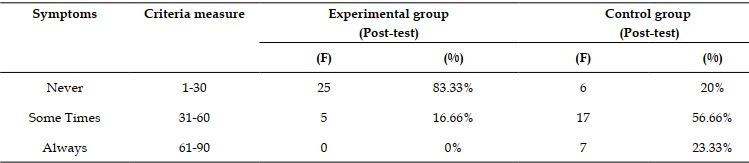
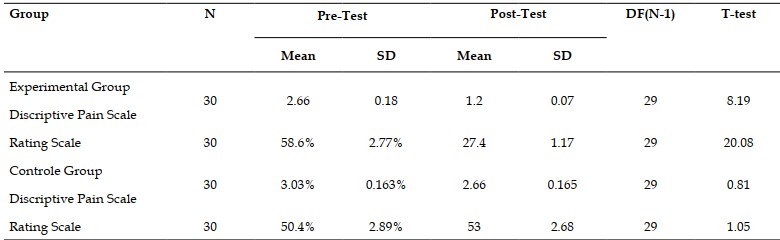
Dysmenorrhea can affect daily activities. The effect of dysmenorrhea is reduced quality of life. The carrot was administered to the school students for the reduction of dysmenorrhea and symptoms. The Most of them had reduction in dysmenorrhea and symptoms the carrot juice is proved to be very effective in menstrual cycle. Objectives of the Study: 1. To assess the Dysmenorrhea among adolescents girls. 2. To evaluate the effectiveness of carrot juice on Dysmenorrhea among the adolescent girls. 3. To find out the association between effectiveness of carrot juice on Dysmenorrhea with selected demographic variables. Design and Method Quantitative Evaluative Research Approach was found to be most appropriate. quasi experimental (pre and post–test control group design) was used in this study. Sample for the studied consisted of 60 school students and selection was done on the basis of Non-Probability purposive sampling selected government school Gwalior. In this study 30 dysmenorrhoea girls were taken as experimental group, this group carrot juice was given for seven consecutive days and 30 dysmenorrhoea girls for control group were got normal treatment. Tool was prepared for collection of data. Demographic variables, Simple descriptive pain scale, Rating scale for symptoms of dysmenorrhea. Results: The mean of adolescents girls with dysmenorrhoea is 2.66 and the standard deviation is 0.18 during pre-test assessment by the simple descriptive pain scale. In post test evaluation the mean is 1.2 and the standard deviation of 0.07 in experimental group. The mean of adolescents girls with dysmenorrhoea is 58.6 and standard deviation is 2.77 during pre-test assessment by the rating scale on symptoms of dysmenorrhoea. In post test evaluation the mean is 27.4 and the standard deviation is 1.17 in experimental group. The mean of adolescents girls with dysmenorrhoea is 3.03 and standard deviation is 38 0.163 during the pre-test assessment by the simple descriptive pain scale. In post test evaluation the mean is 2.66 and standard deviation is 0.165 in control group. The mean of the adolescents girls with dysmenorrhoea is 50.4 and the standard deviation is 2.89 during pretest assessment by the rating scale on symptoms of dysmenorrhoea. In post test evaluation the mean is 53 and the standard deviation 2.6 in control group. Discussion: The present study concluded to assess the effectiveness of carrot juice in reduction of dysmenorrhea and symptoms on school students. Conculsion: The main study was to assess the effectiveness of carrot juice in reduction of dysmenorrhea and symptoms on school students. The following conclusion was drawn on the basis of findings of the study: • The pre test finding showed that the dysmenorrhea and symptoms was present. • The carrot was administered to the school students for the reduction of dysmenorrhea and symptoms. • Most of them had reduction in dysmenorrhea and symptoms, the carrot juice is proved to be very effective in menstrual cycle.
References
- 1. Handhika W. Effectiveness of Carrot Juice (Daucus Carota) on Decreasing Degrees of Dysmenorrhea in Young Women in Dormitory Student Housing STIKES’ Aisyiyah Yogyakarta: STIKES’ Aisyiyah Yogyakarta; 2015.
- 2. Adesola A et al., Knowledge of adolescents‘ girls regarding primary dysmenorrhea and natural remedy in Nigeria. Journal of school of nursing. 2010 March.
- 3. Bergner P. et al., (2001), Female Herbs and dysmenorrhea‖, Medical Herbalism.
- 4. Campbell M.A., Mc Grath P.J., Dysmenorrheain-adolescent/abstracts
- 5. Charu S., Amita R., Sujoy R., Thomas G.A. Menstrual characteristics’ and ‘prevalence and effects of dysmenorrhea’ on quality of life of medical students. Journal of Collaborative Research on Internal Medicine & Public Health. 2012; 4(4): 276-94.
- 6. Deepika David, A study to assess the knowledge regarding home remedies to relieve dysmenorrhea among adolescent, international journal of current research, Vol. 6, issue 10, pp. 9279-9282 October 2014.
- 7. Derek R. Smith; Menstrual disorder and their adverse symptoms at work: an emergency occupational health issue in the nursing profession, nursing and health sciences‖, 2008 Sep; 3(10): pp. 222-228.
- 8. Dr. Easton patric, How to cure menstrual problems treat painful periods. Article world. 2011.
- 9. Dutta D.C. Text book of Gynecology. 4th edition, published by New central book agency, published at Calcutta, p. 174.
- 10. Esvandiary J., Sekar M., Wijoyo Y. Analgesic Effects and Anti-Inflammatory Effects of Beta Carotene on Mice. Dalam: Jurnal Penelitian. Yogyakarta: Fakultas Farmasi Universitas Sanata Dharma; 2007.
- 11. Latha P. et al. A study to assess the effectiveness of mentha spicata paste on dysmenorrhea among adolescent girls in Narayana College of Nursing, Nellore, narayana journal, 4(1), pp. 19-20.
- 12. McKay D.L., Blumberg J.B. A review of the bioactivity and potential health benefits of peppermint tea (Mentha piperita L.). USDA Human Nutrition Research Center on Aging at Tufts University, 711 Washington St., Boston, MA 02111, USA. diane.mckay@tufts.edu
Data Sharing Statement
There are no additional data available. All raw data and code are available upon request.
Funding
This research received no funding.
Author Contributions
All authors contributed significantly to the work and approve its publication.
Ethics Declaration
This article does not involve any human or animal subjects, and therefore does not require ethics approval.
Acknowledgements
We would like to express our gratitude to the patients, their families, and all those who have contributed to this study.
Conflicts of Interest
No conflicts of interest in this work.
About this article

Cite this article
Anugya Gaur. A Study to assess the Effectiveness of Carrot Juice Upon Dysmenorrhea among Adolecents Girls in Selected Government School Gwalior. Int J Practical Nurs. 2025; 13(1): 07-14
Licence:
Attribution-Non-commercial 4.0 International (CC BY-NC 4.0)This license enables reusers to distribute, remix, adapt, and build upon the material in any medium or format for noncommercial purposes only, and only so long as attribution is given to the creator.
| Received | Accepted | Published |
|---|---|---|
| February 08, 2025 | March 21, 2025 | April 30, 2025 |
DOI: https://doi.org/10.21088 ijpn.2347.7083.13125.1
Keywords
EffectivenessDysmenorheaCarrot JuiceAdolescent GirlsSearch for Similar Articles
Similar Articles
- From Artificial Limbs to Intelligent Limbs: Advances in Sensory-Enabled Prosthet...
- Pilot Study to Evaluate the Effectiveness of Novel Designed Nebulizer (NDN) on P...
- Periodic Review of Benchmarks Contributing to Reduction of Healthcare Associated...
- Forensic Nursing
- Women Empowerment in Rural Community
Article Level Metrics
Last UpdatedTuesday 22 September 2026, 12:37:13 (IST)
1405
Accesses
14
195
00
Citations
NA
NA
NA
Download citation
Article Keywords
Keyword Highlighting
Highlight selected keywords in the article text.
Timeline
| Received | February 08, 2025 |
| Accepted | March 21, 2025 |
| Published | April 30, 2025 |
licence
Attribution-Non-commercial 4.0 International (CC BY-NC 4.0)
This license enables reusers to distribute, remix, adapt, and build upon the material in any medium or format for noncommercial purposes only, and only so long as attribution is given to the creator.