Full Text (PDF)
International Journal of Political Science 11(2):p 83-91, July-Dec 2025. | DOI: https://doi.org/10.21088/ijops.2454.9371.11225.1
Original Article
Women Empowerment in the Southern States of India
Author Information
Licence:
Attribution-Non-commercial 4.0 International (CC BY-NC 4.0)This license enables reusers to distribute, remix, adapt, and build upon the material in any medium or format for noncommercial purposes only, and only so long as attribution is given to the creator.
International Journal of Political Science 11(2):p 83-91, July-Dec 2025. | DOI: https://doi.org/10.21088/ijops.2454.9371.11225.1
How Cite This Article:
Padma U.S., Nanzy P.S. Women Empowerment in the Southern states of India. Int J Pol Sci 2025; 11(2): 83–91.Timeline
Received : July 19, 2025
Accepted : August 25, 2025
Published : December 30, 2025
Abstract
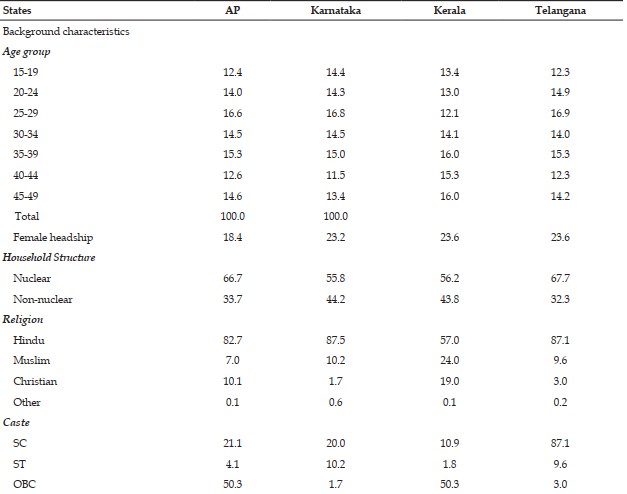
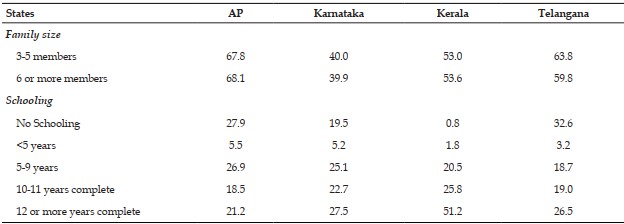
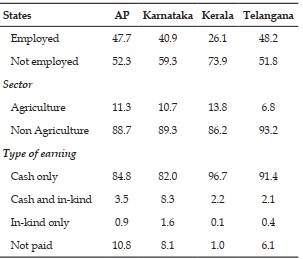
Empowerment is the process of improving women’s economic and social status in society while simultaneously protecting them from all forms of violence. This study has been made in this to assess women empowerment and decision-making in the four southern states in India. According to the needs of this study, all of the data was taken from the fifth National Family Health Survey (NFHS-5). The major objectives of this study are: (i) To identify the socio, economic and demographic characteristics of women among the four southern states (Andhra Pradesh, Karnataka, Kerala and Telangana); (ii) To compare women empowerment and decision-making in these southern states; (iii) To compare the type of violence against women in these southern states. In the states of Andhra Pradesh, Karnataka and Telangana, most of the women in the sample belong to the age group of 25-29. In Kerala majority of women belongs to the age group 35-39 and 45-49. About 23.6 percent of households are in the female headship in the three states except for Andhra Pradesh. According to household structure, more than half of them belong to the nuclear family in these four southern states. Regarding employment, more than half percent of the women were not employed in the past 12 months in all states. The percentage of women who are not employed was highest in the state of Kerala and lowest in the state of Telangana. Among the employed women majority of them are engaged in the non-agriculture sector. 91percent of women in Kerala decide how to spend their cash earnings, but in all other three southern states, this proportion is less than 80 percent. It is a positive indicator of women empowerment. Many married women are unemployed, and they do have not their own money, even though they have the decision-making power for how their husband’s cash earnings are spent. The majority of decisions are made jointly by husband and wife. The women in nuclear families have more autonomy in decision-making in all the states studied. Considering socio-demographic variables, the state of Kerala has a larger proportion of women engaging in decision-making than other states. More than three-quarters of women in all four southern states have a personal banking or savings account. Physical violence occurs at a higher rate than sexual violence in all of the states studied. Kerala women are subjected to less physical and sexual violence. Women’s educational attainment aids them in playing a substantial part in family decision-making. As a result, comprehensive measures to improve women’s educational status are important.
References
- 1. Banerjee Sudatta and Amrita Roy 2015: “Determinants of Female Autonomy across Indian States, Journal of Economics, Business and Management,Vol.3, No.11,Novemeber.
- 2. Kishor Sunita, Kamala Gupta 2004: “Women’s Empowerment in India and Its States : Evidence from the NFHS, Economic and Political Weekly, Vol.39, No.7, Feb 14-20, pp694-712.
- 3. Kishor Sunita, Kamala Gupta 2009:”Gender Equality and Women’s Empowerment in India, National Family Health Survey (NFHS-3), India, 2005-06, Mumbai, International Institute for Population Sciences; Calveron, Maryland, USA; ICF Macro.
- 4. National Family Health Survey (NFHS-V), 2019-20, AndraPradesh, International Institute for Population Sciences, Mumbai
- 5. National Family Health Survey (NFHS-V), 2019-20, Karnataka, International Institute for Population Sciences, Mumbai
- 6. National Family Health Survey (NFHS-V), 2019-20, Kerala, International Institute for Population Sciences, Mumbai
- 7. National Family Health Survey (NFHS-V), 2019-20, Telangana, International Institute for Population Sciences, Mumbai
Data Sharing Statement
There are no additional data available. All raw data and code are available upon request.
Funding
This research received no funding.
Author Contributions
All authors contributed significantly to the work and approve its publication.
Ethics Declaration
This article does not involve any human or animal subjects, and therefore does not require ethics approval.
Acknowledgements
We would like to express our gratitude to the patients, their families, and all those who have contributed to this study.
Conflicts of Interest
No conflicts of interest in this work.
About this article

Cite this article
Padma U.S., Nanzy P.S. Women Empowerment in the Southern states of India. Int J Pol Sci 2025; 11(2): 83–91.
Licence:
Attribution-Non-commercial 4.0 International (CC BY-NC 4.0)This license enables reusers to distribute, remix, adapt, and build upon the material in any medium or format for noncommercial purposes only, and only so long as attribution is given to the creator.
| Received | Accepted | Published |
|---|---|---|
| July 19, 2025 | August 25, 2025 | December 30, 2025 |
DOI: https://doi.org/10.21088/ijops.2454.9371.11225.1
Keywords
Women EmpowermentEducational AttainmentDecision-Making PowerSocio-Economic StatusViolence Against WomenSearch for Similar Articles
Similar Articles
- Identity, Knowledge, and Autonomy: A Study of Minority Educational Institutions...
- Digital Governance in State vs Central Universities: A Comparative Study
- Primary Educational Development in Telangana: Policy Impact and Future Direction...
- The Role of Cultural Nationalism in India’s Development: A Study of RSS Ideology
- Navigating China’s Historic Evolution
Article Level Metrics
Last UpdatedSaturday 17 October 2026, 09:30:02 (IST)
1548
Accesses
7
254
00
Citations
NA
NA
NA
Download citation
Article Keywords
Keyword Highlighting
Highlight selected keywords in the article text.
Timeline
| Received | July 19, 2025 |
| Accepted | August 25, 2025 |
| Published | December 30, 2025 |
licence
Attribution-Non-commercial 4.0 International (CC BY-NC 4.0)
This license enables reusers to distribute, remix, adapt, and build upon the material in any medium or format for noncommercial purposes only, and only so long as attribution is given to the creator.