Full Text (PDF)
Indian Journal of Plant and Soil 12(1):p 17-26, Jan - June 2025. | DOI: 10.21088/ijps.2348.9677.12125.2
Original Article
Synergistic eEffects of Triacontanol and Silicon Dioxide on Growth and Productivity of Turmeric (Curcuma longa L.)
Akbar Ali, Princy Tyagi, Krishan Kant, Shalu Gupta, Navneet Kaur, Mukta Satsangi, Parnika Jindal
Author Information
Licence:
Attribution-Non-commercial 4.0 International (CC BY-NC 4.0)This license enables reusers to distribute, remix, adapt, and build upon the material in any medium or format for noncommercial purposes only, and only so long as attribution is given to the creator.
Indian Journal of Plant and Soil 12(1):p 17-26, Jan - June 2025. | DOI: 10.21088/ijps.2348.9677.12125.2
How Cite This Article:
Tyagi P, Ali A, Kant K, et al. Synergistic Effects of Triacontanol and Silicon Dioxide on Growth and Productivity of Turmeric (Curcuma longa L.). Ind J Plant Soil. 2025;12(1):17-26.Timeline
Received : May 08, 2025
Accepted : June 16, 2025
Published : June 30, 2025
Abstract
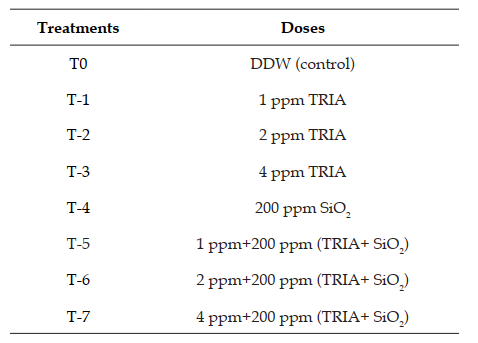
Curcuma longa L. (family Zingiberaceae), one of the earliest spices cultivated in Southeast Asia, has been used for centuries as a natural remedy for chronic diseases. This study investigated the effects of triacontanol (TRIA) and silicon dioxide (SiO2) on turmeric’s development, biochemistry, and yield attributes. An experiment using a randomized block design (RBD) applied eight spray treatments at 5-day intervals: (T-0) DDW (control), (T-1) 1 ppm TRIA, (T-2) 2 ppm TRIA, (T-3) 4 ppm TRIA, (T-4) 200 ppm SiO2, (T-5) 1 ppm TRIA + 200 ppm SiO2, (T-6) 2 ppm TRIA + 200 ppm SiO2, and (T-7) 4 ppm TRIA + 200 ppm SiO2. Key results revealed that treatment T-7 (4 ppm TRIA + 200 ppm SiO2) produced the highest shoot length per plant (18.93% increase) and fresh weight (68.53% increase), whereas T-3 (4 ppm TRIA) yielded the maximum root length per plant (45.45%), number of leaves per plant (38.88%), leaf area (48.54%), and rhizome length (73.33%). Biochemically, T-3 showed the highest total chlorophyll content (10.97% increase), while T-7
References
- 1. Araujo CAC, Leon LL. Biological activities of Curcuma longa L. Mem Inst Oswaldo Cruz. 2001; 96:723–8.
- 2. Ansar S, Jilani S, Abbasi H, Hashimi A, Ahmed Y, Khatoon R, et al. Curcuma longa: A treasure of medicinal properties. CellMed. 2020; 10(2):9–1.
- 3. Sanghvi K, Chandrasheker KS, Pai V. Review on Curcuma longa: ethnomedicinal uses, pharmacological activity and phytochemical constituents. Res J Pharm Technol. 2020;13(8): 3983–6.
- 4. Praveen A, Mawale KS, Parvatam G, Chaudhari SR. Efficacy of silver nanoparticles (NPs) and fungal elicitors on the curcuminoid production in Curcuma longa L. Plant Physiol Biochem. 2025; 220:109501.
- 5. Chattopadhyay I, Biswas K, Bandyopadhyay U, Banerjee RK. Turmeric and curcumin: Biological actions and medicinal applications. Curr Sci. 2004; 87:44–53.
- 6. Fuloria S, Mehta J, Chandel A, Sekar M, Rani NNIM, Begum MY, et al. A comprehensive review on the therapeutic potential of Curcuma longa Linn. in relation to its major active constituent curcumin. Front Pharmacol. 2022; 13:820806.
- 7. Vaughn AR, Branum A, Sivamani RK. Effects of turmeric (Curcuma longa) on skin health: a systematic review of the clinical evidence. Phytother Res. 2016;30(8):1243–64.
- 8. Sarı E, Sarıışık M. Use of turmeric, the golden spice in kitchen in different discipline areas. Toros Univ J Food Nutr Gastronomy. 2025;4(1):97–108.
- 9. Omosa LK, Midiwo JO, Kuete V. Curcuma longa. In: Kuete V, editor. Medicinal Spices
- 10. Amante G, Wedajo M, Temteme S. Growth and yield response of turmeric (Curcuma longa L.) to NPSB and urea fertilizer in Yeki district, southwest Ethiopia. Int J Food Agric Nat Resour. 2025;6(1):100–5.
- 11. Soleimani V, Sahebkar A, Hosseinzadeh H. Turmeric (Curcuma longa) and its major constituent (curcumin) as nontoxic and safe substances. Phytother Res. 2018;32(6):985–95.
- 12. Kotra VSR, Satyabanta L, Goswami TK. A critical review of analytical methods for determination of curcuminoids in turmeric. J Food Sci Technol. 2019;56(12):5153–66.
- 13. Albaqami JJ, Hamdi H, Narayanankutty A, Visakh NU, Sasidharan A, Kuttithodi AM, et al. Chemical composition and biological activities of the leaf EOs of Curcuma longa, Curcuma aromatica and Curcuma angustifolia. Antibiotics. 2022;11(11):1547.
- 14. Parthasarathy M, Anand AK, Rakesh Rao KR, Ramakrishnan R, Sudheer WN, Nagella P. Plant breeding advances in turmeric (Curcuma longa L.). In: Nagella P, editor. Biodiversity and Genetic Improvement of Herbs and Spices. 2025. . 435–69.
- 15. Naeem M, Khan M. Triacontanol: A potent plant growth regulator in agriculture. J Plant Interact. 2012; 7:129–42.
- 16. Khan MMA, Hashmi N, Moinuddin, Dar TA. Changes in growth, yield, photosynthetic characteristics, enzyme activities and EO production of fennel (Foeniculum vulgare Mill.) under growth regulator treatments. J Essent Oil Res. 2014;26(2):105–13.
- 17. Krishnan RR, Kumari BD. Effect of N-triacontanol on the growth of salt stressed soybean plants. J Biosci. 2008;19(2):53–62.
- 18. Borowski E, Blamowski ZK. The effects of triacontanol ‘TRIA’ and Asahi SL on the development and metabolic activity of sweet basil (Ocimum basilicum L.) plants treated with chilling. Folia Hortic. 2009;21(1):39–48.
- 19. Khan MMA, Hashmi N, Moinuddin, Dar TA. Changes in growth, yield, photosynthetic characteristics, enzyme activities and EO production of fennel (Foeniculum vulgare Mill.) under growth regulator treatments. J Essent Oil Res. 2014;26(2):105–13.
- 20. Karam EA, Keramat B. Foliar spray of triacontanol improves growth by alleviating oxidative damage in coriander under salinity. Indian J Plant Physiol. 2017;22(1):120–4.
- 21. Naeem M, Ansari AA, Aftab T, Shabbir A, Alam MM, Khan MMA, et al. Application of triacontanol modulates plant growth and physiological activities of Catharanthus roseus (L.). Int J Bot Stud. 2019; 4:131–5.
- 22. Islam S, Mohammad F. Triacontanol as a dynamic growth regulator for plants under diverse environmental conditions. Physiol Mol Biol Plants. 2020;26(5):871–83.
- 23. Zaid A, Mohammad F, Fariduddin Q. Plant growth regulators improve growth, photosynthesis, mineral nutrient and antioxidant system under cadmium stress in menthol mint (Mentha arvensis L.). Physiol Mol Biol Plants. 2020;26(1):25–39.
- 24. Islam S, Zaid A, Mohammad F. Role of triacontanol in counteracting the ill effects of salinity in plants: a review. J Plant Growth Regul. 2021; 40:1–10.
- 25. Mukarram M, Khan MMA, Corpas FJ. Silicon nanoparticles elicit an increase in lemongrass (Cymbopogon flexuosus (Steud.) Wats) agronomic parameters with a higher EO yield. J Hazard Mater. 2021; 412:125254.
- 26. Assis FA, Moraes JC, Auad AM, Coelho M. The effects of foliar spray application of silicon on plant damage levels and components of larval biology of the pest butterfly Chlosyne lacinia saundersii (Nymphalidae). Int J Pest Manag. 2013;59(2):128–34.
- 27. Avestan S, Ghasemnezhad M, Esfahani M, Byrt CS. Application of nano-silicon dioxide improves salt stress tolerance in strawberry plants. Agronomy. 2019;9(5):246.
- 28. Hedayati A, Hosseini B, Palazon J, Maleki R. Improved tropane alkaloid production and changes in gene expression in hairy root cultures of two Hyoscyamus species elicited by silicon dioxide nanoparticles. Plant Physiol Biochem. 2020; 155:416–28.
- 29. Khan MR, Siddiqui ZA. Use of silicon dioxide nanoparticles for the management of Meloidogyne incognita, Pectobacterium betavasculorum and Rhizoctonia solani disease complex of beetroot (Beta vulgaris L.). Sci Hortic. 2020; 265:109211.
- 30. Singh D, Chhonkar PK, Pandey RN. Soil plant water analysis: a methods manual. New Delhi: IARI; 1999. p. 80–2.
- 31. Kadam JR, Shinde PB. Practical manual on soil physics—A method manual. Rahuri: Dept. of Agricultural Chemistry and Soil Science, PGI; 2005. p. 24.
- 32. Page AL, editor. The Methods of Soil Analysis, Part-2. Madison: ASA, SSSA; 1983.
- 33. Knudsen DL, Peterson GA, Pratt PF. Lithium, sodium, and potassium. In: Page AL, editor. Methods of soil analysis: Part 2. Chemical and microbiological properties. 2nd ed. Madison: ASA, SSSA; 1982. p. 225–46.
- 34. Ghosh AB, Bajaj JC, Hasan R, Singh D. Soil and water testing methods: A laboratory manual. New Delhi: IARI; 1983. p. 31–6.
- 35. Olsen SR, Sommers LE. Phosphorous. In: Page AL, editor. Methods of soil analysis: Part 2, Chemical and microbiological properties. 2nd ed. Madison: ASA, SSSA; 1982. p. 403–30.
- 36. Mackinney G. Absorption of light by chlorophyll solutions. J Biol Chem. 1941;140(2):315–22.
- 37. Maclachlan S, Zalik S. Plastid structure, chlorophyll concentration, and free amino acid composition of a chlorophyll mutant of barley. Can J Bot. 1963;41(7):1053–62.
- 38. Guenther E. The EOs. Vol. 1. New York: D. Van Nostrand Company; 1972.
- 39. Kant K, Gupta S, Kaur N, Jindal P, Ali A. Novel foliar approaches enhancing active constituents, flower yield and EO content in Damask rose (Rosa damascena Mill.): A review. J Plant Nutr. 2023;46(18):4532–58.
- 40. El-Beltagi HS, Gad M, Abdel-Haleem M, Shalaby TA, Rezk AA, Khedr EH. Triacontanol: A multifunctional growth regulator for enhancing stress tolerance. J Crop Health. 2025;77(2):1–20.
- 41. Kaur K, Gupta M, Rattanpal HS, Kaur A, Anand S, Singh M. Influence of exogenously applied growth regulators on mitigating fruit splitting and enhancing yield and quality in ‘Daisy’ mandarin in an arid irrigated region of the Punjab. Appl Fruit Sci. 2025;67(3):94.
- 42. Ali HMM, Perveen S. Effect of foliar applied triacontanol on wheat (Triticum aestivum L.) under arsenic stress: A study of changes in growth, yield and photosynthetic characteristics. Physiol Mol Biol Plants. 2020; 26:1215–24.
- 43. Perveen S, Iqbal M, Nawaz A, Parveen A, Mahmood S. Induction of drought tolerance in Zea mays L. by foliar application of triacontanol. Pak J Bot. 2016;48(3):907–15.
- 44. Naeem M, Khan MMA, Moinuddin, Idrees M, Aftab T. Triacontanol-mediated regulation of growth and other physiological attributes, active constituents and yield of Mentha arvensis L. Plant Growth Regul. 2011; 65:195–206.
- 45. Singh M, Khan MMA, Moinuddin, Naeem M. Augmentation of nutraceuticals, productivity and quality of ginger (Zingiber officinale Rosc.) through triacontanol application. Plant Biosyst. 2012;146(1):106–13.
- 46. Siddiqui MH, Al-Whaibi MH, Faisal M, Al Sahli AA. Nano-silicon dioxide mitigates the adverse effects of salt stress on Cucurbita pepo L. Environ Toxicol Chem. 2014;33(11):2429–37.
- 47. Othman AJ, Eliseeva LG, Ibragimova NA, Zelenkov VN, Latushkin VV, Nicheva DV. Dataset on the effect of foliar application of different concentrations of silicon dioxide and organosilicon compounds on the growth and biochemical contents of oak leaf lettuce (Lactuca sativa var. crispa) grown in phytotron conditions. Data Brief. 2021; 38:107328.
- 48. Janmohammadi M, Amanzadeh T, Sabaghnia N, Ion V. Effect of nano-silicon foliar application on safflower growth under organic and inorganic fertilizer regimes. Bot Lith. 2016;22(1):53–64.
- 49. Simko I, Zhao R, Peng H. Differential impact of SiO 2 foliar application on lettuce response to temperature, salinity, and drought stress. Plants. 2025;14(12):1845.
- 50. Parveen A, Siddiqui ZA. Impact of silicon dioxide nanoparticles on growth, photosynthetic pigments, proline, activities of defense enzymes and some bacterial and fungal pathogens of tomato. Vegetos. 2022;1–11
Data Sharing Statement
There are no additional data available. All raw data and code are available upon request.
Funding
This research received no funding.
Author Contributions
All authors contributed significantly to the work and approve its publication.
Ethics Declaration
This article does not involve any human or animal subjects, and therefore does not require ethics approval.
Acknowledgements
We would like to express our gratitude to the patients, their families, and all those who have contributed to this study.
Conflicts of Interest
No conflicts of interest.
About this article

Cite this article
Tyagi P, Ali A, Kant K, et al. Synergistic Effects of Triacontanol and Silicon Dioxide on Growth and Productivity of Turmeric (Curcuma longa L.). Ind J Plant Soil. 2025;12(1):17-26.
Licence:
Attribution-Non-commercial 4.0 International (CC BY-NC 4.0)This license enables reusers to distribute, remix, adapt, and build upon the material in any medium or format for noncommercial purposes only, and only so long as attribution is given to the creator.
| Received | Accepted | Published |
|---|---|---|
| May 08, 2025 | June 16, 2025 | June 30, 2025 |
DOI: 10.21088/ijps.2348.9677.12125.2
Keywords
Turmeric (Curcuma longa L.)TriacontanolSilicon dioxideRhizome and EOSearch for Similar Articles
Similar Articles
- Impact of Seed Mycoflora on Seed Health Status of Bottle Gourd
- Impact of Rainfall Variability and Soil Characteristics on Rainfed Agricultural...
- Efficacy of Jeevamrut Against Cercospora Leaf Spot of Spinach (Spinacia oleracea...
- Soil Series and Land Capability Classification of Itanagar Capital Complex
- GIS based Analytical Hierarchy Process for Analysis of Land Suitability for Sesa...
Article Level Metrics
Last UpdatedThursday 16 July 2026, 04:53:57 (IST)
502
Accesses
15
163
00
Citations
NA
NA
NA
Download citation
Article Keywords
Keyword Highlighting
Highlight selected keywords in the article text.
Timeline
| Received | May 08, 2025 |
| Accepted | June 16, 2025 |
| Published | June 30, 2025 |
licence
Attribution-Non-commercial 4.0 International (CC BY-NC 4.0)
This license enables reusers to distribute, remix, adapt, and build upon the material in any medium or format for noncommercial purposes only, and only so long as attribution is given to the creator.