Full Text (PDF)
Indian Journal of Plant and Soil 12(1):p 37-47, Jan - June 2025. | DOI: 10.21088/ijps.2348.9677.12125.4
Original Article
Soil Colour as Proxy to assess Drainage in Rice growing Alluvial Soils of Godavari Basin, Andhra Pradesh
Author Information
Licence:
Attribution-Non-commercial 4.0 International (CC BY-NC 4.0)This license enables reusers to distribute, remix, adapt, and build upon the material in any medium or format for noncommercial purposes only, and only so long as attribution is given to the creator.
Indian Journal of Plant and Soil 12(1):p 37-47, Jan - June 2025. | DOI: 10.21088/ijps.2348.9677.12125.4
How Cite This Article:
Bhaskar BP. Soil colour as Proxy to assess Drainage in Rice growing Alluvial Soils of Godavari basin, Andhra Pradesh. Ind J Plant Soil. 2025;12(1):37-47.Timeline
Received : April 18, 2025
Accepted : May 17, 2025
Published : June 30, 2025
Abstract
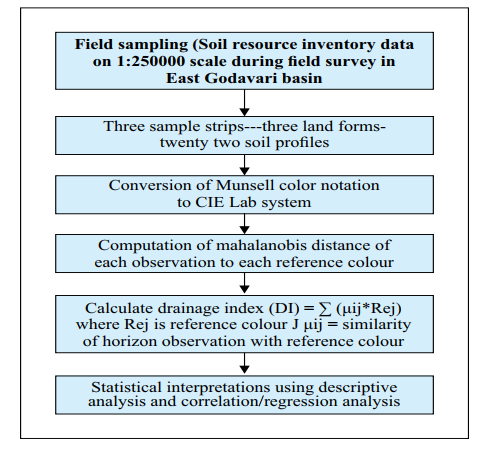
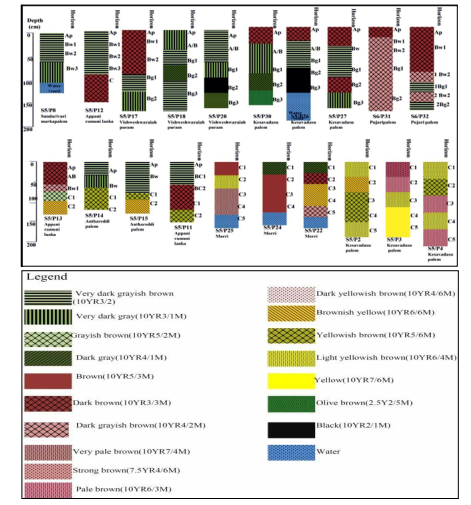
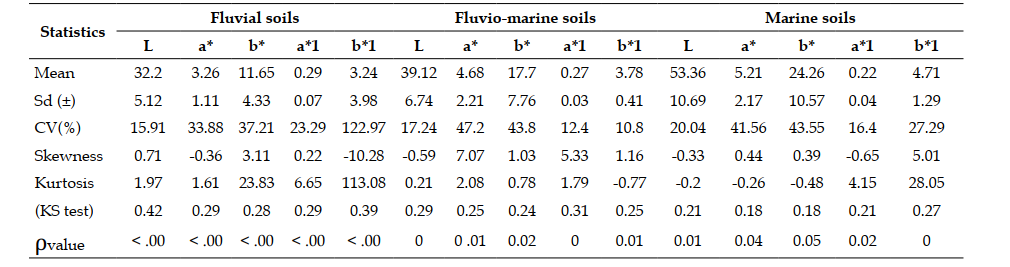
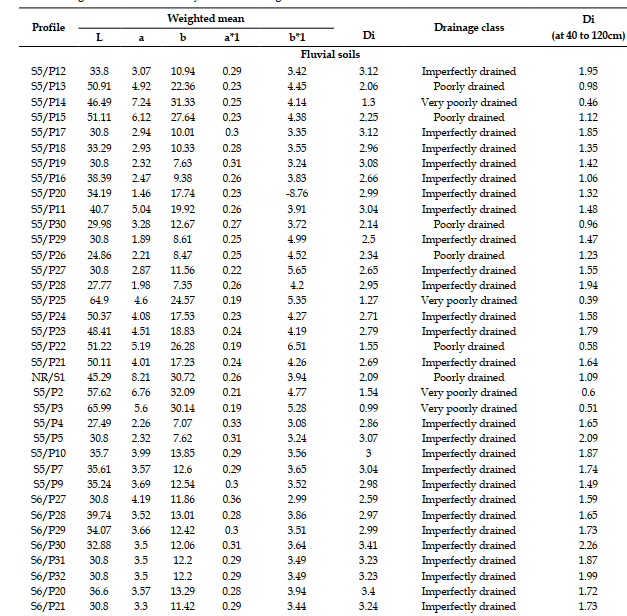
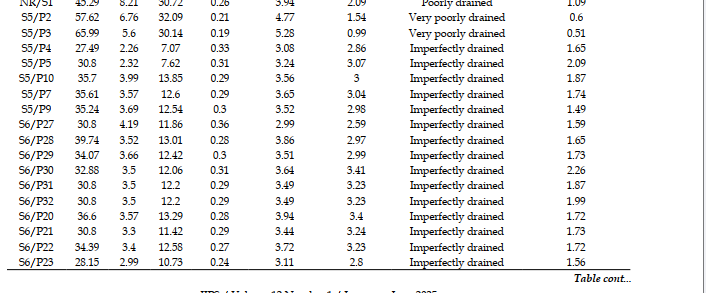
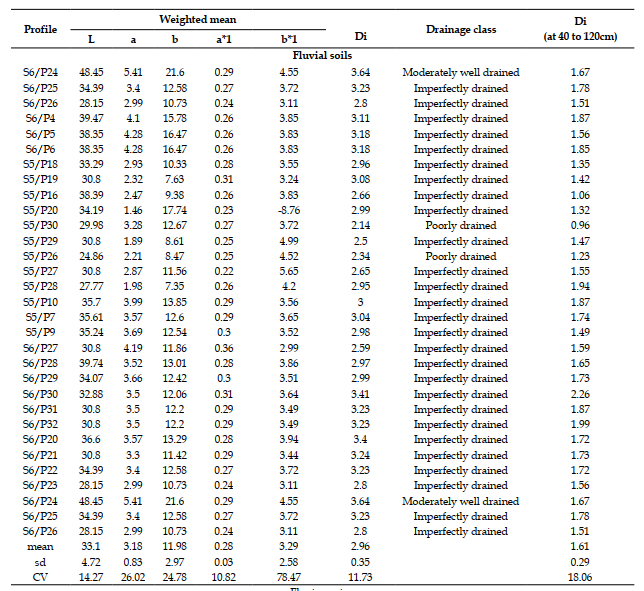
Alluvial soils in the Godavari basin’s rice fields can be assessed for drainage using Munsell color. Munsell color gradations are converted to the CIELab system. Then, Mahalanobis distance is computed to create a drainage index. Soil samples from three landforms were analyzed: fluvial, fluvio-marine, and marine. The soil resource inventory was on 1:250000 scale. Fluvial plains had dark gray to very dark grayish-brown soil. The texture ranged from silty clay to clay. Fluvio-marine soils had intermittent sandy layers. Marine landforms showed varied colors in the C horizons’ sandy layers. Fluvial plains’ genetic horizons contained cambic (30.54±14.31cm) and slicken sided (104.5±15.57cm) features. Clay textured, very dark grayish brownish soils were most common (30%). Dark grayish-brown (12.8%) and silty clay dark brown (12.8%) soils followed Vertisols, except Fluventic Eutrudepts, had a mean L value of 32.2 ± 5.12 (CV of 15.91%). The mean “a” value was 3.26 ± 1.11. Variability was moderate (CV of 33.88%). An a*1 value less than 0.3 indicated low iron and poorly drained profiles. Fluvial soils had a mean drainage index (Di) of 2.96±0.35. Variability was low (CV of 11.73%), and drainage was imperfect. A strong positive relationship existed between the drainage index (DI) and CIE “L” values in fluvial soils (R²=0.29). Fluviomarine soils had a mean Di of 2.98±0.39 at 40 to 100 cm. The CV was 18.48%. These imperfectly drained soils had high “b” values. Di correlated with “a” and “b” values: Di = 4.02 - 1.09(a)+0.23(b) with an R² of 0.98.The study shows that CIELab values can define drainage class in alluvial soil profiles in the Godavari basin.
References
- 1. Isbell, R.F. (1996). The Australian Soil Classification. Collingwood: CSIRO Publishing. Google Scholar.
- 2. Aitkenhead, M.J., Coull, M., Towers, W., Hudson, G. & Black, H,I,J.(2013). Prediction of soil characteristics and colour using data from the National Soils Inventory of Scotland. Geoderma. 200–201:99–107. doi: 10.1016/j. geoderma.2013.02.013. DOI Google Scholar=
- 3. Pretorius, M.L., Van Huyssteen, C.W. & Brown, L.R. (2017).Soil color indicates carbon and wetlands: developing a color-proxy for soil organic carbon and wetland boundaries on sandy coastal plains in South Africa. Environmental Monitoring and Assessment. 189(11):556. Doi: 10.1007/s10661-017-6249-z. DOI PubMed Google Scholar
- 4. Schwertmann, U. & Taylor, R. (1977). Iron oxides. In: Dixon JB, Weed SB, editors. Minerals in Soil Environments. Madison: Soil Science Society of America; pp. 151–158. Google Scholar
- 5. Bouma, J. (1983).Hydrology and soil genesis of soils with aquic moisture regimes. In: Wilding LP, Smeck NE, Hall GF, editors. Pedogenesis and Soil Taxonomy. 1. Concepts and Interactions. Dordrecht: Elsevier Science Publishers; pp. 253–281. Google Scholar
- 6. Blavet, D., Mathe, E. & Leprun, J.C. (2000) Relations between soil colour and waterlogging duration in a representative hillside of the West African granito-gneissic bedrock. Catena. 39(3):187–210. doi: 10.1016/ s0341-8162(99)00087-9. DOI Google Scholar
- 7. Evans CV, Franzmeier DP. Color index values to represent wetness and aeration in some Indiana soils. Geoderma. 1988; 41(3–4): 353–368. doi: 10.1016/0016-7061(88)90070-5. DOI Google Scholar
- 8. Chaplot, V., Walter, C. & Curmi, P. (2000). Improving soil hydromorphy prediction according to DEM resolution and available pedological data. Geoderma. 97(3–4):405–422. doi: 10.1016/s0016-7061(00)00048-3. DOI Google Scholar
- 9. Bhaskar, B.P. & Utpal Baruah. (2024). Agropedological characterization of chars and beels in the Brahmaputra valley, Assam. Selfy page developers PVT, Limited. IIP, Chikmagalur, Karnataka, pp.215.
- 10. Torrent, J., Schwertmann, U., Fechter, H. & Alferez, F. (1983). Quantitative relationships between soil color and hematite content. Soil Science. 136(6):354–358. doi: 10.1097/00010694- 198312000-00004. DOI Google Scholar
- 11. Schaetzl, R., Krist, F., Stanley, K. & Hupy, C. (2009). The natural soil drainage index: an ordinal estimate of long-term soil wetness. Physical Geography. 30(5):383–409. doi:10.2747/ 0272-3646.30.5.383. DOI Google Scholar
- 12. McBratney, A,B., Mendonca-Santos, M.L. & Minasny, B. (2003). On digital soil mapping. Geoderma. 117(1–2):3–52. doi: 10.1016/s0016- 7061(03)00223-4. DOI Google Scholar
- 13. Kravchenko, A.N, Bollero, G.A., Omonode, R, A. & Bullock, D.G. (2002). Quantitative mapping of soil drainage classes using topographical data and soil electrical conductivity. Soil Science Society of America Journal. 66(1):235–243. doi: 10.2136/sssaj 2002.0235. DOI Google Scholar
- 14. Bell, J.C., Cunningham, R.L. & Havens, M,W. (1992)Calibration and validation of a soillandscape model for predicting soil drainage class. Soil Science Society of America Journal. 56(6):1860–1866. doi: 10.2136/sssaj1992. 03615995005600060035x. DOI Google Scholar
- 15. Malone, B.P., McBratney, A.B. & Minasny B.(2018). Description and spatial inference of soil drainage using matrix soil colours in the Lower Hunter Valley, New South Wales, Australia. PeerJ. Apr 16;6:e4659. doi: 10.7717/peerj.4659. PMID: 29682425; PMCID: PMC5907776.
- 16. Chaplot .V., Walter. C., Curmi. P., Lagacherie. P., & King. D. (2004). Using the topography of the saprolite upper boundary to improve the spatial prediction of the soil hydromorphic index. Geoderma. 123(3–4):343–354. doi: 10.1016/j.geoderma.2004.03.001. DOI Google Scholar
- 17. Peng W, Wheeler D.B., Bell, J.C, Krusemark M.G. (2003). Delineating patterns of soil drainage class on bare soils using remote sensing analyses. Geoderma. 115(3–4):261–279. doi: 10.1016/s0016-7061(03)00066-1. DOI Google Scholar
- 10. 1016/s0016-7061(03)00066-1. DOI Google Scholar remotely sensed and digital elevation data. Photogrammetric Engineering and Remote Sensing. 1997;62:171–177. Google Scholar
- 18. Cialella A, Dubayah R, Lawrence W, Levine E. (1997). Predicting soil drainage class using remotely sensed and digital elevation data. Photogrammetric Engineering and Remote Sensing. 1997;62:171–177. Google Scholar
- 19. Hurst, V.J.(1977). Visual estimation of iron in saprolite, Geol. Soc. Am. Bull., 1977, vol. 88, pp. 174–176.
- 20. Leone, N., Mercurio, M., Grilli, E., et al.,(2011). Potential of vis-NIR reflectance spectroscopy for the mineralogical characterization of synthetic gleys: a preliminary investigation, Period. Miner., 2011, vol. 80, pp. 433–453.
- 21. Sanchez-Maranon, M., Delgado, G., Melgosa, M., et al., (1997) CIELAB color parameters and their relationship to soil characteristics in Mediterranean red soils, Soil Sci., 162, pp. 833–842.
- 22. Vodyanitski, Yu.N., and Kirillova, N.P. (2016). Conversion of Munsell color Coordinates to Cie L*a*b *system:Tables and Calculation examples.Mascow University Soil Science Bulletin., 71(4-5):139-146.
- 23. Viscarra Rossel R.A, Minasny B, Roudier P, McBratney AB. 2006. Colour space models for soil science. Geoderma 133(3–4):320– 337 DOI 10.1016/j.geoderma.2005.07.017
- 24. Vodyanitskii, Y. N. & Kirillova, N.P. (2016). Application of the CIE-L* a* b* system to characterize soil color. Eurasian Soil Science, 49(11), 1259-1268.
- 25. Northcote KH. (1979). A Factual Key for the Recognition of Australian Soils. Fourth Edition. Glenside: Rellim Technical Publications.
- 26. Soil Survey Staff. (2014). Keys to Soil Taxonomy. Twelfth Edition Edition, United States Department of Agriculture, Natural Resources Conservation Service, Washington DC.
- 27. Naoki Moritsuka, Kaori Matsuoka, Keisuke Katsura, Shuji Sano & Junta Yanai. (2014) Soil color analysis for statistically estimating total carbon, total nitrogen and active ironcontents in Japanese agricultural soils, Soil Science and Plant Nutrition. 60:4, 475-485, DOI: 10.1080/00380768.2014.906295
- 28. Akpan, J. F., Aki, E. E. and Isong, I. A. (2017). Comparative assessment of wetland and coastal plain soils in Calabar, Cross River State. Global journal of Agricultural sciences. 16: 17-30
- 29. Abayneh, E. (2005). Characteristics, genesis and classification of reddish soils from Sidamo Ethiopia. Ph.D Thesis, University of Putra Malaysia. pp. 25-52.47 IJPS / Volume 12 Number 1 / January – June 2025
- 30. Akl, E.E. and Isong, I.A. (2018). Characterization of physic-chemical properties and micronutrient status of soils developed on Anantigha coastal marine sediments in Calabar. Global Journal of Agricultural Sciences. 17:1-13. DOI: 10.4314/ gjass.v17i1.1.
Data Sharing Statement
There are no additional data available. All raw data and code are available upon request.
Funding
This research received no funding.
Author Contributions
All authors contributed significantly to the work and approve its publication.
Ethics Declaration
This article does not involve any human or animal subjects, and therefore does not require ethics approval.
Acknowledgements
We would like to express our gratitude to the patients, their families, and all those who have contributed to this study.
Conflicts of Interest
No conflicts of interest.
About this article

Cite this article
Bhaskar BP. Soil colour as Proxy to assess Drainage in Rice growing Alluvial Soils of Godavari basin, Andhra Pradesh. Ind J Plant Soil. 2025;12(1):37-47.
Licence:
Attribution-Non-commercial 4.0 International (CC BY-NC 4.0)This license enables reusers to distribute, remix, adapt, and build upon the material in any medium or format for noncommercial purposes only, and only so long as attribution is given to the creator.
| Received | Accepted | Published |
|---|---|---|
| April 18, 2025 | May 17, 2025 | June 30, 2025 |
DOI: 10.21088/ijps.2348.9677.12125.4
Keywords
CIE Lab10.21088/ijps.2348.9677.12125.4Drainage IndexCorrelationMahanalobis DistanceMunsell Colour ChartsSimilaritySearch for Similar Articles
Similar Articles
- Impact of Seed Mycoflora on Seed Health Status of Bottle Gourd
- Impact of Rainfall Variability and Soil Characteristics on Rainfed Agricultural...
- Efficacy of Jeevamrut Against Cercospora Leaf Spot of Spinach (Spinacia oleracea...
- Soil Series and Land Capability Classification of Itanagar Capital Complex
- GIS based Analytical Hierarchy Process for Analysis of Land Suitability for Sesa...
Article Level Metrics
Last UpdatedThursday 16 July 2026, 04:07:10 (IST)
502
Accesses
9
163
00
Citations
NA
NA
NA
Download citation
Article Keywords
Keyword Highlighting
Highlight selected keywords in the article text.
Timeline
| Received | April 18, 2025 |
| Accepted | May 17, 2025 |
| Published | June 30, 2025 |
licence
Attribution-Non-commercial 4.0 International (CC BY-NC 4.0)
This license enables reusers to distribute, remix, adapt, and build upon the material in any medium or format for noncommercial purposes only, and only so long as attribution is given to the creator.