Full Text (PDF)
International Journal of Neurology and Neurosurgery 16 (3-4 ):p 67-70, July-December 2024. | DOI: https://doi.org/10.21088/ijnns.0975.0223.163424.4
Case Report
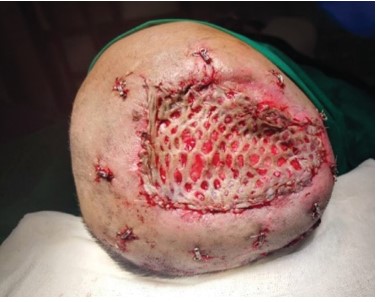
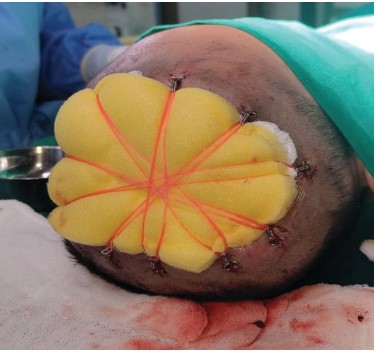
Role of External Tissue Expansion and Wound Closure Technique in the Management of Postburn Raw Area Scalp
Ravi Kumar Chittoria, Shreyash Jain, Amrutha J S
Author Information
Licence:
Attribution-Non-commercial 4.0 International (CC BY-NC 4.0)This license enables reusers to distribute, remix, adapt, and build upon the material in any medium or format for noncommercial purposes only, and only so long as attribution is given to the creator.
International Journal of Neurology and Neurosurgery 16 (3-4 ):p 67-70, July-December 2024. | DOI: https://doi.org/10.21088/ijnns.0975.0223.163424.4
How Cite This Article:
Shreyash Jain, Ravi Kumar Chittoria, Amrutha J S, Role of External Tissue Expansion and Wound Closure Technique in the Management of Postburn Raw Area Scalp. International Journal of Neurology and Neurosurgery. 2024;16(3-4):67-70.Timeline
Received : July 28, 2024
Accepted : October 31, 2024
Published : December 30, 2024
Abstract
The reconstruction of scalp defects remains a significant challenge in plastic surgery. External Tissue Expansion (ETE) has garnered attention for its capacity to regenerate soft tissues, including skin, subcutaneous fat, and breast tissue. As a minimally invasive and cost-effective tissue engineering approach, ETE demonstrates great potential in wound regeneration. Despite promising outcomes, several challenges must be addressed before its routine clinical application can be realized.Basic in vivo and in vitro studies have explored the mechanisms underlying ETE-mediated tissue regeneration. Findings suggest that ETE facilitates cell proliferation and migration, enhances adipogenesis, promotes angiogenesis, and provides a favorable environment for soft tissue growth. Understanding the mechanical and chemical signals involved in ETE-induced tissue regeneration could enable its broader adaptation in clinical practice.This article reviews the clinical applications of ETE, examines preclinical animal models, and evaluates the potential mechanisms by which ETE promotes tissue regeneration, offering insights into its future integration into clinical settings.
References
- 1. Neumann CG. The expansion of an area of skin by progressive distension of a subcutaneous balloon; use of the method for securing skin for subtotal reconstruction of the ear. PlastReconstr Surg. 1957;19:124–30.
- 2. Radovan C. Breast reconstruction after mastectomy using temporary expander. PlastReconstr Surg. 1982;70:195–208.
- 3. Austad ED, Rose GL. A self-inflating tissue expander. PlastReconstr Surg. 1982;70:588–94.
- 4. Matev I. Thumb reconstruction after amputation at the metacarpophalangeal joint. J Bone Joint Surg Am. 1970;52-A:957–65.
- 5. Codvilla A. On the means of lengthening, in the lower limbs, the muscle and tissues which are shortened through deformity. Am J Orthop Surg. 1905;2:353–69.
- 6. Lasheen AE, Salim A, Hefny MR, Al-Bakly E. External tissue expansion successfully achieved using negative pressure. Surg Today. 2004;34:193–6.
- 7. Barnea Y, Gur E, Amir A, Leshem D, Zaretski A, Miller E, et al. Delayed primary closure of fasciotomy wounds with Wisebands, a skin- and soft tissue-stretch device. Injury. 2006;37:561–6.
- 8. Nielson DL, Wu SC, Armstrong DG. Delayed primary closure of diabetic foot wounds using the DermaClose RC Tissue Expander. Foot Ankle J. 2008;1:3.
Data Sharing Statement
There are no additional data available. All raw data and code are available upon request.
Funding
This research received no funding.
Author Contributions
All authors contributed significantly to the work and approve its publication.
Ethics Declaration
This article does not involve any human or animal subjects, and therefore does not require ethics approval.
Acknowledgements
We would like to express our gratitude to the patients, their families, and all those who have contributed to this study.
Conflicts of Interest
No conflicts of interest in this work.
About this article

Cite this article
Shreyash Jain, Ravi Kumar Chittoria, Amrutha J S, Role of External Tissue Expansion and Wound Closure Technique in the Management of Postburn Raw Area Scalp. International Journal of Neurology and Neurosurgery. 2024;16(3-4):67-70.
Licence:
Attribution-Non-commercial 4.0 International (CC BY-NC 4.0)This license enables reusers to distribute, remix, adapt, and build upon the material in any medium or format for noncommercial purposes only, and only so long as attribution is given to the creator.
| Received | Accepted | Published |
|---|---|---|
| July 28, 2024 | October 31, 2024 | December 30, 2024 |
DOI: https://doi.org/10.21088/ijnns.0975.0223.163424.4
Keywords
External Tissue Expansion (ETE)tissue regenerationwound closurescalpraw areaburnSearch for Similar Articles
Similar Articles
- Young Female Developed Cervical Hematoma While Weight Lifting
- Role of Bone: Abrasion in Wound Bed Preparation in Pediatric Scalp Electrical Bu...
- A Case Report of Rare Syndrome: Fahr’s Syndrome
- Is Resection of Disc Necessary in Surgery for Spinal Degeneration?
- Cerebral Infarction in Scalp Electrical Burns
Article Level Metrics
Last UpdatedMonday 23 November 2026, 00:42:28 (IST)
3630
Accesses
6
424
00
Citations
NA
NA
NA
Download citation
Article Keywords
Keyword Highlighting
Highlight selected keywords in the article text.
Timeline
| Received | July 28, 2024 |
| Accepted | October 31, 2024 |
| Published | December 30, 2024 |
licence
Attribution-Non-commercial 4.0 International (CC BY-NC 4.0)
This license enables reusers to distribute, remix, adapt, and build upon the material in any medium or format for noncommercial purposes only, and only so long as attribution is given to the creator.