Full Text (PDF)
International Journal of Political Science 8(1):p 35-42, January – June 2022. | DOI: https://doi.org/10.21088/ijpos.2454.9371.8122.4
Review Article
National Youth Policy, 2014: Implementation, Performance and Setbacks
Nagendra Ambedkar Sole, Urvashi Pareek
Author Information
Licence:
Attribution-Non-commercial 4.0 International (CC BY-NC 4.0)This license enables reusers to distribute, remix, adapt, and build upon the material in any medium or format for noncommercial purposes only, and only so long as attribution is given to the creator.
International Journal of Political Science 8(1):p 35-42, January – June 2022. | DOI: https://doi.org/10.21088/ijpos.2454.9371.8122.4
How Cite This Article:
Urvashi Pareek, Nagendra Ambedkar Sole/National Youth Policy, 2014: Implementation, Performance and Setbacks/International Journal of Political Science 2022; 8(1):35–42.Timeline
Received : November 12, 2021
Accepted : March 08, 2022
Published : June 30, 2022
Abstract
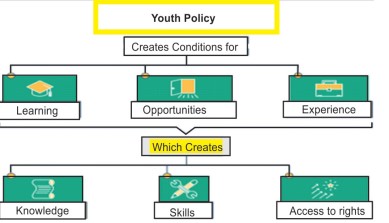
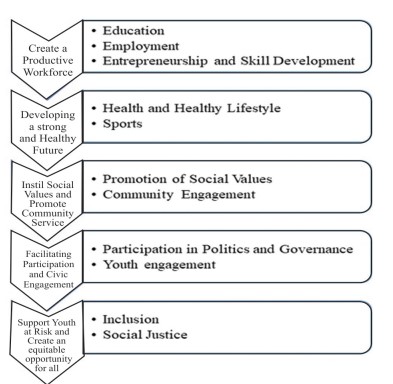
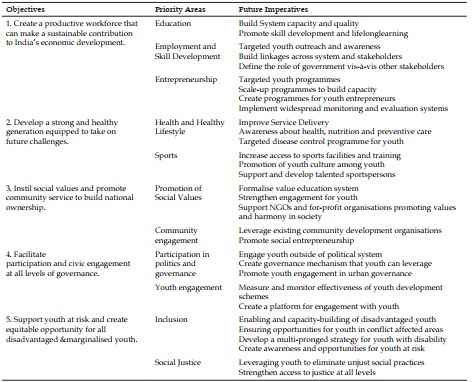
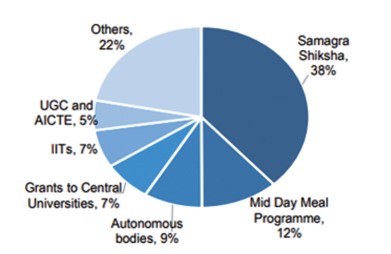
Youth comprises the most valuable and productive section in a population of a nation, and the development of a nation determines the development of a nation. Thus, it is required to formulate and implement policies dedicated towards the growth and development of the youth, build their capabilities, impart skills and training to the youth and prepare a strong base of human resource for the nation to progress. According to the Census 2011, the Youth in India comprises about 34.8% of the total population, and this demographic dividend makes it a young nation and also provides advantages of reaping this vast talent pool for economic growth. The paper highlights the National Youth Policy of India implemented in 2014. It describes youth, importance and various schemes for the youth in India, its vision, objectives and future imperatives. It also discusses the enactment of the youth policy until 2020, impact analysis of the policy and setbacks. It is a review paper and attempts to analyse whether the National Youth Policy, 2014 has been able to achieve its goal of empowering Youth of India and achieve a global position in all spheres by harnessing their capabilities. The paper concludes that the most critical factor today is to create a happy and stress –free environment for the youth so that they get a chance to develop to the fullest. The National Youth Policy fails to understand this aspect of happiness. Happiness Index is developed, and its vitality is internationally recognised, so the policy-makers must look into this dimension to strengthen and empower the youth while implementing this policy with a good spirit.
References
- 1. Business Standard. (2016, 27th April). Business Standard. Retrieved 5th May, 2020, from Business Standard Web Site: https://www. business-standard.com/article/governmentp r e s s - r e l e a s e / c h a n g e s - i n - n e w - y o u t h - policy-2014-116042601053_1.html.
- 2. Council of Europe. (2015). Council of Europe, European Union. Retrieved 18th April, 2010, from Council of Europe: https://www.coe.int/en/ web/youth/about-youth-policy.
- 3. Department of Youth Affairs. (2019). Department of Youth Affairs. Retrieved 13th April, 2020, from Ministry of Youth Affairs and Sports, Government of India: https://yas.nic.in/sites/default/files/ Annual%20Report%20%28English%29%202018- 19.pdf.
- 4. EU-CoE. (2018, November). European Union and the Council of Europe. Retrieved 3rd April, 2020, from European Union and the Council of Europe for youth partnership: https://pjp-eu.coe.int/en/ web/youth-partnership.
- 5. Ministry of Finance. (2012, 28th February). Ministry of Finance, Government of India. Retrieved 16th April 2020, from Ministry of Finance Web Site: https://www.indiabudget.gov. in/budget2011-2012/ub2011-12/bh/bh1.pdf.
- 6. MoYAS. (2020). Ministry of Youth Affairs and Sports . Retrieved 15th April, 2020, from Ministry of Youth Affairs and Sports, Government of India: https://yas.gov.in/youth-affairs/npyad.
- 7. NHRM. (2005). National Rural Health Mission. Retrieved 13th April, 2020, from Ministry Health and Family Welfare, Government of India: https://nhm.gov.in/index1.php?lang=1&level=1 &lid=49&sublinkid=969.
- 8. NSS. (2019). National Service Scheme. Retrieved 15th April, 2020, from Ministry of Youth Affairs and Sports, Government of India: https://nss.gov. in/national-youth-parliament-festival.
- 9. NSS. (n.d.). National Service Scheme, Ministry of Youth Affairs and Sports. Retrieved 17th April, 2020, from National Service Scheme, Ministry of Youth Affairs and Sports: https://nss.gov.in/.
- 10. NYP. (2014). Ministry of Youth Affairs and Sports. Retrieved 5th April, 2020, from Ministry of Youth Affairs and Sports, Government of India: https:// yas.nic.in/sites/default/files/National-YouthPolicy-Document.pdf.
- 11. OHCHR. (1948). United Nations Human Rights. Retrieved 5th April, 2020, from United Nations Human Rights Office of the High Commissioner: https://www.ohchr.org/en/udhr/documents/ udhr_translations/eng.pdf.
- 12. OHCHR. (1976, 3rd January). United Nations Human Rights. Retrieved 15th April, 2020, from United Nations Human Rights Office of the High Commissioner: https://www.ohchr.org/EN/ ProfessionalInterest/Pages/CESCR.aspx.
- 13. PIB. (2015). Press Information Bureau. Retrieved 23rd April, 2020, from PIB WebSite: https://pib. gov.in/newsite/PrintRelease.aspx?relid=123463.
- 14. RGNIYD. (2017). Rajiv Gandhi National Institute of Youth Development. Retrieved 20th April, 2020, from Rajiv Gandhi National Institute of Youth Development, Government of India: http://rgniyd.gov.in/sites/default/files/pdfs/ publications/youth_development_index.pdf.
- 15. Shodhganga. (n.d.). Shodhganga. Retrieved 28th April, 2020, from Shodhganga INFLIBNET: h t t p s : / / s h o d h g a n g a . i n f l i b n e t . a c . i n / bitstream/10603/131468/8/08_chapter%204.pdf.
Data Sharing Statement
There are no additional data available. All raw data and code are available upon request.
Funding
This research received no funding.
Author Contributions
All authors contributed significantly to the work and approve its publication.
Ethics Declaration
This article does not involve any human or animal subjects, and therefore does not require ethics approval.
Acknowledgements
We would like to express our gratitude to the patients, their families, and all those who have contributed to this study.
Conflicts of Interest
No conflicts of interest in this work.
About this article

Cite this article
Urvashi Pareek, Nagendra Ambedkar Sole/National Youth Policy, 2014: Implementation, Performance and Setbacks/International Journal of Political Science 2022; 8(1):35–42.
Licence:
Attribution-Non-commercial 4.0 International (CC BY-NC 4.0)This license enables reusers to distribute, remix, adapt, and build upon the material in any medium or format for noncommercial purposes only, and only so long as attribution is given to the creator.
| Received | Accepted | Published |
|---|---|---|
| November 12, 2021 | March 08, 2022 | June 30, 2022 |
DOI: https://doi.org/10.21088/ijpos.2454.9371.8122.4
Keywords
National youth policyEmpowermentHuman resourceYouth priority areasHappinessSearch for Similar Articles
Similar Articles
- Identity, Knowledge, and Autonomy: A Study of Minority Educational Institutions...
- Digital Governance in State vs Central Universities: A Comparative Study
- Primary Educational Development in Telangana: Policy Impact and Future Direction...
- The Role of Cultural Nationalism in India’s Development: A Study of RSS Ideology
- Navigating China’s Historic Evolution
Article Level Metrics
Last UpdatedMonday 21 September 2026, 11:48:11 (IST)
1328
Accesses
11
238
00
Citations
NA
NA
NA
Download citation
Article Keywords
Keyword Highlighting
Highlight selected keywords in the article text.
Timeline
| Received | November 12, 2021 |
| Accepted | March 08, 2022 |
| Published | June 30, 2022 |
licence
Attribution-Non-commercial 4.0 International (CC BY-NC 4.0)
This license enables reusers to distribute, remix, adapt, and build upon the material in any medium or format for noncommercial purposes only, and only so long as attribution is given to the creator.