Full Text (PDF)
Indian Journal of Legal Medicine 4(1):p 19-28, Jan-June 2025. | DOI: N.A
Original Article
Emerging Trends in Legal Medicine
Priyam Upadhyay, Garvit Chopra
Author Information
Licence:
Attribution-Non-commercial 4.0 International (CC BY-NC 4.0)This license enables reusers to distribute, remix, adapt, and build upon the material in any medium or format for noncommercial purposes only, and only so long as attribution is given to the creator.
Indian Journal of Legal Medicine 4(1):p 19-28, Jan-June 2025. | DOI: N.A
How Cite This Article:
Upadhyay P, Chopra G. Emerging Trends in Legal Medicine. Indian Journal of Legal Medicine. 2025;4(1):19-28.Timeline
Received : November 18, 2024
Accepted : December 24, 2024
Published : June 20, 2025
Abstract
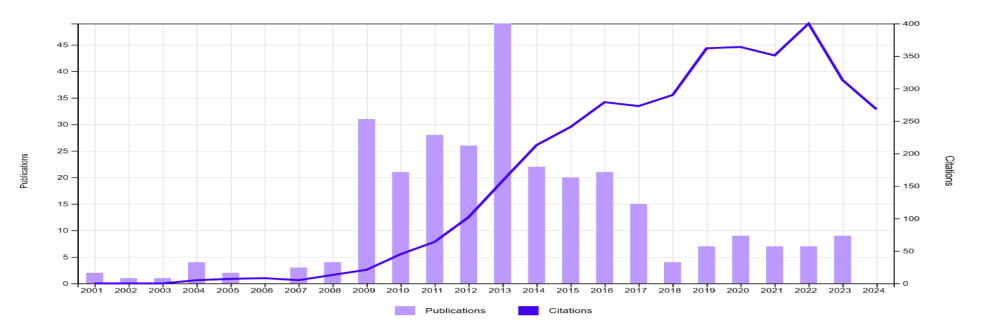
Background: Legal medicine, or medical jurisprudence, integrates medicine and law, addressing forensic investigations, malpractice evaluations, and health-related legal issues. Globally, it encompasses subfields like forensic pathology, toxicology, and medical ethics. Technological advancements, including DNA profiling and digital forensics, have expanded its scope. In India, the field blends traditional practices with modern innovations, yet challenges like inadequate infrastructure and limited region-specific research persist. Aim: To analyze emerging trends in global legal medicine, with a special focus on Indian research output from 2000 to 2023. Objectives 1. Assess publication trends and thematic focus in Indian legal medicine research. 2. Identify leading institutions and their contributions. 3. Evaluate citation impact to understand research influence. 4. Explore gaps and potential future directions. Methods: A bibliometric study using data from the Web of Science Core Collection (2000–2023). The dataset was analyzed using VOSviewer and Biblioshiny for trends in publications, author networks, and thematic focus. Results: Indian legal medicine research saw a consistent rise post-2013, with dominant themes in forensic techniques (35%), medico-legal practices (25%), and emerging technologies (15%). Highly cited works centered on forensic toxicology and medico-legal ethics. The research corpus achieved an h-index of 30, highlighting moderate global impact. Conclusion: While advancements in forensic techniques and emerging technologies are notable, gaps in region-specific research and global collaborations remain. Addressing these challenges can enhance the field’s impact.
References
- 1. Black’s Law Dictionary, 6th edition, 1990, West Publishing Co. U.S.A.
- 2. Adarsh K.R., “The Ancient Art of Discussion: Insights from Charaka Samhita,” International Journal of Ayurveda and Pharma Research, Vol. 12, Issue 8, August 2024, pp. 34–37. DOI: 10.47070/ijapr.v12i8.3327.
- 3. Web of Science Core Collection. Database search conducted on November 2, 2024.
- 4. VOSviewer software, version 1.6.19: Tool used for bibliometric and network visualization analysis.
- 5. Biblioshiny package for RStudio: Bibliometric analysis tool employed for trends and statistical data representation.
- 6. Modi, J. P. (2022). A Textbook of Medical Jurisprudence and Toxicology. 27th Edition. LexisNexis Butterworths.
- 7. Sharma, B. R. (2010). “Role of forensic science in criminal justice: An Indian perspective.” Medicine, Science and the Law, 50(2), 88-94.
- 8. Shi, L., et al. (2019). “Bibliometric analysis of global forensic medicine research.” Journal of Forensic and Legal Medicine, 62, 1-7.
- 9. Jones, A. W. (2013). “Impact of forensic toxicology research: A bibliometric study of citation trends.” Forensic Science International, 232(1-3), 230-238.
- 10. Parmar, R., & Rao, D. (2018). “Emerging trends in forensic medicine education in India.” Indian Journal of Forensic Medicine & Pathology, 11(3), 153-158.
- 11. “State of Forensic Medicine in India: Challenges and Opportunities.” (2020). National Medical Journal of India, 33(1), 45-49.
- 12. Perumal, A. (2015). “Forensic advances in India: An overview.” Asian Journal of Forensic Sciences, 6(4), 15-22.
- 13. Jaiswal, P., & Verma, A. (2022). “Integration of AI and forensic medicine in India: Emerging opportunities.” Indian Journal of Legal Medicine, 12(4), 298-309.
- 14. Patel, S., & Gupta, R. (2021). “Critical gaps in medico-legal research in India.” Journal of Clinical Forensic Medicine, 15(2), 134-141.
- 15. Das, S. K. (2018). “Advancements in forensic toxicology: Implications for medico-legal practice.” Forensic Toxicology, 36(3), 391-402.
- 16. Reddy, K. S. N. (2021). The Essentials of Forensic Medicine and Toxicology. 35th Edition. Jaypee, Hyderabad.
Data Sharing Statement
There are no additional data available. All raw data and code are available upon request
Funding
This research received no funding.
Author Contributions
All authors contributed significantly to the work and approve its publication.
Ethics Declaration
This article does not involve any human or animal subjects, and therefore does not require ethics approval.
Acknowledgements
We would like to express our gratitude to the patients, their families, and all those who have contributed to this study.
Conflicts of Interest
No conflicts of interest in this work.
About this article

Cite this article
Upadhyay P, Chopra G. Emerging Trends in Legal Medicine. Indian Journal of Legal Medicine. 2025;4(1):19-28.
Licence:
Attribution-Non-commercial 4.0 International (CC BY-NC 4.0)This license enables reusers to distribute, remix, adapt, and build upon the material in any medium or format for noncommercial purposes only, and only so long as attribution is given to the creator.
| Received | Accepted | Published |
|---|---|---|
| November 18, 2024 | December 24, 2024 | June 20, 2025 |
DOI: N.A
Keywords
Legal medicineForensic techniquesMedico-legal practicesBibliometric analysisIndiaEmerging technologiesForensic toxicologySearch for Similar Articles
Similar Articles
- Good Faith and Compassion in Termination Beyond 24 Weeks: A Liberal Reading of...
- Litigation Stress in Medical Practice: An Invisible Occupational Hazard from fea...
- When Healing Meets Law: Practical Guidance from a Medicolegal Perspective: An In...
- Bharatiya Nyaya Sanhita a Bane of NMC Registered Physicians
- Critical Appraisal of Legal Complexities in Medico-Legal Consent: A Physician’s...
Article Level Metrics
Last UpdatedWednesday 30 September 2026, 08:34:16 (IST)
1188
Accesses
24
434
00
Citations
NA
NA
NA
Download citation
Article Keywords
Keyword Highlighting
Highlight selected keywords in the article text.
Timeline
| Received | November 18, 2024 |
| Accepted | December 24, 2024 |
| Published | June 20, 2025 |
licence
Attribution-Non-commercial 4.0 International (CC BY-NC 4.0)
This license enables reusers to distribute, remix, adapt, and build upon the material in any medium or format for noncommercial purposes only, and only so long as attribution is given to the creator.