Full Text (PDF)
International Physiology 13(2):p 83-95, July - Dec 2025. | DOI: https://doi.org/10.21088/ip.2347.1506.13225.3
Review Article
Emerging Relation between Chrononutrition and Cancer
Sanjeet Kumar Singh, Anita Kumari, Amita Kumari, Abhimanyu Ganguly, Abhishek Kumar Singh, Anup Kumar Dhanvijay, Amita Singh
Author Information
Licence:
Attribution-Non-commercial 4.0 International (CC BY-NC 4.0)This license enables reusers to distribute, remix, adapt, and build upon the material in any medium or format for noncommercial purposes only, and only so long as attribution is given to the creator.
International Physiology 13(2):p 83-95, July - Dec 2025. | DOI: https://doi.org/10.21088/ip.2347.1506.13225.3
How Cite This Article:
Kumari A, Singh SK, Kumari A, et al. Emerging Relation between Chrononutrition and Cancer. Int Phy. 2025;13(2):83-95.Timeline
Received : September 17, 2025
Accepted : November 12, 2025
Published : December 30, 2025
Abstract
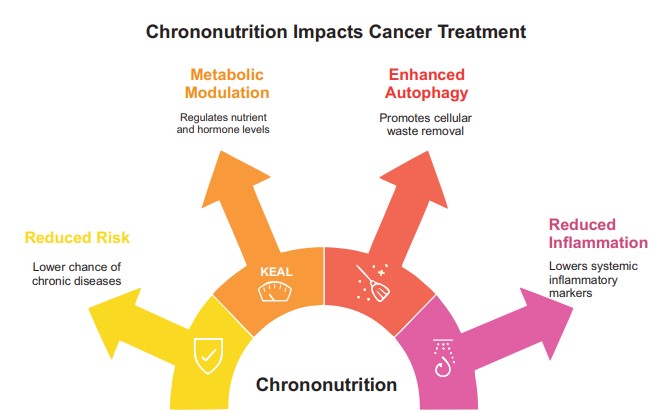
Circadian rhythms, driven by the suprachiasmatic nucleus and orchestrated by clock genes, regulate vital cellular and systemic processes including DNA repair, apoptosis, metabolism, and immune surveillance. Disruption of these rhythms, through shift work, artificial light at night, or irregular eating, is strongly associated with increased cancer risk and progression. Chronotype the individual preference for morning or evening activity modifies susceptibility, with evening types consistently showing higher incidence of breast, lung, prostate, and endometrial cancers. Nutrition timing, or chrononutrition, further influences circadian alignment; early time-restricted eating (TRE) and prolonged overnight fasting improve metabolic balance and appear protective against tumorigenesis. Fasting and ketogenic diets enhance cancer therapy responsiveness by lowering insulin/ IGF-1 signaling, inducing autophagy, and reducing inflammation. Chronotherapy, synchronizing drug delivery with circadian rhythms, improves tolerability and therapeutic efficacy. Integration of chrononutrition and chronotherapy offers a promising framework for precision oncology, although large-scale clinical validation remains a critical need.
References
- 1. Patke A, Young MW, Axelrod S. Molecular mechanisms and physiological importance of circadian rhythms. Nat Rev Mol Cell Biol. 2020 Feb;21(2):67–84.
- 2. Ozturk N, Ozturk D, Kavakli IH, Okyar A. Molecular Aspects of Circadian Pharmacology and Relevance for Cancer Chronotherapy. Int J Mol Sci. 2017 Oct 17;18(10):2168.
- 3. Rosenwasser AM, Turek FW. Neurobiology of Circadian Rhythm Regulation. Sleep Med Clin. 2015 Dec;10(4):403–12.
- 4. Hastings MH, Maywood ES, Brancaccio M. Generation of circadian rhythms in the suprachiasmatic nucleus. Nat Rev Neurosci. 2018 Aug;19(8):453–69.
- 5. Reinke H, Asher G. Crosstalk between metabolism and circadian clocks. Nat Rev Mol Cell Biol. 2019 Apr;20(4):227–41.
- 6. Musiek ES, Holtzman DM. Mechanisms linking circadian clocks, sleep, and neurodegeneration. Science. 2016 Nov 25;354(6315):1004–8.
- 7. Richards J, Gumz ML. Advances in understanding the peripheral circadian clocks. FASEB J. 2012 Sep;26(9):3602–13.
- 8. Durgan DJ, Young ME. The cardiomyocyte circadian clock: emerging roles in health and disease. Circ Res. 2010 Mar 5;106(4):647–58.
- 9. Hanahan D, Weinberg RA. Hallmarks of cancer: the next generation. Cell. 2011 Mar 4;144(5):646–74.
- 10. Hanahan D, Weinberg RA. The hallmarks of cancer. Cell. 2000 Jan 7;100(1):57–70.
- 11. Straif K, Baan R, Grosse Y, Secretan B, El Ghissassi F, Bouvard V, et al. Carcinogenicity of shift-work, painting, and fire-fighting. Lancet Oncol. 2007 Dec;8(12):1065–6.
- 12. Stevens RG, Hansen J, Costa G, Haus E, Kauppinen T, Aronson KJ, et al. Considerations 12. Stevens RG, Hansen J, Costa G, Haus E, Kauppinen T, Aronson KJ, et al. Considerations of circadian impact for defining “shift work” in cancer studies: IARC Working Group Report. Occup Environ Med. 2011 Feb;68(2):154–62.
- 13. Montaruli A, Castelli L, Mulè A, Scurati R, Esposito F, Galasso L, et al. Biological Rhythm and Chronotype: New Perspectives in Health. Biomolecules. 2021 Mar 24;11(4):487.
- 14. Adan A, Archer SN, Hidalgo MP, Di Milia L, Natale V, Randler C. Circadian typology: a comprehensive review. Chronobiol Int. 2012 Nov;29(9):1153–75.
- 15. Taillard J, Philip P, Chastang JF, Bioulac B. Validation of Horne and Ostberg morningness eveningness questionnaire in a middle-aged population of French workers. J Biol Rhythms. 2004 Feb;19(1):76–86
- 16. Zajenkowski M, Jankowski KS, Stolarski M. Why do evening people consider themselves more intelligent than morning individuals? The role of big five, narcissism, and objective cognitive ability. Chronobiol Int. 2019 Dec;36(12):1741–51.
- 17. Makarem N, Paul J, Giardina EGV, Liao M, Aggarwal B. Evening chronotype is associated with poor cardiovascular health and adverse health behaviors in a diverse population of women. Chronobiol Int. 2020 May;37(5):673–85.
- 18. Hill DW, Chtourou H. The effect of time of day and chronotype on the relationships between mood state and performance in a Wingate test. Chronobiol Int. 2020 Nov;37(11):1599–610.
- 19. Roveda E, Mule A, Galasso L, Castelli L, Scurati R, Michielon G, et al. Effect of chronotype on motor skills specific to soccer in adolescent players. Chronobiol Int. 2020 Apr;37(4):552–63.
- 20. Montaruli A, Castelli L, Galasso L, Mulè A, Bruno E, Esposito F, et al. Effect of chronotype on academic achievement in a sample of Italian University students. Chronobiol Int. 2019 Nov;36(11):1482–95.
- 21. Li T, Xie Y, Tao S, Yang Y, Xu H, Zou L, et al. Chronotype, Sleep, and Depressive Symptoms Among Chinese College Students: A CrossSectional Study. Front Neurol. 2020;11:592825.
- 22. Belfry KD, Deibel SH, Kolla NJ. Time of Day Matters: An Exploratory Assessment of Chronotype in a Forensic Psychiatric Hospital. Front Psychiatry. 2020;11:550597.
- 23. Schulte PFJ, Riemersma-van der Lek RF. Evening chronotype, disordered eating behavior, bipolar disorder, and light therapy. Acta Psychiatr Scand. 2021 Feb;143(2):181–2.
- 24. Bauducco S, Richardson C, Gradisar M. Chronotype, circadian rhythms and mood. Curr Opin Psychol. 2020 Aug;34:77–83.
- 25. Taylor BJ, Hasler BP. Chronotype and Mental Health: Recent Advances. Curr Psychiatry Rep. 2018 Jul 23;20(8):59.
- 26. Kivelä L, Papadopoulos MR, Antypa N. Chronotype and Psychiatric Disorders. Curr Sleep Med Rep. 2018;4(2):94–103.
- 27. Chauhan S, Norbury R, Faßbender KC, Ettinger U, Kumari V. Beyond sleep: A multidimensional model of chronotype. Neurosci Biobehav Rev. 2023 May; 148:105114.
- 28. Ruddick-Collins LC, Morgan PJ, Johnstone AM. Mealtime: A circadian disruptor and determinant of energy balance? J Neuroendocrinol. 2020 Jul;32(7):e12886.
- 29. Henry CJ, Kaur B, Quek RYC. Chrononutrition in the management of diabetes. Nutr Diabetes. 2020 Feb 19;10(1):6.
- 30. Taslim NA, Farradisya S, Gunawan WB, Alfatihah A, Barus RIB, Ratri LK, et al. The interlink between chrono-nutrition and stunting: current insights and future perspectives. Front Nutr. 2023;10:1303969.
- 31. Takahashi JS. Molecular components of the circadian clock in mammals. Diabetes Obes Metab. 2015 Sep;17(0 1):6–11.
- 32. Ko CH, Takahashi JS. Molecular components of the mammalian circadian clock. Hum Mol Genet. 2006 Oct 15;15 Spec No 2:R271-277.
- 33. Partch CL, Green CB, Takahashi JS. Molecular architecture of the mammalian circadian clock. Trends Cell Biol. 2014 Feb;24(2):90–9.
- 34. Takahashi JS. Finding new clock components: past and future. J Biol Rhythms. 2004 Oct;19(5):339–47.
- 35. Paatela E, Munson D, Kikyo N. Circadian Regulation in Tissue Regeneration. Int J Mol Sci. 2019 May 8;20(9):2263.
- 36. Chen Z, McKnight SL. A conserved DNA damage response pathway responsible for coupling the cell division cycle to the circadian and metabolic cycles. Cell Cycle. 2007 Dec 1;6(23):2906–12.
- 37. Labrecque N, Cermakian N. Circadian Clocks in the Immune System. J Biol Rhythms. 2015 Aug;30(4):277–90.
- 38. Baxter M, Ray DW. Circadian rhythms in innate immunity and stress responses. Immunology. 2020 Dec;161(4):261–7.
- 39. Tahkamo L, Partonen T, Pesonen AK. Systematic review of light exposure impact on human circadian rhythm. Chronobiol Int. 2019 Feb;36(2):151–70.
- 40. Shafi AA, Knudsen KE. Cancer and the Circadian Clock. Cancer Res. 2019 Aug 1;79(15):3806–14.
- 41. Liu H, Liu Y, Hai R, Liao W, Luo X. The role of circadian clocks in cancer: Mechanisms and clinical implications. Genes Dis. 2023 Jul;10(4):1279–90.
- 42. Guimaraes DP, Hainaut P. TP53: a key gene in human cancer. Biochimie. 2002 Jan;84(1): 83–93.
- 43. Williams AB, Schumacher B. p53 in the DNADamage-Repair Process. Cold Spring Harb Perspect Med. 2016 May 2;6(5):a026070.
- 44. Schwartzenberg-Bar-Yoseph F, Armoni M, Karnieli E. The tumor suppressor p53 downregulates glucose transporters GLUT1 and GLUT4 gene expression. Cancer Res. 2004 Apr 1;64(7):2627–33.
- 45. Ortega-Campos SM, Verdugo-Sivianes EM, Amiama-Roig A, Blanco JR, Carnero A. Interactions of circadian clock genes with the hallmarks of cancer. Biochim Biophys Acta Rev Cancer. 2023 May;1878(3):188900.
- 46. Phoi YY, Rogers M, Bonham MP, Dorrian J, Coates AM. A scoping review of chronotype and temporal patterns of eating of adults: tools used, findings, and future directions. Nutr Res Rev. 2022 Jun;35(1):112–35.
- 47. Von Behren J, Hurley S, Goldberg D, Clague DeHart J, Wang SS, Reynolds P. Chronotype and risk of post-menopausal endometrialcancer in the California Teachers Study. Chronobiol Int. 2021 Aug;38(8):1151–61.
- 48. Costas L, Frias-Gomez J, Benavente Moreno Y, Peremiquel-Trillas P, Carmona A, de Francisco J, et al. Night work, chronotype and risk of endometrial cancer in the Screenwide casecontrol study. Occup Environ Med. 2022 Feb 24;oemed-2021-108080.
- 49. Hurley S, Goldberg D, Von Behren J, Clague DeHart J, Wang S, Reynolds P. Chronotype and postmenopausal breast cancer risk among women in the California Teachers Study. Chronobiol Int. 2019 Nov;36(11):1504–14.
- 50. Von Behren J, Goldberg D, Hurley S, Clague DeHart J, Wang SS, Reynolds P. Prospective analysis of sleep characteristics, chronotype, and risk of breast cancer in the california teachers study. Cancer Causes Control. 2024 Apr;35(4):597–604.
- 51. Xie J, Zhu M, Ji M, Fan J, Huang Y, Wei X, et al. Relationships between sleep traits and lung cancer risk: a prospective cohort study in UK Biobank. Sleep. 2021 Sep 13;44(9):zsab089.
- 52. Peeri NC, Tao MH, Demissie S, Nguyen USDT. Sleep Duration, Chronotype, and Insomnia and the Risk of Lung Cancer: United Kingdom Biobank Cohort. Cancer Epidemiol Biomarkers Prev. 2022 Apr 1;31(4):766–74.
- 53. Dickerman BA, Markt SC, Koskenvuo M, Hublin C, Pukkala E, Mucci LA, et al. Sleep disruption, chronotype, shift work, and prostate cancer risk and mortality: a 30-year prospective cohort study of Finnish twins. Cancer Causes Control. 2016 Nov;27(11): 1361–70.
- 54. Cordina-Duverger E, Cénée S, Trétarre B, Rebillard X, Lamy PJ, Wendeu-Foyet G, et al. Sleep Patterns and Risk of Prostate Cancer: A Population-Based Case Control Study in France (EPICAP). Cancer Epidemiol Biomarkers Prev. 2022 Nov 2;31(11):2070–8.
- 55. Papantoniou K, Castaño-Vinyals G, Espinosa A, Aragonés N, Pérez-Gómez B, Burgos J, et al. Night shift work, chronotype and prostate cancer risk in the MCC-Spain case-control study. Int J Cancer. 2015 Sep 1;137(5):1147–57.
- 56. Leung L, Grundy A, Siemiatycki J, Arseneau J, Gilbert L, Gotlieb WH, et al. Shift Work al. Night shift work, chronotype and prostate cancer risk in the MCC-Spain case-control study. Int J Cancer. 2015 Sep 1;137(5):1147–57.
- 57. Freeman JR, Saint-Maurice PF, Zhang T, Matthews CE, Stolzenberg-Solomon RZ. Sleep and Risk of Pancreatic Cancer in the UK Biobank. Cancer Epidemiol Biomarkers Prev. 2024 Apr 3;33(4):624–7.
- 58. Tian S, Huangfu L, Ai S, Zheng J, Shi L, Yan W, et al. Causal relationships between chronotype and risk of multiple cancers by using longitudinal data and Mendelian randomization analysis. Sci China Life Sci.2023 Oct;66(10):2433–6.
- 59. Sun X, Ye D, Jiang M, Qian Y, Mao Y. Genetically proxied morning chronotype was associated with a reduced risk of prostate cancer. Sleep.2021 Oct 11;44(10):zsab104.
- 60. Chaix A, Manoogian ENC, Melkani GC, Panda S. Time-Restricted Eating to Prevent and Manage Chronic Metabolic Diseases. Annu Rev Nutr. 2019 Aug 21;39:291–315.
- 61. Srour B, Plancoulaine S, Andreeva VA, Fassier P, Julia C, Galan P, et al. Circadian nutritional behaviours and cancer risk: New insights from the NutriNet-santé prospective cohort study: Disclaimers. Int J Cancer. 2018 Nov 15;143(10):2369–79.
- 62. Palomar-Cros A, Espinosa A, Straif K, PérezGómez B, Papantoniou K, Gómez-Acebo I, et al. The Association of Nighttime Fasting Duration and Prostate Cancer Risk: Results from the Multicase-Control (MCC) Study in Spain. Nutrients. 2021 Jul 30;13(8):2662.
- 63. Palomar-Cros A, Harding BN, Espinosa A, Papantoniou K, Perez-Gomez B, Straif K, et al. Association of time of breakfast and nighttime fasting duration with breast cancer risk in the multicase-control study in Spain. Front Nutr. 2022;9:941477
- 64. D’cunha K, Park Y, Leech RM, Protani MM, Marquart-Wilson L, Reeves MM. Eating frequency, timing of meals, and sleep duration before and after a randomized controlled weight loss trial for breast cancer survivors. J Cancer Surviv. 2024 Sep 24;
- 65. Molina-Montes E, Rodríguez-Barranco M, Ching-López A, Artacho R, Huerta JM, Amiano P, et al. Circadian clock gene variants and their link with chronotype, chrononutrition, sleeping patterns and obesity in the European prospective investigation into cancer and nutrition (EPIC) study. Clin Nutr. 2022 Sep;41(9):1977–90.
- 66. Adafer R, Messaadi W, Meddahi M, Patey A, Haderbache A, Bayen S, et al. Food Timing, Circadian Rhythm and Chrononutrition: A Systematic Review of Time-Restricted Eating’s Effects on Human Health. Nutrients. 2020 Dec 8;12(12):3770.
- 67. Masi D, Spoltore ME, Rossetti R, Watanabe M, Tozzi R, Caputi A, et al. The Influence of Ketone Bodies on Circadian Processes Regarding Appetite, Sleep and Hormone Release: A Systematic Review of the Literature. Nutrients. 2022 Mar 28;14(7):1410.
- 68. Zhou L, Zhang Z, Nice E, Huang C, Zhang W, Tang Y. Circadian rhythms and cancers: the intrinsic links and therapeutic potentials. J Hematol Oncol. 2022 Mar 4;15(1):21.
- 69. Kogevinas M, Espinosa A, Castelló A, GómezAcebo I, Guevara M, Martin V, et al. Effect of mistimed eating patterns on breast and prostate cancer risk (MCC-Spain Study). Int J Cancer. 2018 Nov 15;143(10):2380–9.
- 70. Omar EM, Omran GA, Mustafa MF, El-Khodary NM. Intermittent fasting during adjuvant chemotherapy may promote differential stress resistance in breast cancer patients. J Egypt Natl Canc Inst. 2022 Sep 12;34(1):38.
- 71. Alshammari K, Alhaidal HA, Alharbi R, Alrubaiaan A, Abdel-Razaq W, Alyousif G, et al. The Impact of Fasting the Holy Month of Ramadan on Colorectal Cancer Patients and Two Tumor Biomarkers: A TertiaryCare Hospital Experience. Cureus. 2023 Jan;15(1):e33920.
- 72. Harvie M, Pegington M, Howell SJ, Bundred N, Foden P, Adams J, et al. Randomised controlled trial of intermittent vs continuous energy restriction during chemotherapy for early breast cancer. Br J Cancer. 2022 May;126(8):1157–67.
- 73. Cheng CW, Adams GB, Perin L, Wei M, Zhou X, Lam BS, et al. Prolonged fasting reduces IGF-1/PKA to promote hematopoieticstem-cell-based regeneration and reverse immunosuppression. Cell Stem Cell. 2014 Jun 5;14(6):810–23.
- 74. Lee C, Safdie FM, Raffaghello L, Wei M, Madia F, Parrella E, et al. Reduced levels of IGF-I mediate differential protection of normal and cancer cells in response to fasting and improve chemotherapeutic index. Cancer Res. 2010 Feb 15;70(4):1564–72.
- 75. Antunes F, Erustes AG, Costa AJ, Nascimento AC, Bincoletto C, Ureshino RP, et al. Autophagy and intermittent fasting: the connection for cancer therapy? Clinics (Sao Paulo). 2018 Dec 10;73(suppl 1):e814s.
- 76. Aly SM. Role of intermittent fasting on improving health and reducing diseases. Int J Health Sci (Qassim). 2014 Jul;8(3):V–VI.
- 77. El-Tanani M, Rabbani SA, Ali AA, Alfaouri IGA, Al Nsairat H, Al-Ani IH, et al. Circadian rhythms and cancer: implications for timing in therapy. Discov Oncol. 2024 Dec 18;15(1):767.
- 78. Altinok A, Lévi F, Goldbeter A. Identifying mechanisms of chronotolerance and chronoefficacy for the anticancer drugs 5-fluorouracil and oxaliplatin by computational modeling. Eur J Pharm Sci. 2009 Jan 31; 36(1):20–38.
- 79. Lévi F, Zidani R, Misset JL. Randomised multicentre trial of chronotherapy with oxaliplatin, fluorouracil, and folinic acid in metastatic colorectal cancer. International Organization for Cancer Chronotherapy. Lancet. 1997 Sep 6;350(9079):681–6.
- 80. Innominato PF, Karaboué A, Focan C, Chollet P, Giacchetti S, Bouchahda M, et al. Efficacy and safety of chronomodulated irinotecan, oxaliplatin, 5-fluorouracil and leucovorin combination as first- or second-line treatment against metastatic colorectal cancer: Results from the International EORTC 05011 Trial. Int J Cancer. 2021 May 15;148(10):2512–21.
Data Sharing Statement
There are no additional data available. All raw data and code are available upon request.
Funding
This research received no funding.
Author Contributions
All authors contributed significantly to the work and approve its publication.
Ethics Declaration
This article does not involve any human or animal subjects, and therefore does not require ethics approval.
Acknowledgements
We would like to express our gratitude to the patients, their families, and all those who have contributed to this study.
Conflicts of Interest
No conflicts of interest in this work.
About this article

Cite this article
Kumari A, Singh SK, Kumari A, et al. Emerging Relation between Chrononutrition and Cancer. Int Phy. 2025;13(2):83-95.
Licence:
Attribution-Non-commercial 4.0 International (CC BY-NC 4.0)This license enables reusers to distribute, remix, adapt, and build upon the material in any medium or format for noncommercial purposes only, and only so long as attribution is given to the creator.
| Received | Accepted | Published |
|---|---|---|
| September 17, 2025 | November 12, 2025 | December 30, 2025 |
DOI: https://doi.org/10.21088/ip.2347.1506.13225.3
Keywords
Circadian RhythmChronotypeChrononutritionTime-Restricted EatingChronotherapySearch for Similar Articles
Similar Articles
- Mechanisms of Myocardial Damage and Structural Remodeling Caused by Doxorubicin-...
- Impact of Sleep Deprivation on Human Physiology: A Review
- The Effect of a Brief Heart Rate Variability Biofeedback Session on Salivary Cor...
- Impact of Vitamin D Supplementation in Enhancing Pulmonary Function in Adults wi...
- Mona Bedi - Editiorial
Article Level Metrics
Last UpdatedTuesday 29 September 2026, 13:48:31 (IST)
1996
Accesses
38
194
00
Citations
NA
NA
NA
Download citation
Article Keywords
Keyword Highlighting
Highlight selected keywords in the article text.
Timeline
| Received | September 17, 2025 |
| Accepted | November 12, 2025 |
| Published | December 30, 2025 |
licence
Attribution-Non-commercial 4.0 International (CC BY-NC 4.0)
This license enables reusers to distribute, remix, adapt, and build upon the material in any medium or format for noncommercial purposes only, and only so long as attribution is given to the creator.