Full Text (PDF)
International Physiology 13(2):p 63-68, July - Dec 2025. | DOI: https://doi.org/10.21088/ip.2347.1506.13225.1
Original Article
Demographic, Anthropometric and Clinical Profile of Obstructive Sleep Apnea Patients at a Tertiary Care Centre in Eastern India: A Cross Sectional Study
Anupkumar Dhanvijay, Shradha Suman, Bhaskar Saha
Author Information
Licence:
Attribution-Non-commercial 4.0 International (CC BY-NC 4.0)This license enables reusers to distribute, remix, adapt, and build upon the material in any medium or format for noncommercial purposes only, and only so long as attribution is given to the creator.
International Physiology 13(2):p 63-68, July - Dec 2025. | DOI: https://doi.org/10.21088/ip.2347.1506.13225.1
How Cite This Article:
Dhanvijay A, Suman S, Saha B. Demographic, Anthropometric and Clinical Profile of Obstructive Sleep Apnea Patients at a Tertiary Care Centre in Eastern India: A Cross-Sectional Study. Int Phy. 2025;13(2):63-68.Timeline
Received : September 17, 2025
Accepted : November 12, 2025
Published : December 30, 2025
Abstract
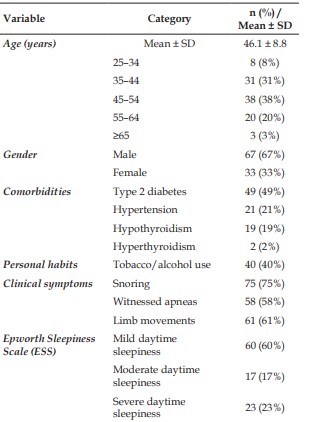
Background: Obstructive Sleep Apnea (OSA) is a prevalent sleep disorder with significant public health implications, including cardiovascular diseases, hypertension, metabolic syndrome, and neurocognitive impairments. Despite its high prevalence, OSA remains underdiagnosed, often requiring clinical assessment and anthropometric measurements as effective screening tools. This study aims to investigate the profile of OSA patients attending a sleep clinic in a tertiary care center in eastern India. Methods: This cross-sectional study with interventional component was conducted between January 2016 and December 2017 at the Department of Physiology, Rajendra Institute of Medical Sciences (RIMS), Ranchi, and the Department of Sleep Medicine, Tata Mains Hospital, Jamshedpur. One hundred consecutive patients (aged 25–70 years) with clinical symptoms suggestive of OSA underwent overnight PSG. Demographic, anthropometric (BMI, neck circumference, waist circumference), and clinical data were collected. Daytime sleepiness was assessed using the Epworth Sleepiness Scale (ESS). OSA was classified based on Apnea Hypopnea Index (AHI). For patients with moderate-to-severe OSA, continuous positive airway pressure (CPAP) therapy was evaluated using a split-night protocol. Results: The mean age was 46.1 ± 8.8 years; 67% were male. Comorbidities included Type 2 diabetes (49%), hypertension (21%), and hypothyroidism (19%). Snoring (75%), witnessed apneas (58%), and excessive daytime sleepiness (ESS ≥10: 83%) were common. Anthropometric indices (BMI, neck and waist circumference) showed significant positive correlation with AHI severity (p<0.001). CPAP therapy in 68 moderate-to-severe patients significantly improved mean oxygen saturation (78.6% → 93.0%, p<0.001) and reduced apnea episodes (25.7 → 5.4, p<0.001). Severe OSA was present in 23% of the cohort. Conclusion: OSA is highly prevalent in patients with comorbidities like Type 2 diabetes, hypertension, and hypothyroidism. Anthropometric measurements such as BMI, waist, and neck circumference are useful predictors of OSA severity. CPAP therapy was highly effective in improving oxygen saturation and reducing apnea episodes. Early diagnosis and intervention are critical to managing the condition and preventing associated complications.
References
- 1. Goyal M, Johnson J. Obstructive Sleep Apnea Diagnosis and Management. Mo Med. 2017 Mar-Apr;114(2):120-124.
- 2. Lee W, Nagubadi S, Kryger MH, Mokhlesi B. Epidemiology of Obstructive Sleep Apnea: A Population-based Perspective. Expert Rev Respir Med. 2008 Jun 1;2(3):349-364.
- 3. Choudhary AK, Kishanrao SS, Dadarao Dhanvijay AK, Alam T. Sleep restriction may lead to disruption in physiological attention and reaction time. Sleep Sci. 2016 JulSep;9(3):207-211.
- 4. Meyer EJ, Wittert GA. Approach the Patient with Obstructive Sleep Apnea and Obesity. J Clin Endocrinol Metab. 2024 Feb 20;109(3): e1267-e1279.
- 5. Yeghiazarians Y, Jneid H, Tietjens JR, Redline S, Brown DL, El-Sherif N, et al. Obstructive sleep apnea and cardiovascular disease: A scientific statement from the American Heart Association. Circulation 2021;144: e56–67.
- 6. De Backer W. Obstructive sleep apnea/ hypopnea syndrome. Panminerva Med. 2013 Jun;55(2):191-5. PMID: 23676959.
- 7. Gonçalves MT, Malafaia S, dos Santos JM, Thomas Roth, Marques DR. Epworth sleepiness scale: A meta-analytic study on the internal consistency, Sleep Medicine, Volume 109, 2023, Pages 261-269.
- 8. Peppard PE, Young T, Barnet JH, Palta M, Hagen EW, Hla KM. Increased prevalence of sleep-disordered breathing in adults. Am J Epidemiol. 2013 May 1;177(9):1006-14.
- 9. Young T. The occurrence of sleep-disordered breathing among middle-aged adults. N Engl J Med. 1993; 328:1230–1235.
- 10. Hsu W, Chiu N, Chang C, Chang T, Lane H. The association between cigarette smoking and obstructive sleep apnea. Tobacco Induced Diseases. 2019;17(April):27.
- 11. Liu Y, Yang L, Stampfer MJ, Redline S, Tworoger SS, Huang T. Physical activity, sedentary behaviour and incidence of obstructive sleep apnea in three prospective US cohorts. Eur Respir J. 2022 Feb 3;59(2):2100606.
- 12. Aurora RN, Punjabi NM. Obstructive sleep apnea and type 2 diabetes mellitus: a bidirectional association. Lancet Respir Med. 2013 Jun;1(4):329-38.
- 13. Choudhary, A. K., Alam, T., Dhanvijay, A. K. D., & Kishanrao, S. S. (2018). Sleep restriction progress to cardiac autonomic imbalance. Alexandria Journal of Medicine, 54(2), 149–153
- 14. Choudhary, A.K., Dhanvijay, A.K.D., Alam, T. et al. Sleep restriction and its inÁuence on blood pressure. Artery Res 19, 42–48 (2017).
- 15. Grunstein RR, Sullivan CE. Sleep apnea and hypothyroidism: mechanisms and management. Am J Med. 1988 Dec;85(6):775-9.
- 16. Borsini E, Blanco M, Schonfeld S, Ernst G, Salvado A. Performance of Epworth Sleepiness Scale and tiredness symptom used with simplified diagnostic tests for the
- 17. Borges PT, Filho ESF, Araujo TME, et al. Correlation of cephalometric and anthropometric measures with obstructive sleep apnea severity. Int Arch Otorhinolaryngol 2013;17(3):321-8.
- 18. Pinto JA, Godoy LBM, Marquis VWPB, Sonego TB, Leal CFA, Ártico MS. Anthropometric data as predictors of Obstructive Sleep Apnea Severity. Braz J Otorhinolaryngol. 2011 JulAug;77(4):516-521.
- 19. 19. Martínez-García M, Capote F, CamposRodríguez F, et al. Effect of CPAP on Blood Pressure in Patients with Obstructive Sleep Apnea and Resistant Hypertension: The HIPARCO Randomized Clinical Trial. JAMA.2013;310(22):2407–2415.
- 20. Abdulkarim, F., Alshawamreh, E. & Alhariri, H. Tracing the complete journey of patient compliance in obstructive sleep apnea management: a 12-year retrospective study on diagnosis, device adherence, and treatment outcomes. Sleep Science Practice 8, 24 (2024)
Data Sharing Statement
There are no additional data available. All raw data and code are available upon request.
Funding
This research received no funding.
Author Contributions
All authors contributed significantly to the work and approve its publication.
Ethics Declaration
This article does not involve any human or animal subjects, and therefore does not require ethics approval.
Acknowledgements
We would like to express our gratitude to the patients, their families, and all those who have contributed to this study.
Conflicts of Interest
No conflicts of interest in this work.
About this article

Cite this article
Dhanvijay A, Suman S, Saha B. Demographic, Anthropometric and Clinical Profile of Obstructive Sleep Apnea Patients at a Tertiary Care Centre in Eastern India: A Cross-Sectional Study. Int Phy. 2025;13(2):63-68.
Licence:
Attribution-Non-commercial 4.0 International (CC BY-NC 4.0)This license enables reusers to distribute, remix, adapt, and build upon the material in any medium or format for noncommercial purposes only, and only so long as attribution is given to the creator.
| Received | Accepted | Published |
|---|---|---|
| September 17, 2025 | November 12, 2025 | December 30, 2025 |
DOI: https://doi.org/10.21088/ip.2347.1506.13225.1
Keywords
Obstructive Sleep ApnoeaPolysomnographyAnthropometryCPAPComorbiditiesEastern IndiaSearch for Similar Articles
Similar Articles
- Mechanisms of Myocardial Damage and Structural Remodeling Caused by Doxorubicin-...
- Impact of Sleep Deprivation on Human Physiology: A Review
- The Effect of a Brief Heart Rate Variability Biofeedback Session on Salivary Cor...
- Impact of Vitamin D Supplementation in Enhancing Pulmonary Function in Adults wi...
- Mona Bedi - Editiorial
Article Level Metrics
Last UpdatedTuesday 08 September 2026, 01:20:52 (IST)
1872
Accesses
27
188
00
Citations
NA
NA
NA
Download citation
Article Keywords
Keyword Highlighting
Highlight selected keywords in the article text.
Timeline
| Received | September 17, 2025 |
| Accepted | November 12, 2025 |
| Published | December 30, 2025 |
licence
Attribution-Non-commercial 4.0 International (CC BY-NC 4.0)
This license enables reusers to distribute, remix, adapt, and build upon the material in any medium or format for noncommercial purposes only, and only so long as attribution is given to the creator.