Full Text (PDF)
Indian Journal of Preventive Medicine 13(1):p 9-16, Jan-June 2025. | DOI: https://doi.org/10.21088/ijpm.2321.5917.13125.2
Original Article
E. Coli and Klebsiella Pneumoniae are Major Culprits in CatheterAssociated Urinary Tract Infections, Exhibiting an Increasing Trend in Drug Resistance
Upendra Baitha, Lalfakmawia Benjamin, Piyush Ranjan, Amandeep Singh, Arvind Kumar, Akriti Arora, Shikhar Gupta, Manish Soneja, Sarita Mohapatra, M.A. Khan, Ashutosh Biswas, Purva Mathur, Naveet Wig
Author Information
Licence:
Attribution-Non-commercial 4.0 International (CC BY-NC 4.0)This license enables reusers to distribute, remix, adapt, and build upon the material in any medium or format for noncommercial purposes only, and only so long as attribution is given to the creator.
Indian Journal of Preventive Medicine 13(1):p 9-16, Jan-June 2025. | DOI: https://doi.org/10.21088/ijpm.2321.5917.13125.2
How Cite This Article:
Lalfakmawia Benjamin, Upendra Baitha, Piyush Ranjan, et al. E. Coli and Klebsiella Pneumoniae are Major Culprits in Catheter-Associated Urinary Tract Infections, Exhibiting an Increasing Trend in Drug Resistance. J Prev Med. 2025; 13(1): 09-16.Timeline
Received : April 05, 2025
Accepted : May 25, 2025
Published : June 30, 2025
Abstract
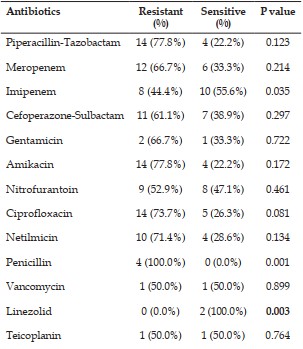
Background and Objective: Catheter-Associated Urinary Tract Infections (CAUTI) are a primary concern in healthcare, leading to increased mortality and morbidity among critically ill patients. This study aimed to identify uropathogens causing CAUTI and assess their antibiotic sensitivity/resistance. Methods: This study was conducted on 100 patients, all aged 18 or above, admitted for more than 48 hours with Foley catheters in place. Microbiologically, we classified the patients confirmed (mCAUTI) and clinically suspected (cCAUTI) based on urine culture results. Results: Out of 100 patients, 21 had positive urine cultures (mCAUTI), while 79 clinically suspected CAUTI cases were culture-negative (cCAUTI). Fever was the most prevalent symptom (67 patients), followed by genitourinary complaints, shock, and altered sensorium. Escherichia coli was the primary isolate among mCAUTI cases, followed by Klebsiella pneumoniae, Acinetobacter baumannii, Enterococcus spp., Enterobacter, and Pseudomonas aeruginosa. Imipenem demonstrated the highest sensitivity against gram-negative isolates, while grampositive isolates exhibited significant drug resistance. Conclusion: The study highlights E. coli and emerging Klebsiella pneumoniae as major CAUTI culprits with rising drug resistance. Urgent, cautious antibiotic practices are vital. Limiting catheter use, stringent aseptic measures, and timely removal are key to reducing CAUTI. Imipenem stands out as the most effective antibiotic, urging its careful use against CAUTI-causing pathogens.
References
- 1. Rogers MAM, Mody L., Kaufman S.R., Fries BE, McMahon L.F., Saint S. Use of urinary collection devices in skilled nursing facilities in five states. J Am Geriatr Soc. 2008; 56(5): 854-861. doi:10.1111/j.1532-5415.2008.01675.x
- 2. Saint S. Clinical and economic consequences of nosocomial catheter-related bacteriuria. Am J Infect Control. 2000; 28(1): 68-75. doi:10.1016/S0196-6553(00)90015-4.
- 3. Platt R., Polk B.F., Murdock B., Rosner B. Mortality Associated with Nosocomial Urinary-Tract Infection. N Engl J Med. 1982; 307 (11): 637-642. doi:10.1056/nejm198209093071101
- 4. Givens C.D., Wenzel R.P. Catheterassociated urinary tract infections in surgical patients: A controlled study on the excess morbidity and costs. J Urol. 1980; 124 (5): 646-648.doi:10.1016/S0022-5347(17)55596-2
- 5. Tambyah P.A., Halvorson K.T., Maki D.G. A prospective study of pathogenesis of catheter- associated urinary tract infections. Mayo Clin Proc. 1999; 74 (2): 131-136. doi:10.4065/74.2.131.
- 6. Warren J.W., Platt R., Thomas R.J., Rosner B, Kass EH. Antibiotic Irrigation and Catheter- Associated Urinary-Tract Infections. N Engl J Med. 1978; 299(11): 570-573. doi:10.1056/nejm197809142991103
- 7. Platt R., Polk B.F., Murdock B., Rosner B. Risk factors for nosocomial urinary tract infection. Am J Epidemiol. 1986; 124(6): 977-985. doi:10.1093/oxfordjournals.aje.a114487
- 8. Kunin C.M., McCormack R.C. Prevention of Catheter-Induced Urinary-Tract Infections by Sterile Closed Drainage. N Engl J Med. 1966; 274(21): 1155-1161.doi:10.1056/NEJM196605262742101
- 9. Wald H.L., Ma A., Bratzler D.W., Kramer A.M. Indwelling urinary catheter use in the postoperative period: Analysis of the national surgical infection prevention project data. Arch Surg. 2008; 143(6): 551-557. doi:10.1001/archsurg.143.6.551
- 10. Kass E.H., Schneiderman L.J. Entry of Bacteria into the Urinary Tracts of Patients with Inlying Catheters. N Engl J Med. 1957; 256(12): 556-557. doi:10.1056/nejm195703212561206
- 11. Garibaldi R.A., Burke J.P., Dickman M.L., Smith C.B.. Factors Predisposing to Bacteriuria during Indwelling Urethral Catheterization. N Engl J Med. 1974; 291 (5): 215-219. doi:10.1056/nejm197408012910501
- 12. Weiner L.M., Webb A.K., Limbago B., et al. Antimicrobial-Resistant Pathogens Associated with Healthcare-Associated Infections: Summary of Data Reported to the National Healthcare Safety Network at the Centers for Disease Control and Prevention, 2011-2014. Infect Control Hosp Epidemiol. 2016; 37(11): 1288-1301. doi:10.1017/ice.2016.174
- 13. Kazi M.M., Harshe A., Sale H., Mane D., Yande M., Chabukswar S. Catheter Associated Urinary Tract Infections (CAUTI) and Antibiotic Sensitivity Pattern from Confirmed Cases of CAUTI in a Tertiary Care Hospital: A Pro
- 14. M.V., R.P., M.B. Prevalence of microorganisms causing catheter associated urinary tract infections (CAUTI) among catheterised patients admitted in a tertiary care hospital. Int J Res Med Sci. 2017; 5 (6): 2367. doi:10.18203/2320-6012.ijrms20172084
- 15. Kakaria B.A., K.A., Tushar R. Study of incidence and risk factors of urinary tract infection in catheterised patients admitted at tertiary care. Int J Res Med Sci. 2018; 6(5): 1730. doi:10.18203/2320-6012.ijrms20181768
- 16. Nicolle L.E. Urinary Catheter-Associated Infections. Infect Dis Clin North Am. 2012; 26(1): 13-27. doi:10.1016/j.idc.2011.09.009
- 17. Centers for Disease Control and Prevention. Background | CAUTI Guidelines | Guidelines Library | Infection Control. Published February 22, 2021. Accessed February 22, 2021. https://www.cdc.gov/infectioncontrol/guidelines/cauti/background.html
- 18. Lo E., Nicolle L.E., Coffin S.E., et al. Strategies to Prevent Catheter-Associated Urinary Tract Infections in Acute Care Hospitals: 2014 Update. Infect Control Hosp Epidemiol. 2014; 35(5): 464-479. doi:10.1086/675718
- 19. Gould C.V., Umscheid C.A., Rajender Agarwal K., Kuntz G., Pegues D.A. Guideline for Prevention of Catheter-Associated Urinary Tract Infections (2009). Accessed February 22, 2021. https://www.cdc.gov/infectioncontrol/guidelines/cauti/
- 20. Datta P., Rani H., Chauhan R., Gombar S., Chander J. Health-care-associated infections: Risk factors and epidemiology from an intensive care unit in Northern India. Indian J Anaesth. 2014; 58(1): 30-35. doi:10.4103/0019- 5049.126785
- 21. Garg S., Prakash S., Bhatia N., Daga M. Urinary catheterization in medical wards. J Glob Infect Dis. 2010; 2(2): 83. doi:10.4103/0974-777x.62870
- 22. Venkataraman R., DIvatia J., Ramakrishnan N., et al. Multicenter observational study to evaluate epidemiology and resistance patterns of common intensive care unit-infections.Indian J Crit Care Med. 2018; 22(1): 20-26. doi:10.4103/ijccm.IJCCM_394_17
- 23. Tambyah P.A., Maki D.G. Catheter-associated urinary tract infection is rarely symptomatic: A prospective study of 1497 catheterized patients. Arch Intern Med. 2000; 160 (5): 678-682. doi:10.1001/archinte.160.5.678
- 24. Sandhu R., Sayal P., Jakkhar R., Sharma G. Catheterization-associated urinary tract infections: Epidemiology and incidence from tertiary care hospital in Haryana. J Health Res Rev. Published online 2018. doi:10.4103/jhrr. jhrr_19_18.
- 25. Bhani D., Bachhiwal R., Sharma R., Kumar Maheshwari R. Microbial profile and antimicrobial susceptibility pattern of uropathogens isolated from catheter associated urinary tract infection (CAUTI). Int J Curr Microbiol Appl Sci. 2017; 6(8): 2446-2453. doi:10.20546/ijcmas.2017.608.289
Data Sharing Statement
There are no additional data available. All raw data and code are available upon request.
Funding
This research received no funding.
Author Contributions
All authors contributed significantly to the work and approve its publication.
Ethics Declaration
This article does not involve any human or animal subjects, and therefore does not require ethics approval.
Acknowledgements
We would like to express our gratitude to the patients, their families, and all those who have contributed to this study.
Conflicts of Interest
No conflicts of interest in this work.
About this article

Cite this article
Lalfakmawia Benjamin, Upendra Baitha, Piyush Ranjan, et al. E. Coli and Klebsiella Pneumoniae are Major Culprits in Catheter-Associated Urinary Tract Infections, Exhibiting an Increasing Trend in Drug Resistance. J Prev Med. 2025; 13(1): 09-16.
Licence:
Attribution-Non-commercial 4.0 International (CC BY-NC 4.0)This license enables reusers to distribute, remix, adapt, and build upon the material in any medium or format for noncommercial purposes only, and only so long as attribution is given to the creator.
| Received | Accepted | Published |
|---|---|---|
| April 05, 2025 | May 25, 2025 | June 30, 2025 |
DOI: https://doi.org/10.21088/ijpm.2321.5917.13125.2
Keywords
Catheter-associated Urinary Tract InfectionsEnterobacteriaceaeAntibiotic resistanceCatheterizationImipenemSearch for Similar Articles
Similar Articles
- Kidney Health Cannot Wait: Making CKD Screening Routine in Primary Care
- Young Onset Type 2 Diabetes in India: A Growing Preventive Challenge
- Climate Change and Human Health in India: Preventive Public Health Strategies fo...
- Maternal Mortality and Health Statistics in India: Legal Assumptions vs Medical...
- Behavioral and Environmental Determinants of Sleep Inequality in College Populat...
Article Level Metrics
Last UpdatedSaturday 24 October 2026, 04:04:16 (IST)
1330
Accesses
17
254
00
Citations
NA
NA
NA
Download citation
Article Keywords
Keyword Highlighting
Highlight selected keywords in the article text.
Timeline
| Received | April 05, 2025 |
| Accepted | May 25, 2025 |
| Published | June 30, 2025 |
licence
Attribution-Non-commercial 4.0 International (CC BY-NC 4.0)
This license enables reusers to distribute, remix, adapt, and build upon the material in any medium or format for noncommercial purposes only, and only so long as attribution is given to the creator.