Full Text (PDF)
Indian Journal of Legal Medicine 1(2):p 49-54, July-Dec 2022. | DOI: N.A
Original Article
Comparison of Small Group Discussions and Didactic Lectures in Forensic Medicine
Lalchand Verma, Chetan Kumar R, Anupam Bansal, VR Patil, Shaswat S Nagar
Author Information
Licence:
Attribution-Non-commercial 4.0 International (CC BY-NC 4.0)This license enables reusers to distribute, remix, adapt, and build upon the material in any medium or format for noncommercial purposes only, and only so long as attribution is given to the creator.
Indian Journal of Legal Medicine 1(2):p 49-54, July-Dec 2022. | DOI: N.A
How Cite This Article:
Verma L, Kumar R C, Bansal A, et al. Comparison of Small Group Discussions and Didactic Lectures in Forensic Medicine. Indian Journal of Legal Medicine. 2020;1(2):49-54.Timeline
Received : June 10, 2022
Accepted : July 16, 2022
Published : December 28, 2022
Abstract
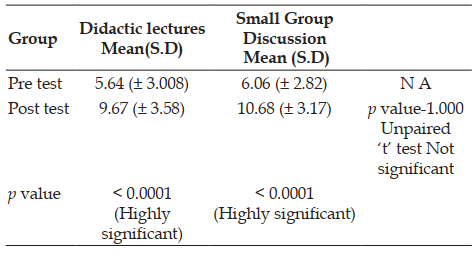
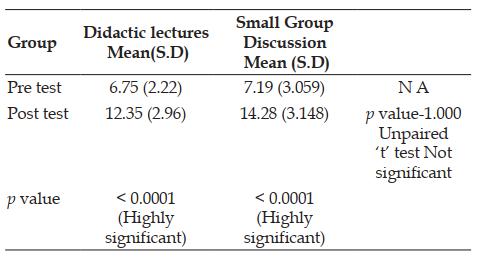
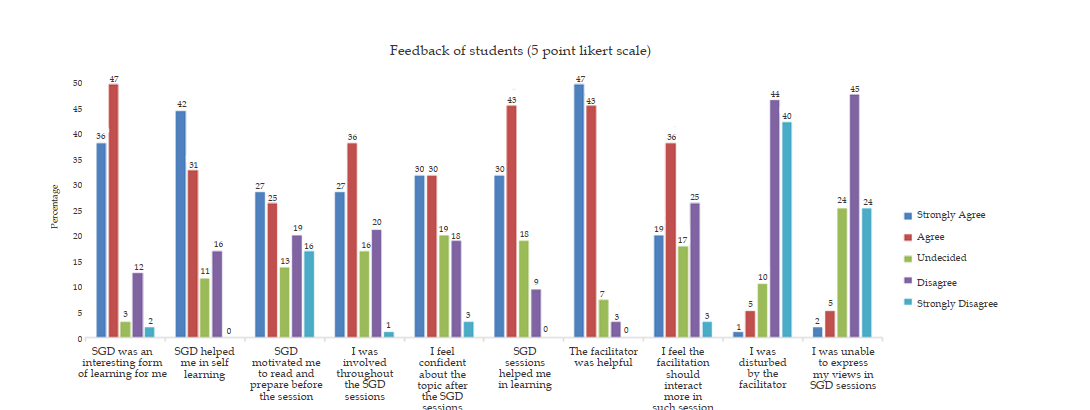
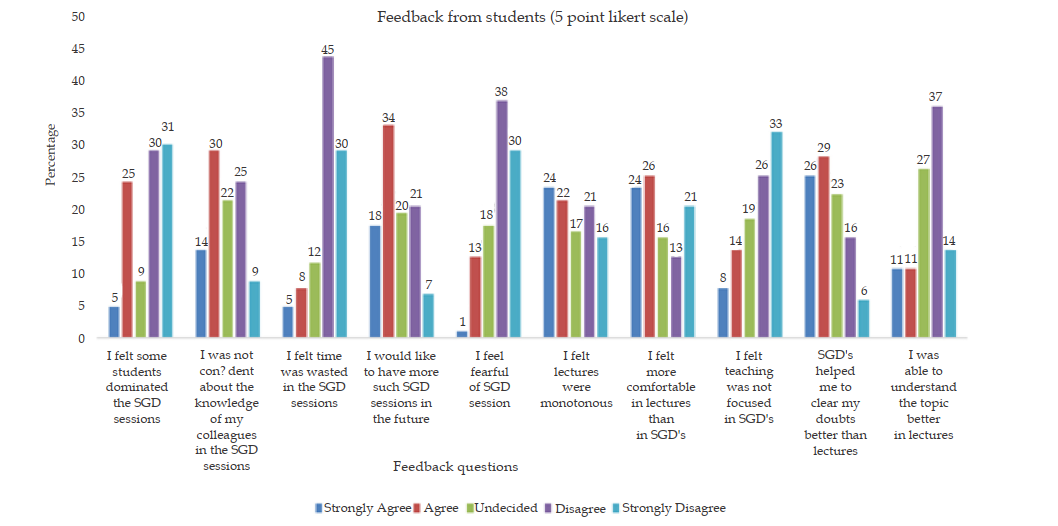
The subject of Forensic Medicine is a clinical subject as per the new curriculum based medical education which requires a variety of teaching and learning modalities, similar to other subjects. There is a need for innovative teaching which involves student interaction and participation. A small group discussion (SGD’s) is one such method proven beneficial. A randomized crossover comparative study was conducted on II phase MBBS students in Forensic medicine who were exposed to both small group teaching and didactic lectures by dividing into 2 equal groups and then doing a crossover in two sessions. Evaluation was done by pre-test, post-test and feedback questionnaire of students with likert scale. Though there was no statistically significant difference between the marks obtained after Small Group discussion or didactic lectures, the perception analysis showed that majority of the students found SGD’s better than didactic lectures in terms of learning, involvement, clearing doubts, increasing self confidence etc. SGD’s can be used as an additional form of teaching in Forensic Medicine which help in increasing students’ involvement, encourage self directed learning and help in making the teaching learning process more focused. However we need to have more faculties to fulfill this and sensitization of students is also required for this.
References
- 1. http://www.supremecourtcases.com/index2. php?option=com_content&itemid=54&do_ pdf=1&id=517.
- 2. Sheikh A, Ahmad F. Forensic medicine; transforming traditional teaching by incorporating a variety of small group teaching approaches at Multan medical and dental college. Professional Med J 2015;22(7):838–43.
- 3. Medical Council of India. Vision 2015. Available at: www.mciindia.org/tools/announcement/ MCI_booklet.pdf (last accessed on August 9; 2015).
- 4. Hafezimoghadam P, Farahmand S, Farsi D, et al. A Comparative Study of Lecture and Discussion Methods in the Education of Basic Life Support and Advanced Cardiovascular Life Support for Medical Students. Tr J Emerg Med. 2013;13(2):59– 63.
- 5. Savkar MK, Mariswamy V, Gangadhar M. Comparison between didactic lectures and small group discussions among second year medical undergraduates in pharmacology. Int J Basic Clin Pharmacol 2016;5:2542–45.
- 6. Fischer RL, Jacobs SL, Herbert WN. Small-group discussion versus lecture format for third-year students in obstetrics and gynecology. Obstet Gynecol. 2004 Aug;104(2):349–53.
- 7. Yadav PP, Chaudhary M, Patel J, Shah A, Kantharia ND. Effectiveness of integrated teaching module in pharmacology among medical undergraduates. Int J Appl Basic Med Res. 2016;6:215–9.
- 8. Sultan Ayoub Meo, Basic steps in establishing effective small group teaching sessions in medical schools. Pak J Med Sci. 2013 Jul-Aug; 29(4):1071– 76.
- 9. Qamar MR, Ahmad A, Niaz K. Learning through small group discussion versus didactic lectures. Pak Armed Forces Med J. 2015;65(3):386–90.
Data Sharing Statement
There are no additional data available.
Funding
This research received no funding.
Author Contributions
All authors contributed significantly to the work and approve its publication.
Ethics Declaration
This article does not involve any human or animal subjects, and therefore does not require ethics approval.
Acknowledgements
Information not provide.
Conflicts of Interest
The authors report no conflicts of interest in this work.
About this article

Cite this article
Verma L, Kumar R C, Bansal A, et al. Comparison of Small Group Discussions and Didactic Lectures in Forensic Medicine. Indian Journal of Legal Medicine. 2020;1(2):49-54.
Licence:
Attribution-Non-commercial 4.0 International (CC BY-NC 4.0)This license enables reusers to distribute, remix, adapt, and build upon the material in any medium or format for noncommercial purposes only, and only so long as attribution is given to the creator.
| Received | Accepted | Published |
|---|---|---|
| June 10, 2022 | July 16, 2022 | December 28, 2022 |
DOI: N.A
Keywords
Small group teachingDidactic lectureCBMESearch for Similar Articles
Similar Articles
- Good Faith and Compassion in Termination Beyond 24 Weeks: A Liberal Reading of...
- Litigation Stress in Medical Practice: An Invisible Occupational Hazard from fea...
- When Healing Meets Law: Practical Guidance from a Medicolegal Perspective: An In...
- Bharatiya Nyaya Sanhita a Bane of NMC Registered Physicians
- Critical Appraisal of Legal Complexities in Medico-Legal Consent: A Physician’s...
Article Level Metrics
Last UpdatedWednesday 30 September 2026, 08:34:17 (IST)
1188
Accesses
12
434
00
Citations
NA
NA
NA
Download citation
Article Keywords
Keyword Highlighting
Highlight selected keywords in the article text.
Timeline
| Received | June 10, 2022 |
| Accepted | July 16, 2022 |
| Published | December 28, 2022 |
licence
Attribution-Non-commercial 4.0 International (CC BY-NC 4.0)
This license enables reusers to distribute, remix, adapt, and build upon the material in any medium or format for noncommercial purposes only, and only so long as attribution is given to the creator.