Full Text (PDF)
International Journal of Neurology and Neurosurgery 16(1-2):p 7-16, January-June 2024. | DOI: https://doi.org/10.21088/ijnns.0975.0223.161224.1
Review Article
Artificial Intelligence in Decoding ADHD (Attention Deficit Hyperactivity Disorder)
Prachi Srivastava, Amaan Arif, Shrijal Singh
Author Information
Licence:
Attribution-Non-commercial 4.0 International (CC BY-NC 4.0)This license enables reusers to distribute, remix, adapt, and build upon the material in any medium or format for noncommercial purposes only, and only so long as attribution is given to the creator.
International Journal of Neurology and Neurosurgery 16(1-2):p 7-16, January-June 2024. | DOI: https://doi.org/10.21088/ijnns.0975.0223.161224.1
How Cite This Article:
Prachi Srivastava, Amaan Arif, Shrijal Singh. Artificial Intelligence in Decoding ADHD (Attention Deficit Hyperactivity Disorder). International Journal of Neurology and Neurosurgery. 2024;16(1-2):07-16.Timeline
Received : January 07, 2024
Accepted : May 29, 2024
Published : June 30, 2024
Abstract
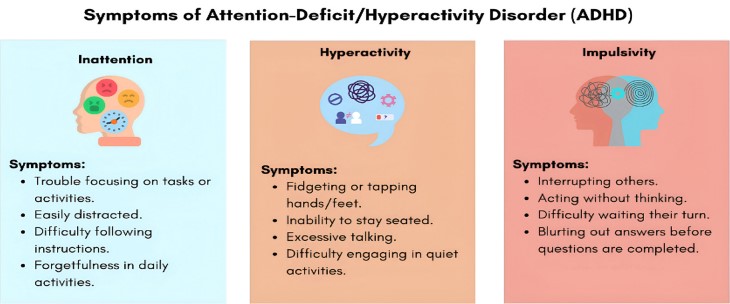
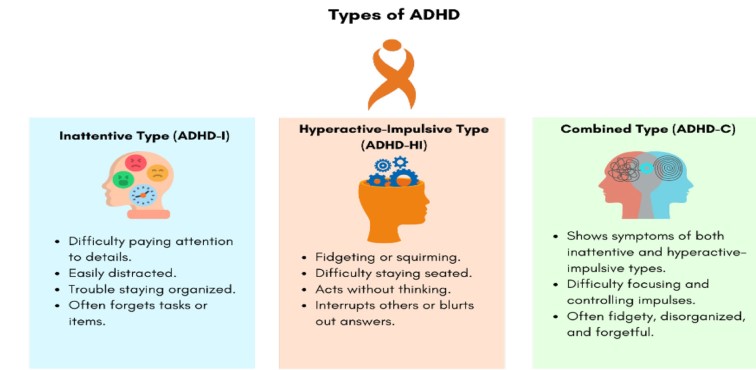
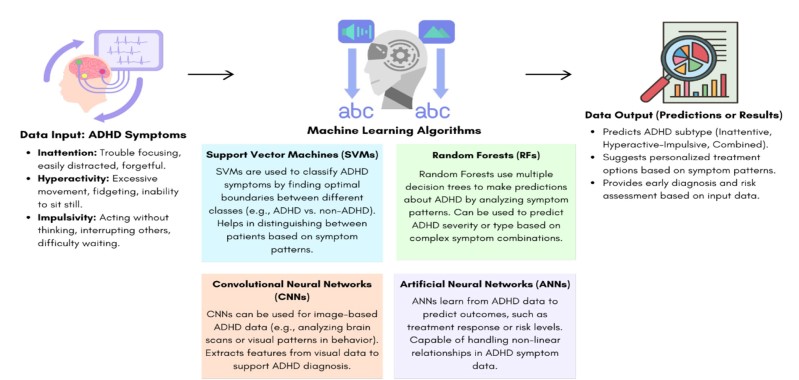
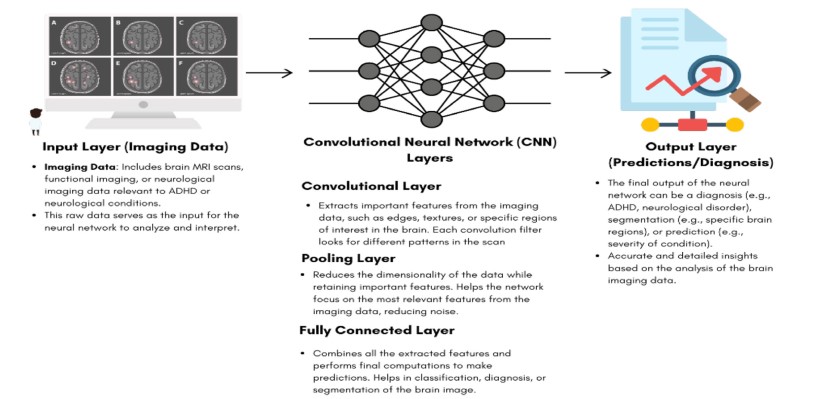
Attention Deficit Hyperactivity Disorder (ADHD) is a common neurodevelopmental disorder that affects both children and adults, is characterized by symptoms of inattention, hyperactivity, and impulsivity. Globally, ADHD affects approximately 5-7% of children and adolescents, as well as 2.5% of adults. The condition significantly impacts daily functioning, social relationships or interactions, and academic or professional performance. ADHD appears differently in different age groups, with classroom disruptions and difficulty in social interactions being common in children, while adults may struggle with time management, organizing, and maintaining interpersonal connections. The disorder is categorized into three main types: mainly inattentive, mostly hyperactive-impulsive, and combination presentation, which are defined by dominant symptom patterns. Diagnosis involves ongoing symptom assessment, with treatment options including medications, behavioural therapies, and management strategies tailored to individual needs. The growing use of Artificial Intelligence (AI) in healthcare has significantly improved ADHD diagnosis and treatment, offering higher precision, efficiency, and personalization. AI algorithms enhance diagnostic accuracy by analyzing large datasets and identifying complex patterns in medical images, enabling early detection of ADHD and related conditions. Moreover, AI-driven treatment plans personalize therapeutic techniques based on individual patient data, improving outcomes and reducing adverse side effects. Benefits of AI include improved diagnostic accuracy, increased efficiency through automation, development of personalized medicine, and reduced healthcare costs. This review explores the role of AI in ADHD diagnosis and treatment, focusing on its transformative potential in improving patient care and advancing precision medicine. Understanding AI applications in healthcare can lead to way for more effective ADHD therapy management and improved patient quality of life.
References
- 1. da Silva, B.S., Grevet, E.H., Silva, L. et al. An overview on neurobiology and therapeutics of attention-deficit/hyperactivity disorder. Discov Ment Health 3, 2 (2023). https://doi. org/10.1007/s44192-022-00030-1
- 2. Williams OC, Prasad S, McCrary A, Jordan E, Sachdeva V, Deva S, Kumar H, Mehta J, Neupane P, Gupta A. Adult attention deficit hyperactivity disorder: a comprehensive review. Ann Med Surg (Lond). 2023 Apr 12;85(5):1802-1810. doi: 10.1097/MS9.0000000000000631. PMID: 37228994; PMCID: PMC10205222.
- 3. Luo, Y., Weibman, D., Halperin, J. M., & Li, X. (2019). A review of heterogeneity in attention deficit/hyperactivity disorder (ADHD). Frontiers in Human Neuroscience, 13. https:// doi.org/10.3389/fnhum.2019.00042
- 4. Arnold, L. E., Hodgkins, P., Caci, H., Kahle, J., & Young, S. (2015). Effect of treatment modality on long-term outcomes in attention-deficit/ hyperactivity disorder: A systematic review. PLOS ONE. https://doi.org/10.1371/journal. pone.0116407
- 5. Al Kuwaiti A, Nazer K, Al-Reedy A, Al-Shehri S, Al-Muhanna A, Subbarayalu AV, Al Muhanna D, Al-Muhanna FA. A Review of the Role of Artificial Intelligence in Healthcare. Journal of Personalized Medicine. 2023; 13(6):951. https:// doi.org/10.3390/jpm13060951
- 6. Ramsay JR. Assessment and monitoring of treatment response in adult ADHD patients: current perspectives. Neuropsychiatr Dis Treat. 2017; 13:221-232, https://doi.org/10.2147/NDT. S104706
- 7. Vitiello, B., & Sherrill, J. (2007). School-based interventions for students with attention deficit hyperactivity disorder: Research implications and prospects. School Psychology Review, 36(2), 287-290. https://doi.org/10.1080/02796015.2007 .12087946
- 8. Shaw, M., Hodgkins, P., Caci, H. et al. A systematic review and analysis of long-term outcomes in attention deficit hyperactivity disorder: effects of treatment and non-treatment. BMC Med 10, 99 (2012). https://doi.org/10.1186/1741-7015-10-99
- 9. Alowais, S.A., Alghamdi, S.S., Alsuhebany, N. et al. Revolutionizing healthcare: the role of artificial intelligence in clinical practice. BMC Med Educ 23, 689 (2023). https://doi.org/10.1186/s12909- 023-04698-z
- 10. Devi, K. J., Alghamdi, W., N, D., Sathish, T., & Alghamdi, W. (2023). Artificial Intelligence in Healthcare: Diagnosis, Treatment, and Prediction. E3S Web of Conferences, 399(3). https://doi.org/10.1051/e3sconf/202339904043
- 11. Khan, A. (2023). Transforming Healthcare through AI: Unleashing the Power of Personalized Medicine. International Journal of Multidisciplinary Sciences and Arts, 2(1). https://doi.org/10.47709/ijmdsa.v2i1.2424
- 12. Schork, N.J. (2019). Artificial Intelligence and Personalized Medicine. In: Von Hoff, D., Han, H. (eds) Precision Medicine in Cancer Therapy . Cancer Treatment and Research, vol 178. Springer, Cham. https://doi.org/10.1007/978-3- 030-16391-4_11
- 13. Ghasemi E, Ebrahimi M, Ebrahimie E. Machine learning models effectively distinguish attention-deficit/hyperactivity disorder using event-related potentials. Cogn Neurodyn. 2022 Dec;16(6):1335-1349. doi: 10.1007/s11571-021- 09746-2. Epub 2022 Feb 15. PMID: 36408064; PMCID: PMC9666608.
- 14. Alkahtani, H.; Aldhyani, T.H.H.; Ahmed, Z.A.T.; Alqarni, A.A. Developing System-Based Artificial Intelligence Models for Detecting the Attention Deficit Hyperactivity Disorder. Mathematics 2023, 11, 4698. https://doi. org/10.3390/math11224698
- 15. Mikolas, P., Vahid, A., Bernardoni, F. et al. Training a machine learning classifier to identify ADHD based on real-world clinical data from medical records. Sci Rep 12, 12934 (2022). https://doi.org/10.1038/s41598-022-17126-x
- 16. TaghiBeyglou, B., Shahbazi, A., Bagheri, F., Akbarian, S., & Jahed, M. (2022). Detection of ADHD cases using CNN and classical classifiers of raw EEG. Computer Methods and Programs in Biomedicine Update, 2, 100080. https://doi. org/10.1016/j.cmpbup.2022.100080
- 17. Zhang, J., Zhang, Zm. Ethics and governance of trustworthy medical artificial intelligence. BMC Med Inform Decis Mak 23, 7 (2023). https://doi. org/10.1186/s12911-023-02103-9
- 18. Wang, XH., Jiao, Y. & Li, L. Identifying individuals with attention deficit hyperactivity disorder based on temporal variability of dynamic functional connectivity. Sci Rep 8, 11789 (2018). https://doi.org/10.1038/s41598- 018-30308-w
- 19. Eloyan, A., Muschelli, J., Nebel, M. B., Liu, H., Han, F., Zhao, T., Caffo, B. (2012). Automated diagnoses of attention deficit hyperactive disorder using magnetic resonance imaging. Frontiers in Systems Neuroscience, 6, Article 61. https://doi.org/10.3389/fnsys.2012.00061
- 20. Chen, M., Li, H., Wang, J., Dillman, J. R., Parikh, N. A., & He, L. (2019). A Multichannel Deep Neural Network Model Analyzing Multiscale Functional Brain Connectome Data for Attention Deficit Hyperactivity Disorder Detection. Radiology: Artificial Intelligence, 1(1), e190012. https://doi.org/10.1148/ryai.2019190012
- 21. Lim, L., Marquand, A., Cubillo, A. A., Smith, A. B., Chantiluke, K., Simmons, A., Mehta, M., & Rubia, K. (2013). Disorder-Specific Predictive Classification of Adolescents with Attention Deficit Hyperactivity Disorder (ADHD) Relative to Autism Using Structural Magnetic Resonance Imaging. PLOS ONE, 8(5), e63660. https://doi. org/10.1371/journal.pone.0063660
- 22. Hu Y, Ran J, Qiao R, Xu J, Tan C, Hu L, Tian Y. Identifying ADHD-Related Abnormal Functional Connectivity with a Graph Convolutional Neural Network. Neural Plast. 2024 Apr 30;2024:8862647. doi: 10.1155/2024/8862647. PMID: 38715980; PMCID: PMC11074862.
- 23. Alshehri S, Alahmari KA, Alasiry A. A Comprehensive Evaluation of AI-Assisted Diagnostic Tools in ENT Medicine: Insights and Perspectives from Healthcare Professionals. J Pers Med. 2024 Mar 28;14(4):354. doi: 10.3390/ jpm14040354. PMID: 38672981; PMCID: PMC11051468.
- 24. Dave, M., Patel, N. Artificial intelligence in healthcare and education. Br Dent J 234, 761–764 (2023). https://doi.org/10.1038/ s41415-023-5845-2
- 25. Sezgin E. Artificial intelligence in healthcare: Complementing, not replacing, doctors and healthcare providers. Digit Health. 2023 Jul 2;9:20552076231186520. doi: 10.1177/20552076231186520. PMID: 37426593; PMCID: PMC10328041.
- 26. Khalifa, M., Albadawy, M., & Iqbal, U. (2024). Advancing clinical decision support: The role of artificial intelligence across six domains. Computer Methods and Programs in Biomedicine Update, 5, 100142. https://doi.org/10.1016/j. cmpbup.2024.100142
- 27. Lin SY, Mahoney MR, Sinsky CA. Ten Ways Artificial Intelligence Will Transform Primary Care. J Gen Intern Med. 2019 Aug;34(8):1626-1630. doi: 10.1007/s11606-019-05035-1. Epub 2019 May 14. PMID: 31090027; PMCID: PMC6667610.
- 28. Davenport, T.H., Glaser, J.P. Factors governing the adoption of artificial intelligence in healthcare providers. Discov Health Systems 1, 4 (2022). https://doi.org/10.1007/s44250-022-00004-8
- 29. Bajwa J, Munir U, Nori A, Williams B. Artificial intelligence in healthcare: transforming the practice of medicine. Future Healthc J. 2021 Jul;8(2):e188-e194. doi: 10.7861/fhj.2021-0095. PMID: 34286183; PMCID: PMC8285156.
- 30. Yeasmin, S. (2019). Benefits of Artificial Intelligence in Medicine. In 2019 2nd International Conference on Computer Applications & Information Security (ICCAIS) (pp. 1-6). Riyadh, Saudi Arabia. https://doi. org/10.1109/CAIS.2019.8769557
- 31. He J, Baxter SL, Xu J, Xu J, Zhou X, Zhang K. The practical implementation of artificial intelligence technologies in medicine. Nat Med. 2019 Jan;25(1):30-36. doi: 10.1038/s41591-018-0307-0. Epub 2019 Jan 7. PMID: 30617336; PMCID: PMC6995276.
- 32. Alshehri S, Alahmari KA, Alasiry A. A Comprehensive Evaluation of AI-Assisted Diagnostic Tools in ENT Medicine: Insights and Perspectives from Healthcare Professionals. J Pers Med. 2024 Mar 28;14(4):354. doi: 10.3390/ jpm14040354. PMID: 38672981; PMCID: PMC11051468.
Data Sharing Statement
There are no additional data available. All raw data and code are available upon request.
Funding
This research received no funding.
Author Contributions
All authors contributed significantly to the work and approve its publication.
Ethics Declaration
This article does not involve any human or animal subjects, and therefore does not require ethics approval.
Acknowledgements
We would like to express our gratitude to the patients, their families, and all those who have contributed to this study.
Conflicts of Interest
No conflicts of interest in this work.
About this article

Cite this article
Prachi Srivastava, Amaan Arif, Shrijal Singh. Artificial Intelligence in Decoding ADHD (Attention Deficit Hyperactivity Disorder). International Journal of Neurology and Neurosurgery. 2024;16(1-2):07-16.
Licence:
Attribution-Non-commercial 4.0 International (CC BY-NC 4.0)This license enables reusers to distribute, remix, adapt, and build upon the material in any medium or format for noncommercial purposes only, and only so long as attribution is given to the creator.
| Received | Accepted | Published |
|---|---|---|
| January 07, 2024 | May 29, 2024 | June 30, 2024 |
DOI: https://doi.org/10.21088/ijnns.0975.0223.161224.1
Keywords
ADHDNeurodevelopmental disorderInattentionHyperactivityImpulsivityDiagnosistreatmentChildrenAdultsSearch for Similar Articles
Similar Articles
- Role of Low-Level Laser Therapy (LLLT) in Management of Scald Burns
- Coexisting Diastematomyelia, Tethered Spinal Cord, Syringomyelia and Filum Termi...
- Nut Carcinoma in Brain: A Rare Presentation of a Malignant Tumor
- A Rare Case of Pediatric Fahr’s Disease with Myoclonus as Initial Presentation
- Epigenetic Modification and their Significance in Neurodevelopmental Disorder
Article Level Metrics
Last UpdatedThursday 12 November 2026, 19:06:32 (IST)
3086
Accesses
4
349
00
Citations
NA
NA
NA
Download citation
Article Keywords
Keyword Highlighting
Highlight selected keywords in the article text.
Timeline
| Received | January 07, 2024 |
| Accepted | May 29, 2024 |
| Published | June 30, 2024 |
licence
Attribution-Non-commercial 4.0 International (CC BY-NC 4.0)
This license enables reusers to distribute, remix, adapt, and build upon the material in any medium or format for noncommercial purposes only, and only so long as attribution is given to the creator.