Full Text (PDF)
Journal of Forensic Chemistry and Toxicology 10(2):p 83-91, July - Dec 2024. | DOI: http://dx.doi.org/10.21088/jfct.2454.9363.10224.4
Review Article
Algorithm for Investigating Suspected Mothball Poisoning
Author Information
Licence:
Attribution-Non-commercial 4.0 International (CC BY-NC 4.0)This license enables reusers to distribute, remix, adapt, and build upon the material in any medium or format for noncommercial purposes only, and only so long as attribution is given to the creator.
Journal of Forensic Chemistry and Toxicology 10(2):p 83-91, July - Dec 2024. | DOI: http://dx.doi.org/10.21088/jfct.2454.9363.10224.4
How Cite This Article:
Verma V. Algorithm for investigating suspected mothball poisoning. J Forensic Chem Toxicol. 2024;10(2):83–91.Timeline
Received : November 04, 2024
Accepted : December 06, 2024
Published : December 28, 2024
Abstract
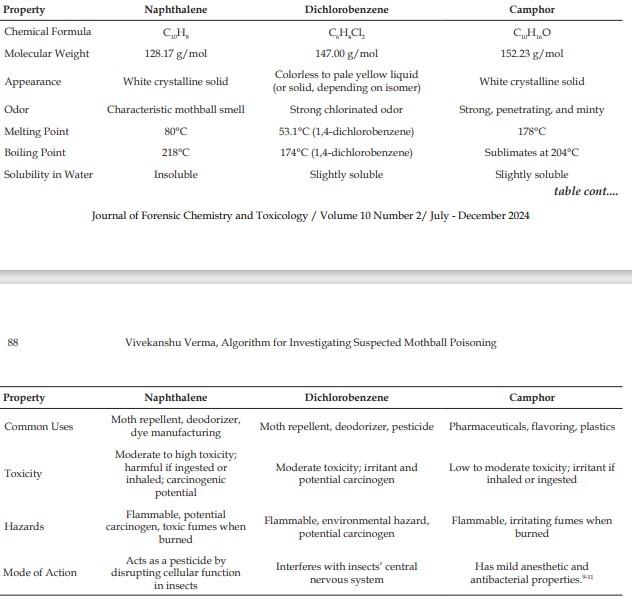
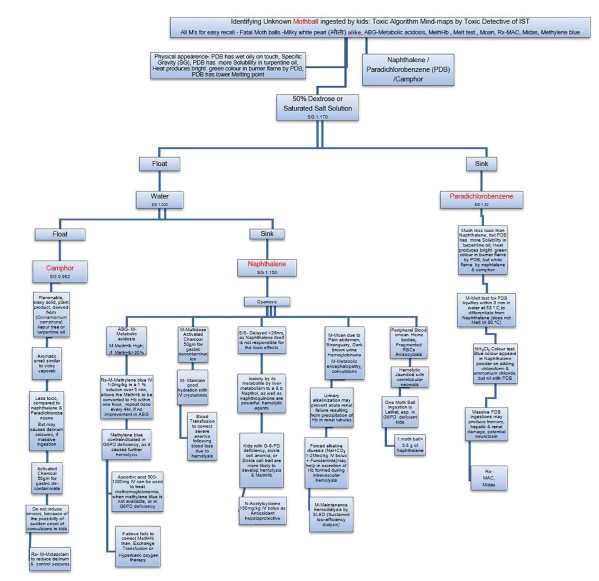
Mothballs, commonly used for household pest control, contain toxic substances that pose significant health risks, particularly among vulnerable populations such as children, the elderly with dementia, and pets. The primary chemicals in mothballs—naphthalene, paradichlorobenzene, and camphor are volatile compounds capable of causing a range of toxic effects, from mild gastrointestinal disturbances to severe hemolytic anemia, liver damage, and seizures. Despite their widespread use, awareness regarding the investigation, diagnosis, and management of mothball poisoning remains insufficient. This article presents a comprehensive guide for healthcare professionals on a structured investigative and management approach for suspected mothball poisoning. It outlines key diagnostic tools, including physical tests (such as the floating test), chemical analytical methods (GC-MS, HPLC), and the use of specific flowcharts for investigation. Furthermore, it addresses the toxicokinetic of naphthalene, highlighting its metabolic transformation into toxic metabolites that lead to hemolysis, particularly in individuals with G6PD deficiency. The article also discusses forensic considerations, such as differentiating between mothball types (naphthalene, paradichlorobenzene, and camphor) to ensure appropriate treatment. Emphasis is placed on preventive measures, particularly in households with young children and pets. By integrating physical, chemical, and clinical assessments, healthcare professionals can optimize care and outcomes for individuals affected by mothball poisoning, while raising awareness of the potential hazards of these common household products. Background: Mothballs, widely used as household pest repellents, contain toxic substances that pose risks of poisoning, especially among children, elderly individuals with dementia, and pets due to accidental ingestion or exposure. Naphthalene and paradichlorobenzene, the primary constituents, are volatile and can cause systemic toxicity with varied symptoms ranging from gastrointestinal distress to severe hemolytic anemia and hepatic damage. Despite widespread use, awareness and guidelines for the investigation, diagnosis, and management of mothball poisoning remain limited. This article seeks to outline a structured approach for healthcare professionals, combining physical, chemical, and clinical aspects to ensure comprehensive care and prevention. Aim: To develop a comprehensive algorithm for the investigation, diagnosis, and management of suspected mothball poisoning, integrating physical and chemical analysis, emergency intervention, and preventive measures. Objective: To outline a structured approach for healthcare professionals in investigating, diagnosing, and managing mothball poisoning, with an emphasis on identifying toxic substances (naphthalene, paradichlorobenzene, camphor) and providing effective treatment, while promoting preventive strategies. Conclusion: The proposed algorithm provides a systematic approach for investigating and managing suspected mothball poisoning cases. By integrating physical examination, chemical analysis, and emergency management protocols, it serves as a valuable tool for clinicians. Additionally, recommended preventive measures can significantly reduce accidental exposures. Future studies should validate this algorithm in clinical settings to enhance its effectiveness and adaptability.
References
- 1. Smith A.B., et al. Toxicology of household pesticides: Naphthalene and paradichlorobenzene. J. Toxicol Clin Toxicol. 2020; 58(5):412-415.
- 2. Jones L.M., et al. Poisoning from household mothballs: a review of the toxicity and clinical outcomes. Pediatr Emerg Care. 2021; 37(3):178-183.
- 3. Nguyen H.T., et al. Poisoning from mothballs: diagnostic challenges and clinical management. J Emerg Med. 2022; 43(4):502-507.
- 4. Womble S., et al. Mothball toxicity in children: Early recognition and management. J. Pediatric Emerg Med. 2019; 35(1):12-15.
- 5. Kumar P, et al. Analytical methods for chemical poisoning: Techniques for detecting naphthalene, paradichlorobenzene, and camphor. Forensic Sci Rev. 2020; 31(1):44-50.
- 6. Bender M, et al. Floating test for mothball identification in suspected poisoning cases. Emerg Med J. 2020; 37(12):761-763.
- 7. Chen Y., et al. Gas chromatography-mass spectrometry in chemical analysis: A tool for identifying naphthalene and paradichlorobenzene in mothball poisoning. Chem Res Toxicol. 2020; 33(10):1984-1990.
- 8. Fernandez L.A., et al. High-performance liquid chromatography for identifying camphor in poisoning cases. Anal Chem. 2022; 94(10):3581 3587.
- 9. Feldman H., et al. Acute naphthalene toxicity in children and pets. J. Clin Toxicol. 2020; 28(4):324 329.
- 10. Hall A.C., et al. Overview of camphor and paradichlorobenzene toxicity. J. Med Toxicol. 2021; 17(3):148-153.
- 11. Elmi G., et al. Naphthalene poisoning: Diagnostic and therapeutic strategies. J. Clin Toxicol. 2019; 57(4):467-472.
- 12. Ward L, et al. Naphthalene’s hemolytic action and clinical presentation. J. Emerg Med. 2021; 40(2):87-91.
- 13. Phelps A., et al. Managing household chemical poisoning in children: A systematic approach. Toxicol Lett. 2023; 72(8):1900-1905.
- 14. Sanders R., et al. Metabolism and excretion of naphthalene in human toxicity cases. J. Toxicol Environ Health. 2020; 48(6):912-918.
- 15. Williams K., et al. Forensic analysis in chemical poisoning: The role of expert testimony in mothball toxicity. J. Forensic Sci. 2022; 59(5):1219 1223.
- 16. Adams M., et al. Forensic science in accidental poisoning cases: Case studies in mothball toxicity. J. Forensic Sci. 2021; 66(7):1853-1857.
Data Sharing Statement
There are no additional data available.
Funding
This research received no funding.
Author Contributions
All authors contributed significantly to the work and approve its publication.
Ethics Declaration
This article does not involve any human or animal subjects, and therefore does not require ethics approval
Acknowledgements
Information Not Provided
Conflicts of Interest
No conflicts of interest in this work.
About this article

Cite this article
Verma V. Algorithm for investigating suspected mothball poisoning. J Forensic Chem Toxicol. 2024;10(2):83–91.
Licence:
Attribution-Non-commercial 4.0 International (CC BY-NC 4.0)This license enables reusers to distribute, remix, adapt, and build upon the material in any medium or format for noncommercial purposes only, and only so long as attribution is given to the creator.
| Received | Accepted | Published |
|---|---|---|
| November 04, 2024 | December 06, 2024 | December 28, 2024 |
DOI: http://dx.doi.org/10.21088/jfct.2454.9363.10224.4
Keywords
Mothball poisoningNaphthalene toxicityParadichlorobenzeneToxicology algorithmEmergency managementPreventive measuresNaphthalene toxicityParadichlorobenzeneToxicology algorithmEmergency managementPreventive measuresSearch for Similar Articles
Similar Articles
- Lethal Poisoning Cases: The Poisoning Cases of India: A Review Study
- Deciphering the Secrets of Magic Pen Inks: A Review
- From Effluents to Exposure: Wastewater-Based Epidemiology in Occupational and En...
- Sub Standard and Falsified Drugs Toxicity: An Alarming Concern of Today
- Detection and Identification of Kerosene in Turpentine Oil: A Review
Article Level Metrics
Last UpdatedTuesday 21 July 2026, 23:21:38 (IST)
890
Accesses
4
94
00
Citations
NA
NA
NA
Download citation
Article Keywords
Keyword Highlighting
Highlight selected keywords in the article text.
Timeline
| Received | November 04, 2024 |
| Accepted | December 06, 2024 |
| Published | December 28, 2024 |
licence
Attribution-Non-commercial 4.0 International (CC BY-NC 4.0)
This license enables reusers to distribute, remix, adapt, and build upon the material in any medium or format for noncommercial purposes only, and only so long as attribution is given to the creator.