Full Text (PDF)
RFP Indian Journal of Medical Psychiatry 5(2):p 41-49, July-December 2022. | DOI: n.a
Original Article
A Study on the Problematic Internet Use in Telangana Undergraduate Medical Students
Koneru Kavya Sri, Md Adil Faizan, Pramod Kumar Reddy Mallepally
Author Information
Licence:
Attribution-Non-commercial 4.0 International (CC BY-NC 4.0)This license enables reusers to distribute, remix, adapt, and build upon the material in any medium or format for noncommercial purposes only, and only so long as attribution is given to the creator.
RFP Indian Journal of Medical Psychiatry 5(2):p 41-49, July-December 2022. | DOI: n.a
How Cite This Article:
Md Adil Faizan, Koneru Kavya Sri, Pramod Kumar Reddy Mallepally/A Study on the Problematic Internet Use in Telangana Undergraduate Medical Students/RFP Indian Journal of Medical Psychiatry. 2022;5(2):41–49.Timeline
Received : July 08, 2022
Accepted : August 24, 2022
Published : December 25, 2022
Abstract
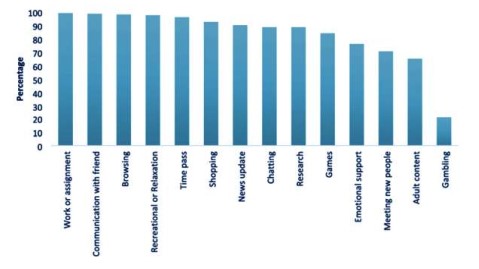
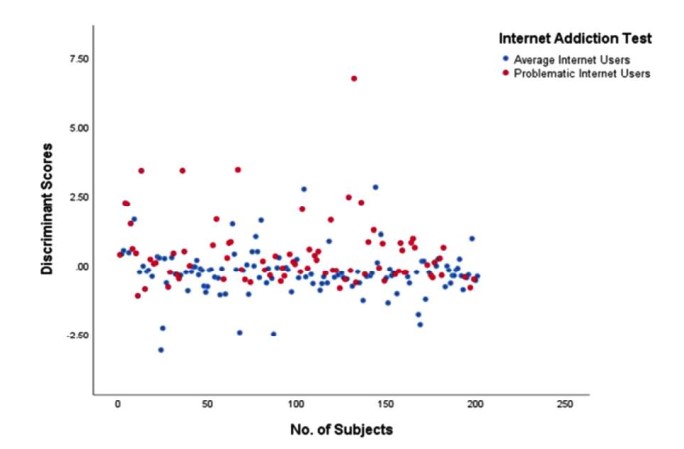
The proportion of problematic internet usage (PIU) varies from 7.3 to 51% globally due to population variety. The purpose of this study is to identify correlates of problematic internet use among telangana undergraduate medical students and to develop a model for distributing new courses across different internet user groups. Material and Methods: From May 1 to June 30th, 2022, 201 medical undergraduate students at medical colleges in Telangana participated in a cross-sectional survey. Demographic data and elements affecting PIU were gathered using a semi-structured, pre-tested questionnaire. PIU was evaluated using Dr. Kimberly Young's Internet Addiction Test (IAT) instrument. In order to evaluate the correlates of PIU, binary logistic regression has been used, and stepwise discriminant analysis (DA) has been used to create a model for allocating new subjects among different groups of internet users. The statistical analysis was performed using SPSS Inc.'s (Chicago, IL) Statistical Package for Social Sciences (Trial version 27.0). Result: PIU was present in all 41.3 percent of the individuals. However, in binary logistic regression, chatting, emotional support, and watching online adult content were significant risk factors for PIU. Univariate analysis demonstrates that internet use for emotional support, watching adult content, and gambling were significantly linked with PIU. The average and problematic internet user categories were accurately assigned to 66.2 percent of respondents by the discriminant model. Conclusion: The foundation course of the curriculum implementation support programme (CISP) for MBBS students could include a discussion of problematic internet use and its possible negative effects.
References
- 1. Global reach (2019). Evolutions of online population. [Cited2019 March 11th].
- 2. Chaudhari B, Menon P, Saldanha D, Tewari A, Bhattacharya L. Internet addiction and its determinants among medical students. Ind Psychiatry J. 2015;24(2):15862.
- 3. Gedam SR, Ghosh S, Modi L, Goyal A,Mansharamani H. Study of internet addiction: prevalence, pattern, and psychopathology among health professional undergraduates. Indian J Soc Psychiatry. 2017;33(4):305–11.
- 4. Scherer K. College life online: healthy and unhealthy internet use. J Coll Stud Dev. 1997;38:655–65.
- 5. Anderson K. Internet use among college students: an exploratory study. J Am Coll Heal. 2001;50(1):21–6.
- 6. Salehi M, Khalili MN, Hojjat SK, Salehi M, Danesh A. Prevalence of internet addiction and associated factors among medical students from Mashhad, Iran in 2013. Iran Red Crescent Med J. 2014;16(5):e17256.
- 7. Mazhari S. The prevalence of problematic internet use and the related factors in medical students, Kerman, Iran. Addict Health. 2012;4(3–4):87–94.
- 8. Zhang MWB, Lim RBC, Lee C, Ho RCM. Prevalence of internet addiction in medical students: a Metaanalysis. Acad Psychiatry. 2018;42(1):88–93.
- 9. Pramanik T, Sherpa MT, Shrestha R. Internet addiction in a group of medical students: a cross sectional study. Nepal Med Coll J. 2012;14(1):46–8.
- 10. Fineberg NA, Demetrovics Z, Stein DJ, Ioannidis K, Potenza MN, Grunblatt E, et al. Manifesto for a European research network into problematic usage of the internet. Eur Neuropsychopharmacol. 2018;28(11):1232–46. https://doi.org/10.1016/j.euroneuro.2018.08.004.
- 11. Sayyah M, Khanafereh S. Prevalence of internet addiction among medical students: a study from southwestern Iran. Cent Eur J Public Health. 2019;27(4):326–9.
- 12. Krishnamurthy S, Chetlapalli SK. Internet addiction: prevalence and risk factors: a crosssectional study among college students in Bengaluru, the Silicon Valley of India. Indian J Public Health. 2015;59(2):115–21.
- 13. Balhara YP, Gupta R, Atilola O, Knez R, Mohorovic T, Gajdhar W, et al. Problematic internet use and its correlates among students from three medical schools across three countries. Acad Psychiatry. 2015;39(6):634–8.
- 14. Christakis DA. Internet addiction: a 21st century epidemic? BMC Med. 2010;8(1):61.
- 15. Cardak M. Psychological well-being and internet addiction among university students. Turk Online J Educ Tech. 2013;12.
- 16. Xiuqin H, Huimin Z, Mengchen L, Jinan W, Ying Z, Ran T. Mental health, personality, and parental rearing styles of adolescents with internet addiction disorder. Cyberpsychol Behav Soc Netw. 2010;13(4):401–6.
- 17. Alavi SS, Alaghemandan H, Maracy MR, Jannatifard F, Eslami M, Ferdosi M. Impact of addiction to internet on a number of psychiatric symptoms in students of Isfahan universities, Iran, 2010. Int J Prev Med. 2012;3(2):122–7.
- 18. Paul AV, Ganapthi CK, Duraimurugan M, Abirami V, Reji E. Internet addiction and associated factors: a study among college students in South India. Innov J Med Health Sci. 2015;5(3):121–5.
- 19. Ceyhan AA. Predictors of problematic internet use on Turkish university students. CyberPsychol Behav. 2008;11(3):363–6.
- 20. Young KS. Internet addiction test manual. Bradford: Center for Internet Addiction Recovery; 2007.
- 21. Frangos CC, Frangos CC, Sotiropoulos I. A metaanalysis of the reliability of Young’s internet addiction test. In proceedings of the world congress on engineering 2012 Jul (Vol. 1, pp. 368-371). London, United Kingdom: World Congress on Engineering.
- 22. Ramayah T, Ahmad NH, Halim HA, Zainal SR, Lo MC. Discriminant analysis: an illustrated example. Afr J Bus Manag. 2010;4(9):1654–67.
- 23. Kim KM, Kim H, Choi JW, Kim SY, Kim JW. What types of internet services make adolescents addicted? Correlates of problematic internet use. Neuropsychiatr Dis Treat. 2020;16:1031–41.
- 24. Haroon MZ, Zeb Z, Javed Z, Awan Z, Aftab Z, Talat W. Internet Addiction in Medical Students. J Ayub Med Coll Abbottabad. 2018;30(Suppl 1):S659–63.
- 25. Sharma A, Sahu R, Kasar PK, Sharma R. Internet addiction among professional courses students: a study from Central India. Int J Med Sci Public Health. 2014;3(9):1069–73.
- 26. Ioannidis K, Chamberlain SR, Treder MS, Kiraly F, Leppink EW, Redden SA, et al. Problematic internet use (PIU): associations with the impulsivecompulsive spectrum. An application of machine learning in psychiatry. J Psychiatr Res. 2016;83:94–102.
- 27. Mamun MA, Hossain MS, Siddique AB, Sikder MT, Kuss DJ, Griffiths MD. Problematic internet use in Bangladeshi students: the role of sociodemographic factors, depression, anxiety, and stress. Asian J Psychiatr. 2019;44:48–54.
- 28. Ghamari F, Mohammadbeigi A, Mohammadsalehi N, Hashiani AA. Internet addiction and modeling its risk factors in medical students, Iran Indian. J Psychol Med. 2011;33(2):158–62.
- 29. Anand N, Jain PA, Prabhu S, Thomas C, Bhat A, Prathyusha PV, et al. Internet use patterns, internet addiction, and psychological distress among engineering university students: a study from India. Indian J Psychol Med. 2018;40(5):458–67.
- 30. Taha MH, Shehzad K, Alamro AS, Wadi M. Internet use and addiction among medical students in Qassim University, Saudi Arabia. Sultan Qaboos Univ Med J. 2019;19(2):e142–7.
- 31. Asiri S, Fallahi F, Ghanbari A, Kazemnejad-Leili E. Internet addiction and its predictors in guilan medical sciences students, 2012. Nurs Midwifery Stud. 2013;2(2):234–9.
- 32. Mitchell KJ, Wells M. Problematic internet experiences: primary or secondary presenting problems in persons seeking mental health care? Soc Sci Med. 2007;65(6):1136–41.
- 33. Faye AD, Gawande S, Tadke R, Kirpekar VC, Bhave SH. WhatsApp addiction and borderline personality disorder: a new therapeutic challenge. Indian J Psychiatry. 2016 Apr;58(2):235–7.
- 34. Martin SP, Robinson JP. The income digital divide: trends and predictions for levels of internet use. Soc Probl. 2007;54(1):1–22.
Data Sharing Statement
There are no additional data available. All raw data and code are available upon request.
Funding
This research received no funding.
Author Contributions
All authors contributed significantly to the work and approve its publication.
Ethics Declaration
This article does not involve any human or animal subjects, and therefore does not require ethics approval.
Acknowledgements
We would like to express our gratitude to the patients, their families, and all those who have contributed to this study.
Conflicts of Interest
No conflicts of interest in this work.
About this article

Cite this article
Md Adil Faizan, Koneru Kavya Sri, Pramod Kumar Reddy Mallepally/A Study on the Problematic Internet Use in Telangana Undergraduate Medical Students/RFP Indian Journal of Medical Psychiatry. 2022;5(2):41–49.
Licence:
Attribution-Non-commercial 4.0 International (CC BY-NC 4.0)This license enables reusers to distribute, remix, adapt, and build upon the material in any medium or format for noncommercial purposes only, and only so long as attribution is given to the creator.
| Received | Accepted | Published |
|---|---|---|
| July 08, 2022 | August 24, 2022 | December 25, 2022 |
DOI: n.a
Keywords
Keywords: Problematic Internet Usage; Medical Students; Gambling; Adult Content.Problematic Internet UsageMedical StudentsGamblingAdult ContentKeywords: Problematic Internet Usage; Medical Students; Gambling; Adult Content.Search for Similar Articles
Article Level Metrics
Last UpdatedWednesday 21 October 2026, 08:19:13 (IST)
1331
Accesses
72
243
00
Citations
NA
NA
NA
Download citation
Article Keywords
Keyword Highlighting
Highlight selected keywords in the article text.
Timeline
| Received | July 08, 2022 |
| Accepted | August 24, 2022 |
| Published | December 25, 2022 |
licence
Attribution-Non-commercial 4.0 International (CC BY-NC 4.0)
This license enables reusers to distribute, remix, adapt, and build upon the material in any medium or format for noncommercial purposes only, and only so long as attribution is given to the creator.