Full Text (PDF)
Indian Journal of Obstetrics and Gynecology 11(4):p 155-160, October-December 2023. | DOI: https://doi.org/10.21088/ijog.2321.1636.11423.3
Original Article
A Cross Sectional Study on Prevalence of Bacterial Vaginosis in Preterm and Term Labor
Monica Rajgopal, Sowmya Shivalingappa, Jayanth Shivalingappa, Bhavana Shivalingappa
Author Information
Licence:
Attribution-Non-commercial 4.0 International (CC BY-NC 4.0)This license enables reusers to distribute, remix, adapt, and build upon the material in any medium or format for noncommercial purposes only, and only so long as attribution is given to the creator.
Indian Journal of Obstetrics and Gynecology 11(4):p 155-160, October-December 2023. | DOI: https://doi.org/10.21088/ijog.2321.1636.11423.3
How Cite This Article:
Sowmya Shivalingappa, Monica Rajgopal, Jayanth Shivalingappa, et al./A Cross Sectional Study on Prevalence of Bacterial Vaginosis in Preterm and Term Labor/Indian J Obstet Gynecol. 2023;11(4): 155–160.Timeline
Received : October 09, 2023
Accepted : November 17, 2023
Published : December 25, 2023
Abstract
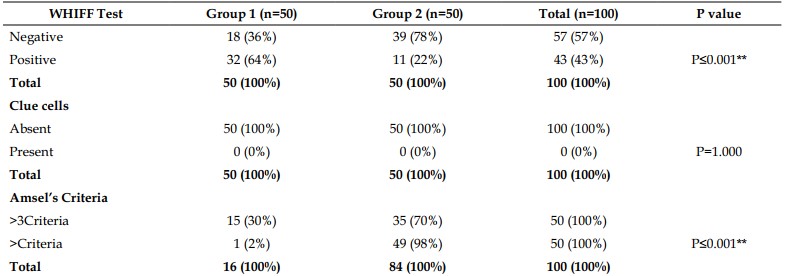
Background: The aim is to examine bacterial vaginosis (BV) in women with preterm and term labor, explore the link between bacterial vaginosis and preterm labor (PTL), and analyze complications for both mother and baby related to bacterial vaginosis. Design: Hospital based cross sectional study. Materials and Method: We had conducted an observational study at Basaveshwara Medical College and Hospital, involving 100 pregnant patients with preterm and term labor (50 patients in each group). Eligible patients attending the Obstetrics and Gynecology Outpatient Department (OBG OPD) and inpatient department will be included. Bacterial vaginosis will be determined using Amsel's criteria, which include evaluating discharge characteristics, vaginal pH, amine odor with KOH test, and presence of clue cells under microscopic examination. Additionally, vaginal swabs will undergo Gram staining. Results: The percentage of patients meeting Amsel's criteria for diagnosing bacterial vaginosis was significantly higher in the preterm labor group compared to the term labor group, with a statistically significant difference. According to Amsel's criteria, the prevalence of bacterial vaginosis was 30% in the preterm labor group and 2% in the term labor group. Conclusion: Bacterial vaginosis is a significant risk factor for preterm labor. Hence, conducting tests for bacterial vaginosis and promptly treating it can help reduce the risk of preterm labor.
References
- 1. Goffinet F, Maillard F, Mihoubi N, Kayem G, Papiernik E, Cabrol D, Paul G. Bacterial vaginosis: prevalence and predictive value for premature delivery and neonatal infection in women with preterm labour and intact membranes. European Journal of Obstetrics & Gynecology and Reproductive Biology. 2003 Jun 10;108(2):146-51.
- 2. McCormick MC. The contribution of low birth weight to infant mortality and childhood morbidity. New England journal of medicine. 1985 Jan 10;312(2):82-90.
- 3. Romero R, Mazor M. Infection and preterm labor. Clinical obstetrics and gynecology. 1988 Sep 1; 31(3):553-84.
- 4. Guaschino S, De Seta F, Piccoli M, Maso G, Alberico S. Aetiology of preterm labour: Bacterial vaginosis (BJOG: An International Journal of Obstetrics and Gynecology 113, SUPPL. 3,(46-51). BJOG: An International Journal of Obstetrics and Gynecology. 2008 Apr;115(5):674.
- 5. Donders GG, Van Bulck B, Caudron J, Londers L, Vereecken A, Spitz B. Relationship of bacterial vaginosis and mycoplasmas to the risk of spontaneous abortion. American journal of obstetrics and gynecology. 2000 Aug 1;183(2):431-7.
- 6. Lamont RF, Anthony F, Myatt L, Booth L, Furr PM, Taylor-Robinson D. Production of prostagland in E2 by human amnion in vitro in response to addition of media conditioned by microorganisms associated with chorioamnionitis and preterm labor. American journal of obstetrics and gynecology. 1990 Mar 1;162(3):819-25.
- 7. Brocklehurst P, Gordon A, Heatley E, Milan SJ. Antibiotics for treating bacterial vaginosis in pregnancy. Cochrane Database of Systematic Reviews. 2013(1).
- 8. Okun N, Gronau KA, Hannah ME. Antibiotics for bacterial vaginosis or Trichomonas vaginalis in pregnancy: a systematic review. Obstetrics & Gynecology. 2005 Apr 1;105(4):857-68.
- 9. US Preventive Services Task Force*. Screening for bacterial vaginosis in pregnancy to prevent preterm delivery: US Preventive Services Task Force recommendation statement. Annals of internal medicine. 2008 Feb 5;148(3):214-9.
- 10. Trabert B, Misra DP. Risk factors for bacterial vaginosis during pregnancy among African American women. American journal of obstetrics and gynecology. 2007 Nov 1;197(5):477-e1.
- 11. Dhawane VR, Tembhare PR. Bacterial vaginosis in preterm labour. Obstet Gynaecol Today 2002; 7: 693. 2002;6.
- 12. Priestly C, Dhar J. What is normal vaginal flora? Reply. Genitourinary Medicine. 1997 Jun 1; 73(3):230.
- 13. Hillier SL. Diagnostic microbiology of bacterial vaginosis. American journal of obstetrics and gynecology. 1993 Aug 1;169(2):455-9.
- 14. Newton ER, Piper J, Peairs W. Bacterial vaginosis and intraamniotic infection. American journal of obstetrics and gynecology. 1997 Mar 1;176(3):672-7.
- 15. Chawanpaiboon S, Pimol K. Bacterial vaginosis in threatened preterm, preterm and term labour. Medical journal of the Medical Association of Thailand. 2010 Dec 1;93(12):1351.
- 16. Desai Veena A, Ragini V, Preet MP. Bacterial Vaginosis in patients with Idiopathic preterm labour. J Obstet Gynaecol India. 2009;59(1):53-7.
- 17. Kiran CK, Kandati J, Ponugoti M. Prevalence of bacterial vaginosis in preterm and termlabour: a one year study. Int J Reprod Contracept Obstet Gynecol. 2017 Jun 1;6(6):2292-6.
- 18. Nwosu CO, Djieyep NA. Candidiasis and trichomoniais among pregnant women in rural North-Eastern Nigeria. West African Journal of Medicine. 2007 Aug 30;26(1):17-9.
- 19. Sangita MA, Chandra P, Gill AK. Incidence of Gardnerella vaginalis in preterm labour. Obst Gynae Today. 1999 May;4(5):299-303.
- 20. Svare JA, Schmidt H, Hansen BB, Lose G. Bacterial vaginosis in a cohort of Danish pregnant women: prevalence and relationship with preterm delivery, low birthweight and perinatal infections. BJOG: An International Journal of Obstetrics & Gynecology. 2006 Dec;113(12):1419-25.
- 21. Hillier SL, Nugent RP, Eschenbach DA, Krohn MA, Gibbs RS, Martin DH, Cotch MF, Edelman R, Pastorek JG, Rao AV, McNellis D. Association between bacterial vaginosis and preterm delivery of a low-birth-weight infant. New England journal of medicine. 1995 Dec 28;333(26):1737-42.
- 22. Subtil D, Denoit V, Le Gouëff F, Husson MO, Trivier D, Puech F. The role of bacterial vaginosis in preterm labor and preterm birth: a case-control study. European Journal of Obstetrics & Gynecology and Reproductive Biology. 2002 Feb 10;101(1):41-6.
Data Sharing Statement
There are no additional data available. All raw data and code are available upon request.
Funding
This research received no funding.
Author Contributions
All authors contributed significantly to the work and approve its publication.
Ethics Declaration
This article does not involve any human or animal subjects, and therefore does not require ethics approval.
Acknowledgements
We would like to express our gratitude to the patients, their families, and all those who have contributed to this study.
Conflicts of Interest
No conflicts of interest in this work.
About this article

Cite this article
Sowmya Shivalingappa, Monica Rajgopal, Jayanth Shivalingappa, et al./A Cross Sectional Study on Prevalence of Bacterial Vaginosis in Preterm and Term Labor/Indian J Obstet Gynecol. 2023;11(4): 155–160.
Licence:
Attribution-Non-commercial 4.0 International (CC BY-NC 4.0)This license enables reusers to distribute, remix, adapt, and build upon the material in any medium or format for noncommercial purposes only, and only so long as attribution is given to the creator.
| Received | Accepted | Published |
|---|---|---|
| October 09, 2023 | November 17, 2023 | December 25, 2023 |
DOI: https://doi.org/10.21088/ijog.2321.1636.11423.3
Keywords
Preterm labourTerm labourBacterial vaginosisAmsels criteria.Search for Similar Articles
Similar Articles
- Altered Placental Insulin Signaling in the Absence of Systemic Insulin Resistanc...
- Maternal and Perinatal Outcome in Severe Pre-eclampsia in a Tertiary Care Center
- Fibromyoma: A Clinical Dilemma
- Optimizing Obstetric Care: A Review of Indications and Outcomes for First-Time C...
- A Rare Case of Geriatric Endometrial Adenocarcinoma Presenting with Nonpuerperal...
Article Level Metrics
Last UpdatedTuesday 20 October 2026, 05:51:47 (IST)
5491
Accesses
11
652
00
Citations
NA
NA
NA
Download citation
Article Keywords
Keyword Highlighting
Highlight selected keywords in the article text.
Timeline
| Received | October 09, 2023 |
| Accepted | November 17, 2023 |
| Published | December 25, 2023 |
licence
Attribution-Non-commercial 4.0 International (CC BY-NC 4.0)
This license enables reusers to distribute, remix, adapt, and build upon the material in any medium or format for noncommercial purposes only, and only so long as attribution is given to the creator.