
No record found.
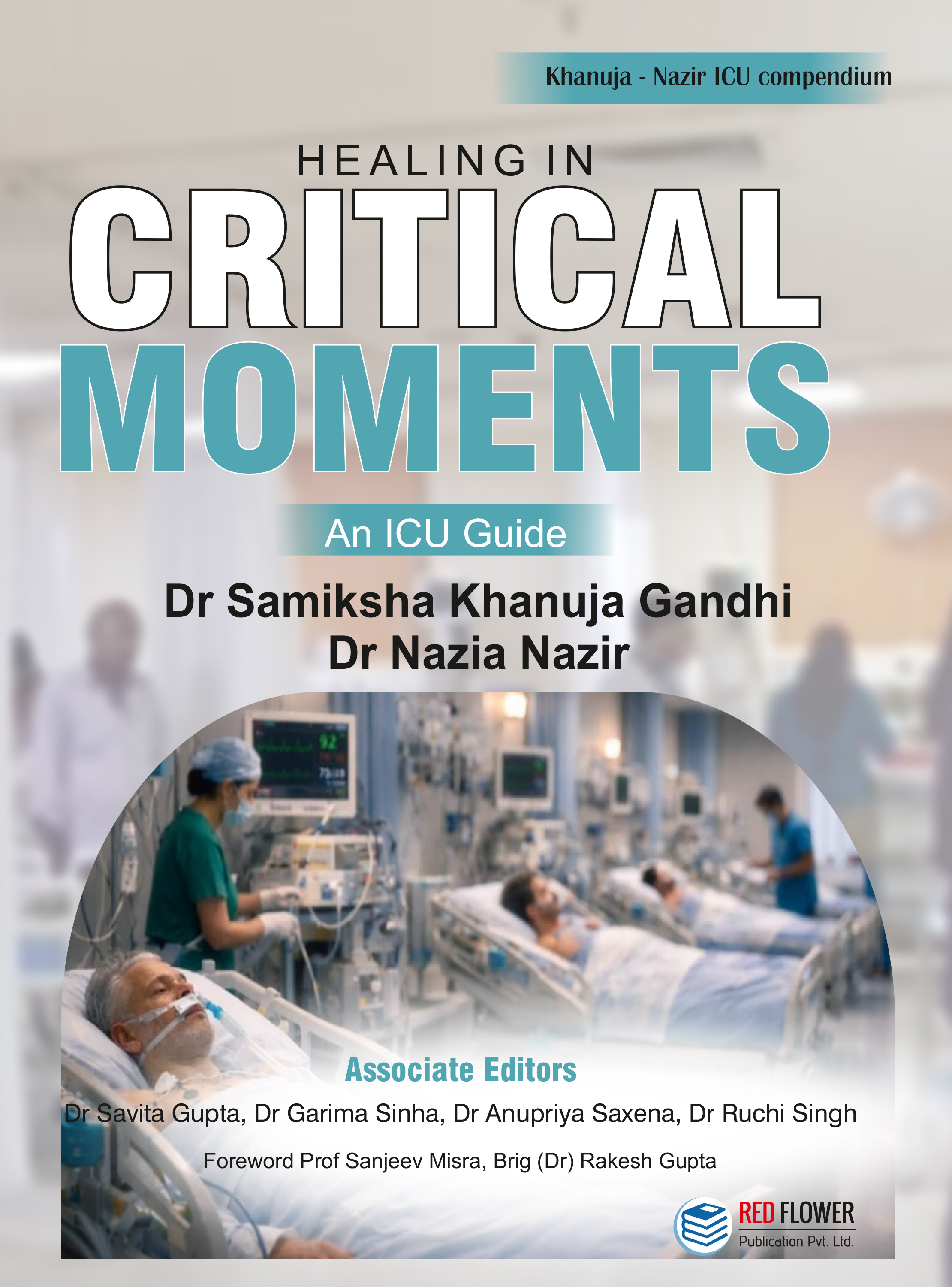
Healing in Critical Moments An ICU Guide
| Author/Editor : | Dr Samiksha Khanuja, Dr. Nazia Nazir, Dr Savita Gupta, Dr Garima Sinha, Dr Anupriya Saxena, Dr Ruchi Singh |
|---|---|
| Pages : | 207 |
| Specialty : | Anaesthesiology, Pain Medicine and Critical Care |
| Book Type : | Academic & Professional |
In the midst of chaos, there is also care; in the face of uncertainty, there is knowledge; and in critical moments, there is healing.” Critical care medicine represents the point where science, skill, teamwork, and compassion converge. The Intensive Care Unit is not merely a physical space—
it is a dynamic environment where timely decisions, precise procedures, and coordinated multidisciplinary efforts determine outcomes. Healing in Critical
Moments has been conceived with this philosophy at its core.
This book is a collective academic effort led by the Department of Anaesthesiology, with valuable contributions from the Department of Emergency Medicine and the College of Nursing. It reflects the shared responsibility of all critical care professionals who work together to stabilize, support, and heal patients during
their most vulnerable moments. The primary aim of this first edition is to provide a clear, practical, and clinically relevant foundation in intensive care for doctors, nurses, and technicians. Emphasis has been placed on basic ICU procedures, essential skills, core theoretical concepts, and the fundamentals of mechanical ventilation, presented in a manner that bridges theory with bedside practice. The content has been structured to support learners at different stages, particularly those beginning their journey in critical care, while remaining useful as a quick reference for day-to-day ICU work.
Recognizing the multidisciplinary nature of critical care, this book integrates perspectives from anaesthesia, emergency medicine, and nursing, reinforcing the
importance of teamwork and shared understanding in the ICU. Every effort has been made to keep the language simple, the approach systematic, and the focus practical, without compromising scientific accuracy.
We hope that Healing in Critical Moments serves not only as a learning resource but also as a companion in the ICU—guiding clinical decisions, enhancing
confidence, and ultimately contributing to better patient care. Constructive feedback and suggestions from readers are warmly welcomed and will be
invaluable in shaping future editions.
Section 1: Introduction to Critical Care
Chapter 1: Understanding the ICU 1
Definition and purpose of the ICU
Common types of ICUs (medical, surgical, cardiac, neuro, etc.)
Key features of ICU
ICU team members and their roles
Admission criteria and patient categories
Chapter 2: ICU Setup and Monitoring Equipment 5
Location of ICU in Hospital
ICU Designs
Number of ICU Beds and ICUs in a Hospital
ICU Monitoring Equipment
Section 2: Vital Signs and Patient Monitoring
Chapter 3: Monitoring Vital Parameters 11
Heart rate and ECG basics
Blood pressure
Respiratory rate
Spo2
Temperature Measurement
Urine output
Chapter 4: Neurological Monitoring 20
Introduction
Basic Clinical Methods of Neurological Monitoring
Responsibilities in Neurological Monitoring
Section 3: Basics of Mechanical Ventilation
Chapter 5: Fundamentals of Respiratory Physiology 25
Anatomical Overview of the Respiratory System
Gas exchange and lung mechanics
Oxygen Transport and Hemoglobin Dynamics
Ventilation and Respiration
Chapter 6: Indications for Mechanical Ventilation 35
Respiratory Failure: Types and Causes
Clinical Signs/Symptoms of Mechanical Ventilation
Non-Invasive vs. Invasive Ventilation
Chapter 7: Modes of Mechanical Ventilation 39
Key Parameters in Mechanical Ventilation
Phases of Respiration during Mechanical Ventilation
General Methods of PPV
Modes of Ventilation
Chapter 8: Alarms and Injury 50
Ventilator Alarms
Ventilator-Induced Lung Injury
Section 4: Common ICU Conditions and Management
Chapter 9: Shock 52
Chapter 10: Sepsis and Septic Shock 56
Definition, causes, and early signs
Fluid resuscitation and antibiotics
Monitoring and supportive care
Chapter 11: ARDS and Respiratory Failure 59
Diagnostic criteria
Ventilatory strategies
Prone positioning and supportive measures
Chapter 12: Cardiovascular Emergencies 65
Acute coronary syndromes
Arrhythmias and cardiac arrest
Use of vasopressors and inotropes
Chapter 13: Neurological Emergencies 76
Stroke and seizures
Coma and brain death criteria
Sedation and analgesia
Section 5: Special Topics in ICU Care
Chapter 14: Infection Prevention 79
Introduction & Objectives
Bundle approach to Infe tion prevention
Hand hygiene and PPE
Central Line–Associated Bloodstream Infections (Clabsi)
Catheter-Related Bloodstream Infections (Crbsi
Isolation protocols
Catheter-Associated Urinary Tract Infections (Cauti)
Surgical Site Infections (SSI)
Ventilator-associated pneumonia (VAP) prevention
Ventilator-Associated Pneumonia (Vap), Ventilatorassociated
Events (Vae) And Nonventilator Hospital-Acquired
Pneumonia (Nv-Hap)
Hospital-Acquired Pressure Ulcers (Hapu)
Epidemiologically Important And
Multidrug-Resistant Organisms - Clostridioides
Difficile Infection (Cdi) And Methicillin-Resistant
Staphylococcus Aureus (Mrsa)
Chapter 15: Nutrition and Fluid Management 105
Enteral vs. parenteral nutrition
Fluid balance and electrolyte monitoring
Blood sugar control
Chapter 16: Ethics and Communication 110
Breaking bad news
End-of-life care and DNR orders
Chapter 17: Vasopressors and Inotropes 113
Introduction
Common Vasopressors and Inotropes
Monitoring and Considerations
Section 6: Practical Skills and Checklists
Chapter 18: ICU Skills and Procedures and Checklist 116
Central line care
Catheterization and NG tube care
Wound dressing and drain management
Chapter 19: Documentation and Reporting 125
Charting ventilator settings
Nursing notes and shift handovers
Legal aspects and record-keeping
Section 7: Miscellaneous
Chapter 20: Basics of Arterial Blood Gas Analysis 131
Chapter 21: Basics of Antibiotics 135
Chapter 22: IV Fluids 154
Chapter 23: Front of Neck Access 157
Chapter 24: Emergency Equipments and Procedures 164
Chapter 25: General Management of Poisoning 176
Chapter 26: Needle Stick Injury Protocol 180
Chapter 27: Coma and Brain Death 183
Dr. Samiksha Khanuja Gandhi is a Professor in the Department of Anaesthesiology at GIMS, Greater Noida. She is an accomplished academician and clinician with wide-ranging expertise in anaesthesia, critical care, pain medicine, and palliative care. She runs a dedicated Pain and Palliative Care Clinic and is committed to delivering holistic, patient-centred care.
She holds a European Diploma in Pain Medicine and has completed a fellowship in Mechanical Ventilation. Dr. Khanuja Gandhi is also a Fellow of Interventional Pain Medicine (FIPM). Her clinical strengths include advanced ICU care, mechanical ventilation, ICU and perioperative pain management, airway management, and regional anaesthesia, with strong procedural and decision-making skills in high-acuity settings.
A passionate and effective teacher, Dr. Khanuja Gandhi is deeply involved in postgraduate education, critical care training, and simulation-based learning. She is known for her clarity of teaching, academic rigor, and ability to simplify complex concepts for trainees. Her academic interests include critical care, ICU pain management, regional anaesthesia, airway management, and palliative care, and she remains actively engaged in mentoring and academic development of young anaesthesiologists.
Dr. Nazia Nazir is a senior anaesthesiologist and academic leader, serving as *Professor and Head of the Department of Anesthesiology, Intensive Care and Pain Medicine* at the *Government Institute of Medical Sciences (GIMS), Greater Noida*. With extensive experience in perioperative care, critical care medicine, and pain management, she is deeply committed to excellence in patient care and medical education.
An accomplished teacher and mentor, Dr. Nazir has played a pivotal role in training undergraduate and postgraduate students, fostering a culture of clinical precision, ethical practice, and evidence-based medicine. Her academic interests span anaesthesia, intensive care, and pain medicine, with contributions to research and scholarly publications that reflect her dedication to advancing the field.
Balancing the demanding worlds of the operating theatre, intensive care unit, and academia, Dr. Nazia Nazir brings both scientific rigor and human compassion to her work. This book reflects her professional journey, clinical insights, and commitment to improving patient outcomes through knowledge, teamwork, and perseverance.
N/A
Subject Category : Anaesthesiology, Pain Medicine and Critical Care
Related Books

TABLE OF CONTENTS AND LIST OF CONTRIBUTORS
| ISBN | 978-81-998089-6-6 |
| Publisher | Red Flower Publications |
| Publication Date | 2026-02-05 |
| Edition | 1/e |
| Cover (PDF) |
LICENCE