
No record found.
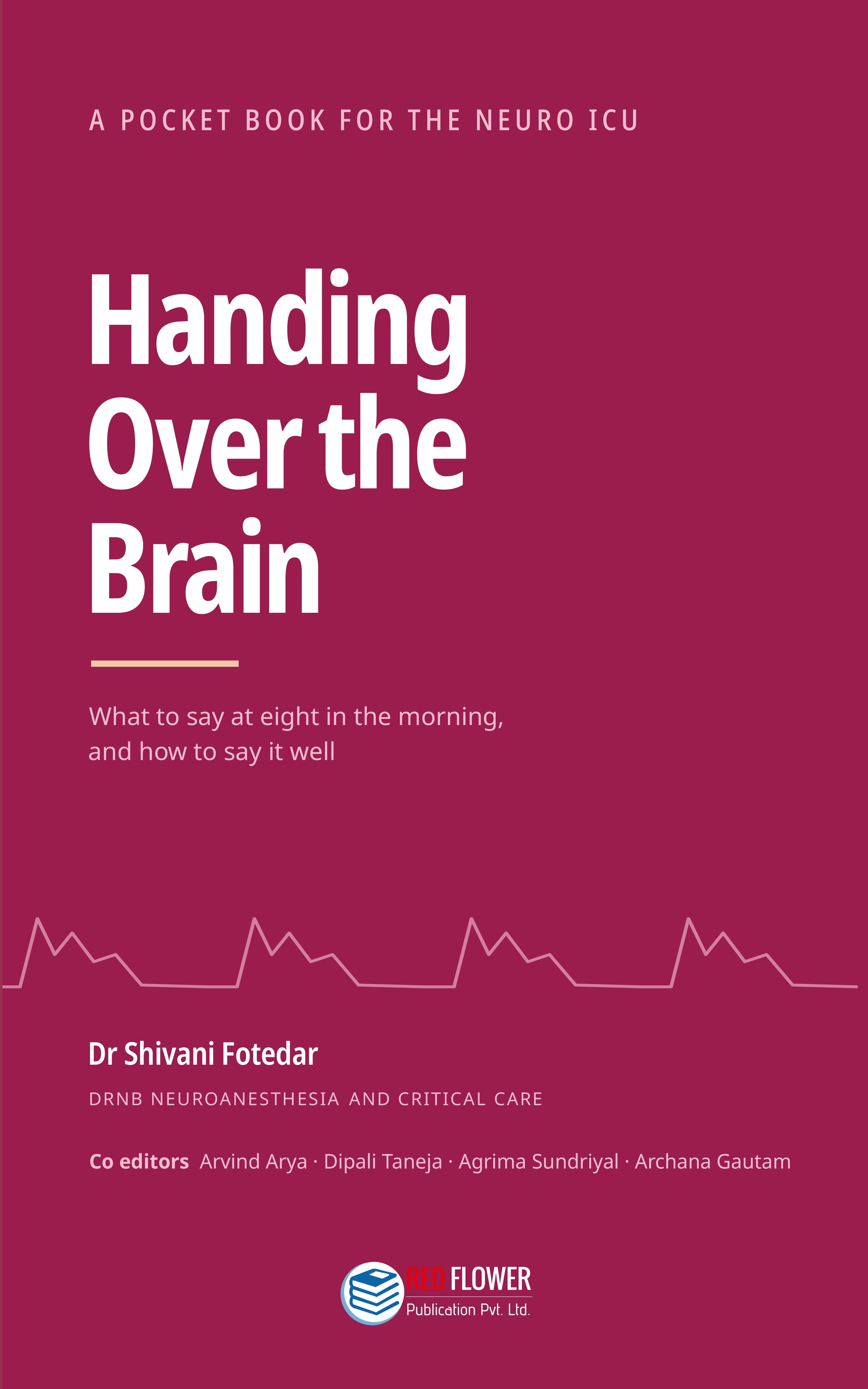
Handing Over the Brain (A pocket book for the neuro ICU)
| Author/Editor : | Dr Shivani Fotedar, Dr Arvind Arya, Dr Dipali Taneja, Dr Agrima Sundriyal, Dr Archana Gautam |
|---|---|
| Pages : | 226 |
| Specialty : | Neurology and Neurosurgery |
| Book Type : | Academic & Professional |
This book started as a note on my phone.
It was a post call morning and I had eleven patients to hand over in about twenty minutes to a consultant who had not been there all night. I remember standing at the first bed, realising that I knew everything about these patients and had no idea how to say it. So that evening I started writing down sentences. Not headings, not checklists, but the actual words that had worked, the ones that made the day team look up and change their plan.
That note grew for two years. This is what it turned into.
I wrote it because nobody taught me handover. We are taught physiology, pharmacology, monitoring, guidelines, and then we are expected to pick up communication by watching whoever we happen to be posted with. If that person is precise, we become precise. If that person says the patient is neurologically stable and moves on, we learn to say that too, and eventually somebody is harmed by it. Handover is a clinical skill with a technique, and it is teachable. It is strange that we treat it as a personality trait.
A few things about how this book is built.
It is deliberately small. Every chapter is meant to be read standing up, in about four minutes, in the gap before you walk into the unit. Every chapter has the same eight sections, so you never have to hunt. The physiology is only as deep as it needs to be to change what you do at the bedside.
The section I care most about is the last but one in every chapter, the handover lines. These are model spoken sentences for a typical patient with that problem. They are not perfect and they are not meant to be recited. Change the numbers, change the phrasing, make them sound like you. I only wanted to write down what good sounds like, because I could not fi nd it written down anywhere.
Where practice varies, I have said so rather than pretending there is one right answer. Where the evidence is soft, I have said that too. The default setting is Indian neurosurgical practice, because that is where I trained, and where North American or European units do things differently and it matters, there is a line about it.
This book will be wrong about something. Guidelines change, numbers get revised, and my own practice will look different in fi ve years. If a number here disagrees with your unit protocol, your protocol wins. Please write and tell me, so the next edition is better than this one.
To the resident reading this at three in the morning, still not sure what to say at eight. This was written for you, by someone who was you very recently
Author and co editors v
Dedication vii
Foreword ix
Preface xi
Acknowledgment xiii
How to use this book xv
PART 1 How handover actually works
Chapter 1: Why neuro handover is its own skill 1
Chapter 2: A structure that works, the neuro version of a standard handover tool 5
Chapter 3: The neurological exam you hand over, and the words to use for it 9
Chapter 4: Sedation holds, wake up tests and what to say about them 14
PART 2 The core physiology you keep referring back to 18
Chapter 5: ICP, CPP and CBF in plain language 19
Chapter 6: Autoregulation, and how to tell when it is gone 23
Chapter 7: Cerebral oxygen delivery, CMRO2 and the supply demand idea 27
Chapter 8: Osmolality, sodium and brain water 31
Chapter 9: Blood pressure targets, and why they differ by diagnosis 36
PART 3 The monitors on the wall 41
Chapter 10: ICP monitors, EVD versus bolt, and what the waveform is telling you 42
Chapter 11: External ventricular drains, the practical stuff nobody writes down 46
Chapter 12: PbtO2 and brain tissue oxygen 50 Chapter
13: Continuous EEG in the ICU 54 Chapter
14: Transcranial Doppler at the bedside 58 Chapter
15: NIRS, microdialysis and the ones you will meet occasionally 62
Chapter 16: Pupillometry and the quantitative pupil 66
PART 4: Traumatic brain injury 70
Chapter 17: The first twelve hours 71
Chapter 18: Tiered management, tier one to tier three 75
Chapter 19: Osmotherapy, mannitol versus hypertonic saline 79
Chapter 20: Decompressive craniectomy, before and after 83
Chapter 21: The TBI patient who is not improving 88
PART 5: Vascular 92
Chapter 22: Aneurysmal SAH, the first 48 hours 93
Chapter 23: Delayed cerebral ischaemia and vasospasm 97
Chapter 24: Nimodipine, triple H and what we actually do now 101
Chapter 25: Intracerebral haemorrhage 105
Chapter 26: Ischaemic stroke after thrombolysis or thrombectomy 109
Chapter 27: Malignant MCA infarction 113 Chapter 28: Cerebral venous sinus thrombosis 117
PART 6: Postoperative neurosurgical patients 122
Chapter 29: The fresh craniotomy overnight 123
Chapter 30: Posterior fossa and the sitting position patient 127
Chapter 31: Pituitary and transsphenoidal patients 131
Chapter 32: Spine and cervical cord patients 135
Chapter 33: The patient who will not wake up after surgery 140
Chapter 34: Shunts, drains and when to panic 144
PART 7: Neurocritical care problems 148
Chapter 35: Status epilepticus and the non convulsive kind 149
Chapter 36: Sodium, CSW versus SIADH versus DI 154
Chapter 37: Fever, infection and when it is central 159
Chapter 38: Airway, ventilation and the neuro specific tracheostomy question 163
Chapter 39: Sedation, analgesia and delirium in a brain injured patient 168
Chapter 40: Nutrition, glycaemia, thromboprophylaxis, the boring things that matter 172
Chapter 41: Autonomic dysreßexia and paroxysmal sympathetic hyperactivity 177
PART 8: The hard conversations 182
Chapter 42: Prognostication without overpromising 183
Chapter 43: Brain death, the step by step process 187
Chapter 44: Organ donation and how to raise it 192
Chapter 45: Talking to families at three in the morning 197
PART 9: Tools 201
Dr Shivani Fotedar is a final-year DrNB resident in Neuroanesthesia and Neurocritical Care at Artemis Health Institute, Gurugram. Her academic interests include cerebral physiology, perioperative neuroscience, neurocritical care, patient safety, structured clinical communication, and innovation in neurological monitoring. Handing Over the Brain reflects her effort to make neuroanesthesia handovers more systematic, practical, and clinically meaningful for trainees and practitioners.
Dr Arvind Arya is Vice President of ISNACC ( Indian Society of Neuroanesthesia and Critical Care ) and Professor and Head of the Department at the Institute of Human Behaviour and Allied Sciences, Delhi. He is a distinguished neuroanesthesiologist, academician, teacher, and mentor, with extensive experience in neuroanesthesia, neurocritical care, and postgraduate education.
Dr Dipali Taneja is Senior Specialist in Neuroanesthesia at Deen Dayal Upadhyay Hospital, Delhi. Her professional work includes perioperative neurological care, anesthetic management for neurosurgical patients, and the teaching and mentorship of anesthesia trainees.
Dr Agrima Sundriyal is Consultant Neuroanesthesia at Artemis Health Institute, Gurugram. Her interests include contemporary neuroanesthesia practice, perioperative optimization, neurocritical care, and safe, patient-centred management of complex neurosurgical patients.
Dr Archana Gautam is a final-year DrNB resident in Neuroanesthesia and Neurocritical Care at Artemis Health Institute, Gurugram. Her areas of interest include perioperative neurological care, neurocritical care, neurophysiology, and structured approaches to safe anesthetic practice. Through this work, she aims to support clear communication and continuity of care in patients undergoing neurosurgical procedures.
Subject Category : Neurology and Neurosurgery
Related Books
TABLE OF CONTENTS AND LIST OF CONTRIBUTORS
| ISBN | 978-81-687704-9-2 |
| Publisher | Red Flower Publications |
| Publication Date | 2026-09-25 |
| Edition | 1/e |
| Cover (PDF) |
LICENCE